


You bought a hair growth oil. Maybe you've already used it a few times. But if you're not seeing results, or your hair looks like it's been dipped in a chip pan, the problem probably isn't the oil itself. It's how to use hair growth oil that makes the real difference. The right application technique, timing, and amount can separate visible hair regrowth from wasted product sitting on your pillowcase.
Most people skip straight to pouring oil on their scalp without thinking about prep, massage technique, or how long to actually leave it in. That's a problem, because hair growth oils work best when they penetrate the scalp properly and reach the follicle. Get it wrong, and you're left with greasy roots and zero noticeable improvement.
At Xquisit Luxe Self Care, we formulate our certified natural hair growth oils right here in the UK, designed to support thicker, stronger hair without harsh chemicals. We've helped over 2,000 customers achieve real results, and we've learned that the right product only works when paired with the right routine. This guide breaks down every step: how to apply hair growth oil, how often, how long to leave it in, and how to avoid the grease. Let's get into it.
What hair growth oil can and can't do
Understanding what hair growth oil actually does to your scalp and hair helps you use it correctly and set realistic expectations from the start. Many people assume they'll wake up with a full head of hair after one application. That's not how it works, and going in with the wrong expectations usually leads to giving up before the oil has a chance to do anything. Knowing the real mechanism behind these oils means you'll apply them properly, stay consistent, and actually see results.
What hair growth oil genuinely does
Hair growth oils work by nourishing and stimulating the scalp environment where your hair follicles live. Active ingredients like castor oil, peppermint, rosemary, and argan oil have been studied for their ability to improve circulation to the scalp, reduce inflammation, and deliver nutrients directly to the follicle. When you learn how to use hair growth oil the right way, these ingredients can support thicker, stronger strands and help reduce shedding over time.
Consistent scalp application, paired with a proper massage technique, improves blood flow to the follicle, which is the key factor in stimulating dormant hair growth.
Your scalp also retains moisture better when oils form a protective barrier against environmental damage. This reduces breakage at the root, which is one of the main reasons people notice their hair appearing fuller after a few weeks of consistent use. The oil isn't creating new hair from nothing. It's improving the conditions your follicles need to do their job properly.
What hair growth oil won't do
Hair growth oil is not a medical treatment for clinical hair loss conditions such as alopecia areata or androgenetic alopecia (male and female pattern baldness). If your hair loss has a hormonal, genetic, or medical cause, oil alone won't reverse it. You should speak to a dermatologist or GP if you're experiencing significant, sudden, or patchy hair loss, as that level of shedding usually requires clinical investigation and treatment.
Timing also matters more than quantity. Most users start noticing reduced shedding and improved scalp health within four to six weeks of consistent use, with visible thickness improvements typically appearing after eight to twelve weeks. Applying more oil than directed won't speed that process up. It will just leave you with greasy hair and clogged follicles, which actually slows things down.
Here's a quick comparison of what you can realistically expect:
| What it supports | What it won't fix |
|---|---|
| Scalp nourishment and hydration | Clinical alopecia or pattern baldness |
| Reduced hair breakage and shedding | Overnight hair growth |
| Stronger, thicker-looking strands | Hormonal hair loss without medical support |
| Improved follicle environment | Heat styling damage on its own |
Step 1. Choose the right oil and set up
Before you touch your scalp, getting the right oil for your specific concern is the most important decision you'll make. Not all hair growth oils work the same way, and using a product that doesn't match your hair type or scalp condition means you're solving the wrong problem. Spending two minutes choosing correctly saves you weeks of frustration.
Pick an oil that matches your hair concern
The ingredients in your oil should directly address what's causing your hair issues in the first place. A general-purpose oil might give you some surface-level shine, but a targeted formula will actually support the follicle. Here's a quick guide to matching ingredients to concerns:
| Hair concern | Look for these ingredients |
|---|---|
| Slow growth or thinning | Castor oil, rosemary oil, peppermint |
| Dry or brittle strands | Argan oil, jojoba oil, coconut oil |
| Scalp irritation or dandruff | Tea tree oil, lavender, neem |
| Breakage and shedding | Biotin-infused oils, black seed oil |
If you're unsure where to start, a certified natural formula that combines castor and rosemary oil covers the most common causes of poor hair growth without irritating a sensitive scalp.
Prepare your scalp before you apply
Once you have the right oil, your scalp needs to be in the right condition to absorb it. Applying oil to a scalp clogged with dry skin, product build-up, or excess sebum blocks the ingredients from reaching your follicles. Start on a freshly washed, slightly damp scalp for the best absorption, ideally right after shampooing and gently towel-drying.
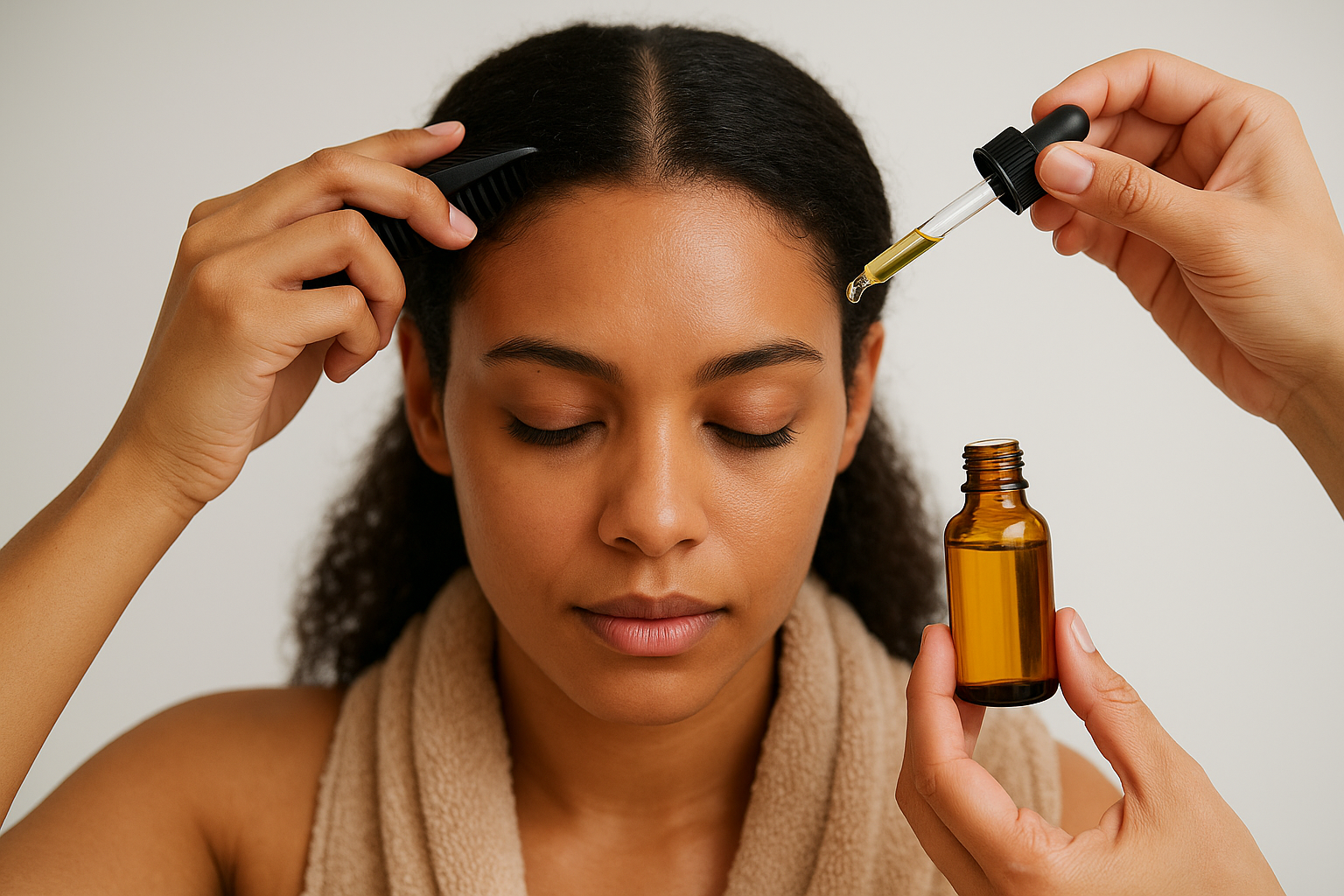
You'll also need to part your hair into sections before applying. For medium to long hair, four to six sections is a practical starting point. Use a tail comb or your fingers to create clean partings directly down to the scalp. This makes sure you apply the oil evenly to the root rather than coating the hair shaft, which is where grease problems usually start.
Step 2. Apply the oil the right way
With your scalp prepped and sectioned, the next step is applying the oil correctly. How much oil you use and where you place it determines whether the product reaches your follicles or just coats the surface of your hair. Most people apply too much and in the wrong spots, which is exactly what creates that heavy, greasy look that puts people off using oil altogether.
Use the right amount for your scalp
Start with three to five drops per section of scalp. That figure sounds small, but your scalp doesn't need a heavy coating to absorb the active ingredients. More oil does not mean faster results. It means blocked follicles and greasy roots by midday. If you have a particularly dry scalp or thick, coarse hair, you can increase to six drops per section, but start conservatively and adjust from there.
The goal is to apply enough oil to feel it on your fingertips when you massage, not enough to see it glistening under a light.
Massage in with the correct technique
Once the oil is on your scalp, use your fingertips, not your nails, to massage in small circular motions for at least three to five minutes. This is the step most people rush, but it's the one that matters most. Circular massage increases blood circulation to the follicle, which is what activates the oil's ingredients and encourages growth. Work section by section, applying gentle but consistent pressure.

Follow this simple sequence each time you apply, as it covers how to use hair growth oil in a way that maximises absorption:
- Apply three to five drops directly to the scalp in each section
- Use fingertips to massage in circular motions for three to five minutes
- Work from the front hairline toward the back, then down the sides
- Avoid rubbing oil along the hair shaft, as this adds unnecessary weight and grease
Step 3. Time it well and wash it out cleanly
Knowing how long to leave hair growth oil in and how to remove it properly is where most people go wrong after getting the application right. Leave it in too long without proper removal and you risk clogged follicles. Wash it out poorly and you carry product build-up into your next application, which reduces absorption every single time.
How long to leave the oil in
The ideal leave-in time depends on what you want the oil to do and how much time you have. For a standard application, leaving the oil on for a minimum of 30 minutes gives the active ingredients enough time to absorb into the scalp. If you have more time available, an overnight treatment delivers better results because the oil works while your body is in recovery mode during sleep. Use an old pillowcase or a loose shower cap to avoid transferring oil onto your bedding.
For the best results when learning how to use hair growth oil, aim for at least two 30-minute sessions per week, with one overnight treatment when your schedule allows.
Here's a quick guide to leave-in times based on your routine:
| Leave-in duration | Best for |
|---|---|
| 30 minutes | Quick mid-week application |
| 2 to 4 hours | Weekend pre-wash treatment |
| Overnight | Maximum absorption, weekly deep treatment |
How to wash it out without leaving residue
Removing hair oil cleanly requires a specific washing method. Apply your shampoo directly to dry or damp hair before adding water. This sounds counterintuitive, but shampooing before fully wetting allows the cleanser to bind with the oil and break it down before water dilutes the shampoo. Work it into your scalp and through your hair, then rinse thoroughly with warm water.
Follow up with a second shampoo pass focused on the roots to clear any remaining residue. Conditioning only the mid-lengths and ends keeps your roots from getting weighed down after washing. Your scalp and roots should feel completely clean after rinsing, not slippery.
Step 4. Use it consistently without looking greasy
Consistency is what separates people who see real hair growth results from those who give up after a few weeks. Knowing how to use hair growth oil correctly means nothing if you apply it once and forget about it for two weeks. Your follicles need regular stimulation and nourishment to respond, and that requires building a realistic routine you can actually maintain.
Build a weekly schedule that works for you
The most practical approach is to fix two or three application days per week and keep them the same each week. Treat it like any other skincare step rather than something optional. If you wash your hair on Wednesdays and Sundays, apply oil the evening before each wash so it works overnight and gets removed cleanly the next morning. That structure removes the decision-making and makes consistency almost automatic.
Two to three consistent applications per week will outperform daily rushed applications every time, because your scalp gets proper absorption time and a clean start between sessions.
Adjust your technique to prevent grease
If your hair still looks greasy after washing, the issue is almost always application amount or distribution, not the oil itself. Revisit how many drops you're using per section and make sure you're working the oil directly into the scalp rather than pulling it down the hair shaft. Keeping the oil on the scalp and roots only is the single most effective way to maintain clean-looking hair between wash days.
You can also time your applications to suit your lifestyle. If you need your hair to look clean the next day, apply on an evening when a morning wash follows. If you prefer a mid-day treatment on a rest day, use two to three drops less than your usual amount and leave it in for two hours before shampooing. Small timing adjustments like this let you stay consistent without compromising how your hair looks on the days that matter.
Key takeaways and next steps
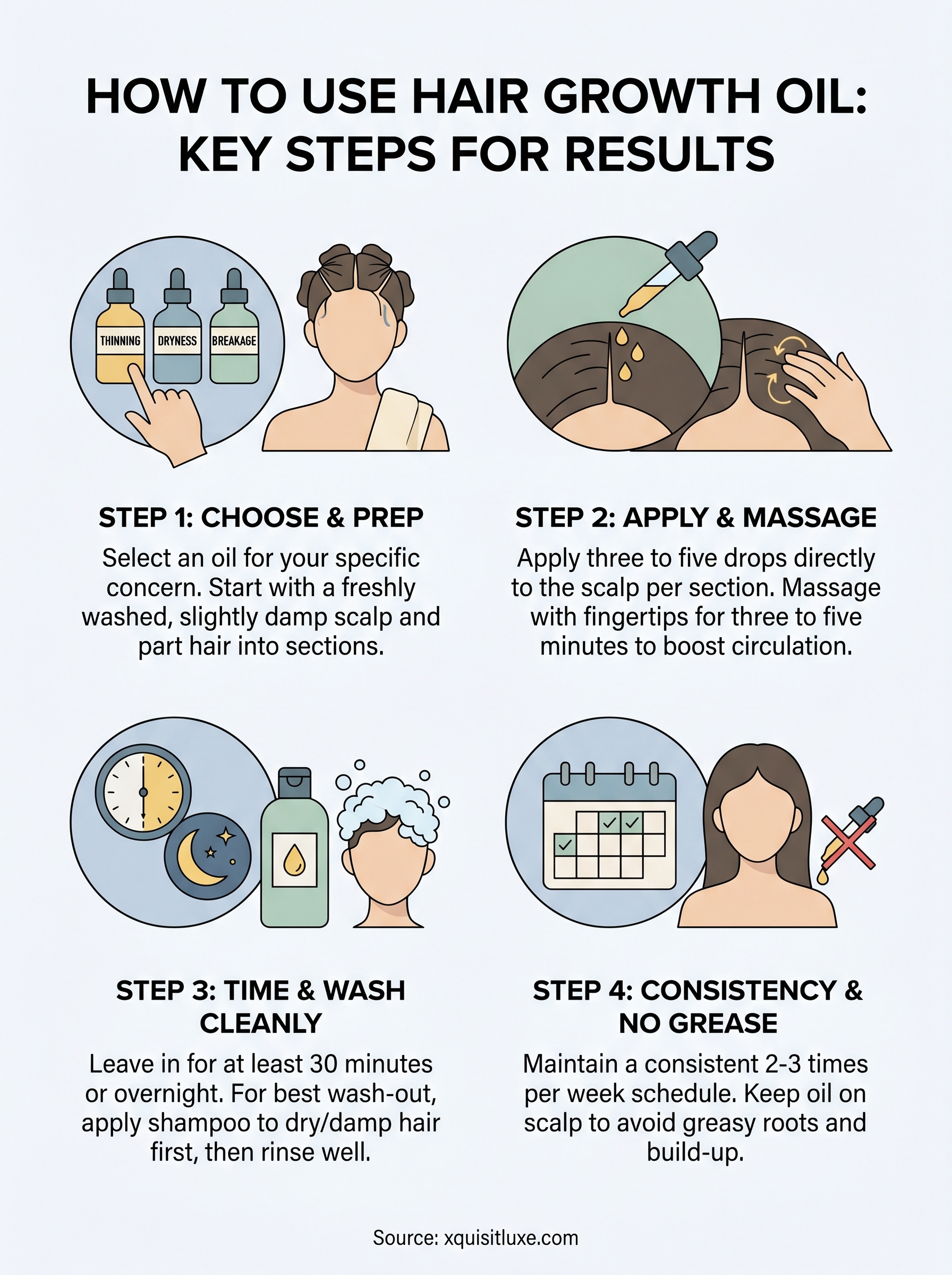
Knowing how to use hair growth oil correctly comes down to four things: choosing the right formula for your concern, applying three to five drops directly to the scalp per section, massaging for at least three to five minutes, and keeping to a consistent two to three times per week schedule. None of these steps are complicated, but skipping any one of them is usually the reason people stop seeing results.
Your scalp responds to regular nourishment and stimulation over time, not to large amounts of oil applied inconsistently. Start with one week of applying the method from this guide exactly as described, and track how your scalp feels after each wash. Small adjustments in timing and amount will get you to a routine that fits your life without the grease. If you're ready to start with a certified natural formula made in the UK, explore the Xquisit Luxe hair growth oil range and find the right product for your hair.
