


Si vous vous êtes déjà tenu devant un miroir en vous demandant pourquoi vos cheveux semblent plus fins qu'avant, vous n'êtes pas seul. Des millions de personnes au Royaume-Uni sont confrontées à l'amincissement des cheveux, à une croissance lente et à des cassures frustrantes, et beaucoup se tournent vers les huiles comme solution naturelle. Mais qu'est-ce que l'huile de croissance capillaire, exactement ? C'est bien plus qu'une simple bouteille tendance sur votre étagère de salle de bain. Ces huiles sont des formulations ciblées conçues pour nourrir le cuir chevelu, renforcer les follicules pileux et créer les conditions propices à des cheveux plus sains et plus volumineux au fil du temps.
Le concept n'est pas nouveau. Des cultures du monde entier utilisent des huiles végétales pour les soins capillaires depuis des siècles. Ce qui a changé, c'est notre compréhension de pourquoi certaines huiles fonctionnent. La recherche moderne confirme désormais ce que les remèdes traditionnels suggéraient depuis longtemps : des ingrédients naturels spécifiques peuvent réellement soutenir l'épaisseur des cheveux et la santé du cuir chevelu lorsqu'ils sont utilisés correctement. Le défi consiste à séparer la science avérée du bruit marketing.
Chez Xquisit Luxe, nous formulons nos produits de soins capillaires naturels certifiés au Royaume-Uni avec cette approche basée sur des preuves, combinant des huiles botaniques éprouvées avec des formulations testées par des dermatologues qui offrent des résultats réels et visibles. Cet article décortique la science derrière les huiles de croissance capillaire, explique comment elles agissent réellement au niveau du follicule, et vous donne un guide clair pour choisir et utiliser l'huile adaptée à votre type de cheveux et à vos objectifs.
Ce qu'est l'huile de croissance capillaire et ce qu'elle peut faire
L'huile de croissance capillaire est une formulation à base de plantes ou un mélange appliqué directement sur votre cuir chevelu et vos mèches de cheveux pour favoriser les conditions dont vos follicules ont besoin pour prospérer. Lorsque les gens demandent ce qu'est l'huile de croissance capillaire, ils s'attendent à une réponse simple, mais la réalité est plus complexe. Ces produits ne sont pas des solutions universelles. Certains agissent en délivrant des acides gras et des antioxydants profondément dans le follicule. D'autres améliorent la circulation sanguine dans le cuir chevelu, garantissant que vos racines capillaires reçoivent l'oxygène et les nutriments dont elles ont besoin pour rester actives et productives pendant chaque cycle de croissance.
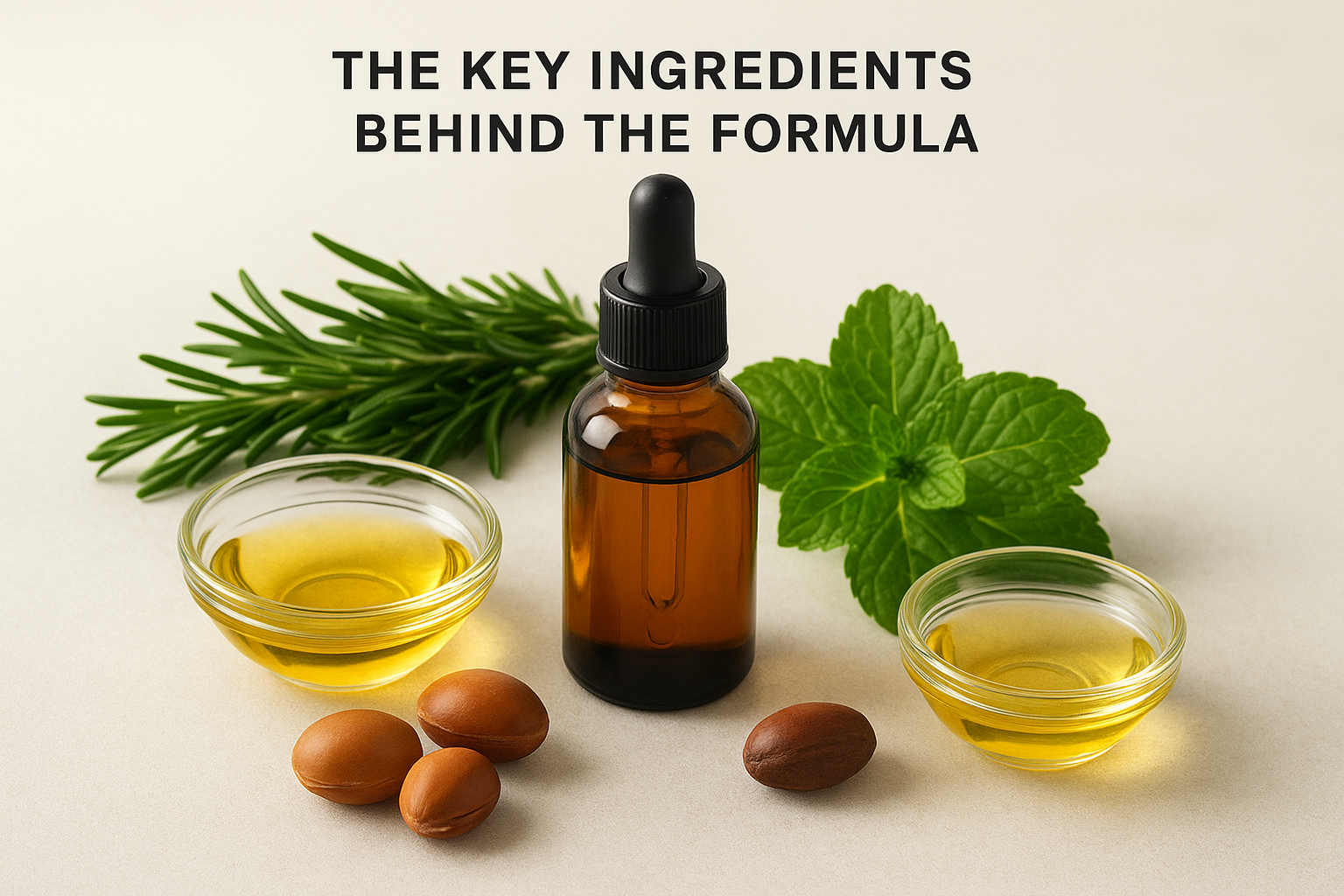
Les ingrédients clés derrière la formule
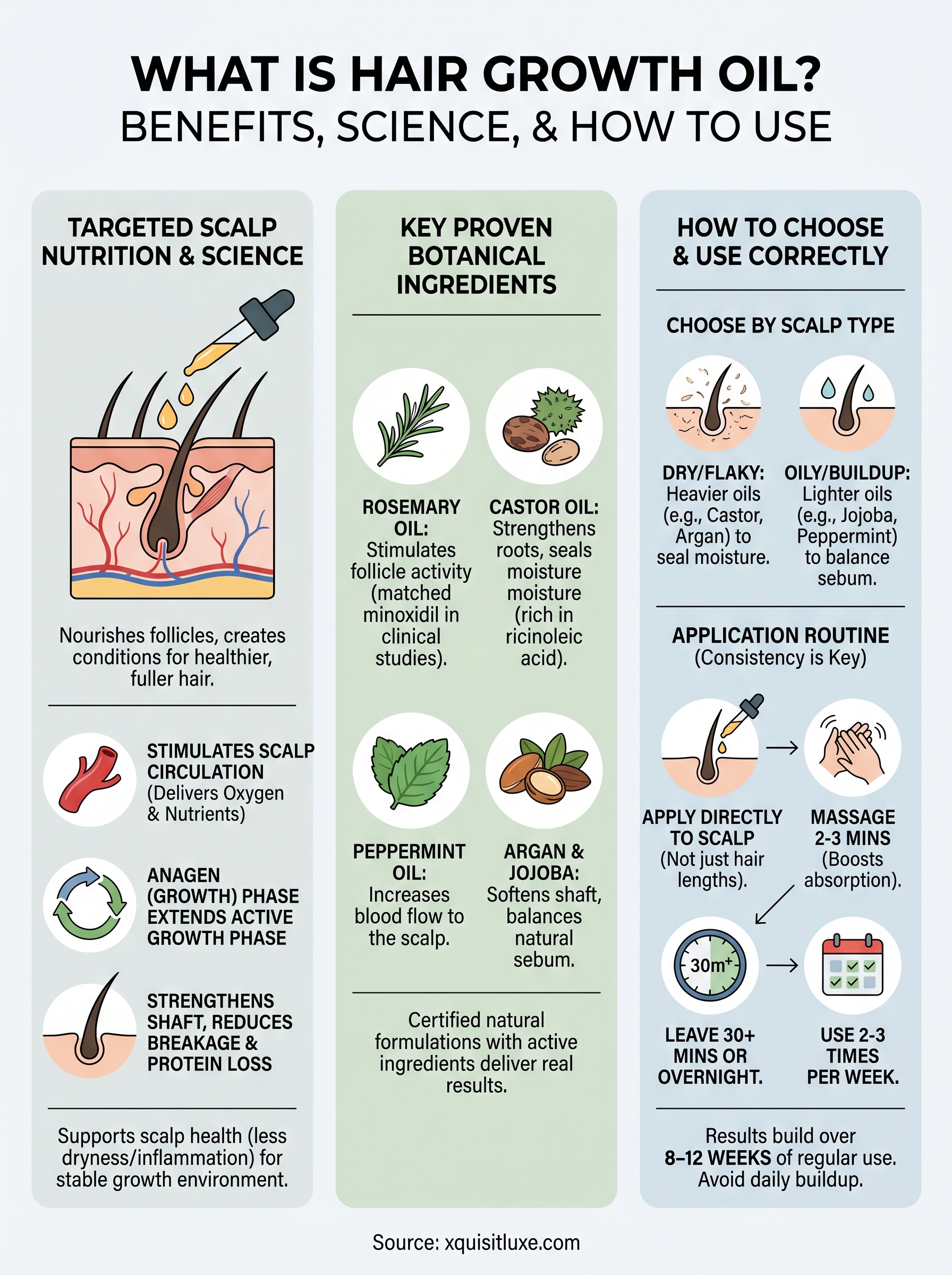
La plupart des huiles de croissance capillaire efficaces sont construites autour d'un ensemble de principes actifs botaniques que la recherche a constamment liés à la santé du cuir chevelu et des follicules. Ceux-ci incluent l'huile de romarin, l'huile de ricin, l'huile de menthe poivrée, l'huile de jojoba et l'huile d'argan, chacune ayant un mécanisme d'action distinct. L'huile de ricin, par exemple, est dense en acide ricinoléique, un acide gras qui soutient la circulation au niveau du cuir chevelu. L'huile de romarin, quant à elle, a été étudiée spécifiquement pour sa capacité à stimuler l'activité folliculaire et à prolonger la phase de croissance active du cheveu.
Une étude clinique publiée dans Skinmed a révélé que l'huile de romarin était comparable au minoxidil 2% pour l'augmentation du nombre de cheveux après six mois d'utilisation constante, avec moins d'effets secondaires sur le cuir chevelu signalés par les participants.
Voici un bref aperçu des ingrédients courants et de leurs rôles principaux :
| Ingrédient | Bénéfice principal |
|---|---|
| Huile de romarin | Stimule l'activité folliculaire et la circulation du cuir chevelu |
| Huile de ricin | Renforce les racines et scelle l'humidité |
| Huile de menthe poivrée | Augmente le flux sanguin vers le cuir chevelu |
| Huile d'argan | Réduit la casse et adoucit la tige du cheveu |
| Huile de jojoba | Équilibre la production naturelle de sébum |
Ce que ces huiles font réellement à vos cheveux
Vos cheveux poussent en trois phases : anagène (croissance active), catagène (transition) et télogène (repos). Les huiles de croissance capillaire agissent principalement en prolongeant la phase anagène, ce qui maintient plus de vos follicules en production active plus longtemps. C'est pourquoi les résultats s'accumulent sur des semaines d'utilisation constante plutôt que d'apparaître après une seule application.
Ces huiles agissent également sur ce qui se passe en dehors du follicule lui-même. Une utilisation régulière réduit la perte de protéines le long de la tige du cheveu, qui est la principale cause de la casse et des pointes fourchues. Lorsque votre tige capillaire reste intacte et hydratée, la longueur que vous obtenez grâce à des follicules sains survit suffisamment longtemps pour devenir perceptible. Des racines plus fortes et des mèches plus fortes travaillent ensemble, et les deux nécessitent le bon mélange de nutriments délivrés de manière constante à votre cuir chevelu.
Pourquoi les gens utilisent des huiles de croissance capillaire
Les gens se tournent vers les huiles de croissance capillaire pour diverses raisons, et comprendre ces raisons aide à clarifier ce que l'huile de croissance capillaire est réellement conçue pour traiter. La motivation la plus courante est l'amincissement visible autour de la ligne des cheveux, des tempes et du sommet du crâne. La perte de cheveux affecte aussi bien les hommes que les femmes, et beaucoup préfèrent commencer par une option naturelle avant d'envisager des traitements cliniques.
Les préoccupations spécifiques qui poussent les gens vers les huiles
Au-delà de l'amincissement, les gens se tournent également vers les huiles de croissance capillaire pour lutter contre la croissance lente, la chute excessive et un cuir chevelu sec ou irrité. Ces préoccupations se chevauchent souvent. Un cuir chevelu qui manque d'humidité ou qui souffre d'inflammation crée un environnement défavorable aux follicules, ce qui ralentit directement la croissance et augmente la casse. Lorsque vous traitez d'abord le cuir chevelu, vos cheveux suivent souvent.
La santé du cuir chevelu est le fondement de la santé des cheveux. Si vos follicules se trouvent dans un environnement sec, enflammé ou privé de nutriments, aucune quantité de coiffage ou de revitalisant ne pourra compenser cela.
La casse est un autre facteur majeur. Beaucoup de gens pensent que leurs cheveux ne poussent pas alors qu'ils poussent et se cassent avant d'atteindre une longueur significative. Les huiles de croissance capillaire qui renforcent la tige et réduisent la perte de protéines vous aident à conserver la longueur que vos cheveux produisent déjà, ce qui fait une différence visible plus rapidement que la simple stimulation de nouvelle croissance.
Pourquoi les huiles naturelles sont particulièrement attrayantes
Pour un nombre croissant de consommateurs, l'attrait va au-delà des résultats. Les formulations naturelles certifiées sans additifs synthétiques conviennent mieux aux personnes soucieuses de ce qu'elles appliquent sur leur peau et leur cuir chevelu. Vous absorbez plus par votre cuir chevelu que par la plupart des autres zones de la peau, ce qui rend la liste des ingrédients bien plus importante que l'emballage.
Choisir des huiles fabriquées à partir d'ingrédients reconnaissables d'origine végétale renforce également la confiance dans une utilisation à long terme. Lorsque vous comprenez exactement ce qui se trouve dans une formule, l'application quotidienne est beaucoup moins risquée. C'est pourquoi la transparence des ingrédients est devenue l'un des facteurs d'achat les plus importants pour les consommateurs de produits de beauté naturels au Royaume-Uni.
Ce que la science dit des huiles de croissance capillaire
Quand on regarde au-delà du marketing et qu'on se demande ce qu'est l'huile de croissance capillaire d'un point de vue scientifique, la recherche est plus encourageante qu'on pourrait le croire. Plusieurs ingrédients clés que l'on trouve couramment dans ces formulations ont été étudiés dans des essais cliniques contrôlés, et non seulement dans des rapports d'observation, ce qui nous donne une base de confiance plus solide.
Des études à connaître
L'huile de romarin est l'huile naturelle la plus rigoureusement étudiée pour la croissance des cheveux. Un essai contrôlé randomisé de 2015 publié dans SKINmed a comparé l'huile de romarin au minoxidil 2 % sur six mois. Les deux groupes ont montré une augmentation statistiquement significative du nombre de cheveux, mais les participants utilisant l'huile de romarin ont signalé beaucoup moins de démangeaisons du cuir chevelu. Cette découverte est importante car elle souligne la tolérabilité comme un véritable avantage des formulations naturelles.
L'huile de menthe poivrée a également montré des promesses dans des études animales, un essai démontrant une profondeur folliculaire et une épaisseur dermique plus élevées par rapport au minoxidil à la même concentration.
L'huile de ricin dispose de moins de données cliniques formelles, mais sa forte teneur en acide ricinoléique a été liée à des effets anti-inflammatoires qui réduisent l'irritation du cuir chevelu. Étant donné que l'inflammation chronique de faible grade est un contributeur reconnu à la miniaturisation des follicules, sa réduction crée un environnement de croissance plus stable pour vos cheveux.
Ce que la recherche ne peut toujours pas promettre
La science soutient ces huiles, mais elle ne soutient pas toutes les allégations que vous verrez sur les emballages. Aucune huile naturelle ne peut inverser la perte de cheveux héréditaire de la même manière que des traitements cliniques comme le finastéride. Ce que les preuves montrent, c'est que ces formulations améliorent les conditions du cuir chevelu et soutiennent la santé des follicules, ce qui se traduit par des cheveux plus épais et plus forts avec une utilisation constante, plutôt que par une repousse spectaculaire en quelques semaines. Se fixer des attentes réalistes dès le départ vous aide à rester constant suffisamment longtemps pour réellement voir des résultats.
Comment choisir la bonne huile pour votre cuir chevelu
Une fois que vous avez compris ce qu'est l'huile de croissance capillaire et comment elle fonctionne, l'étape suivante consiste à en choisir une qui convient à l'état spécifique de votre cuir chevelu. Toutes les huiles ne sont pas aussi efficaces pour tout le monde. Votre type de cuir chevelu, votre principale préoccupation capillaire et la qualité des ingrédients déterminent si une huile donne de vrais résultats ou si elle reste simplement en surface sans pénétrer suffisamment profondément pour faire une différence.
Adaptez l'huile à votre type de cuir chevelu
Votre cuir chevelu se divise en trois catégories générales : sec, gras ou équilibré. Chacun réagit différemment aux mêmes ingrédients. Les huiles lourdes comme l'huile de ricin conviennent bien aux cuirs chevelus secs et aux cheveux épais car elles retiennent l'humidité et renforcent la tige. Si votre cuir chevelu a tendance à produire trop de sébum, des options plus légères comme l'huile de jojoba ou d'argan sont bien mieux adaptées, car elles régulent le sébum sans ajouter de poids excessif ni obstruer les follicules.
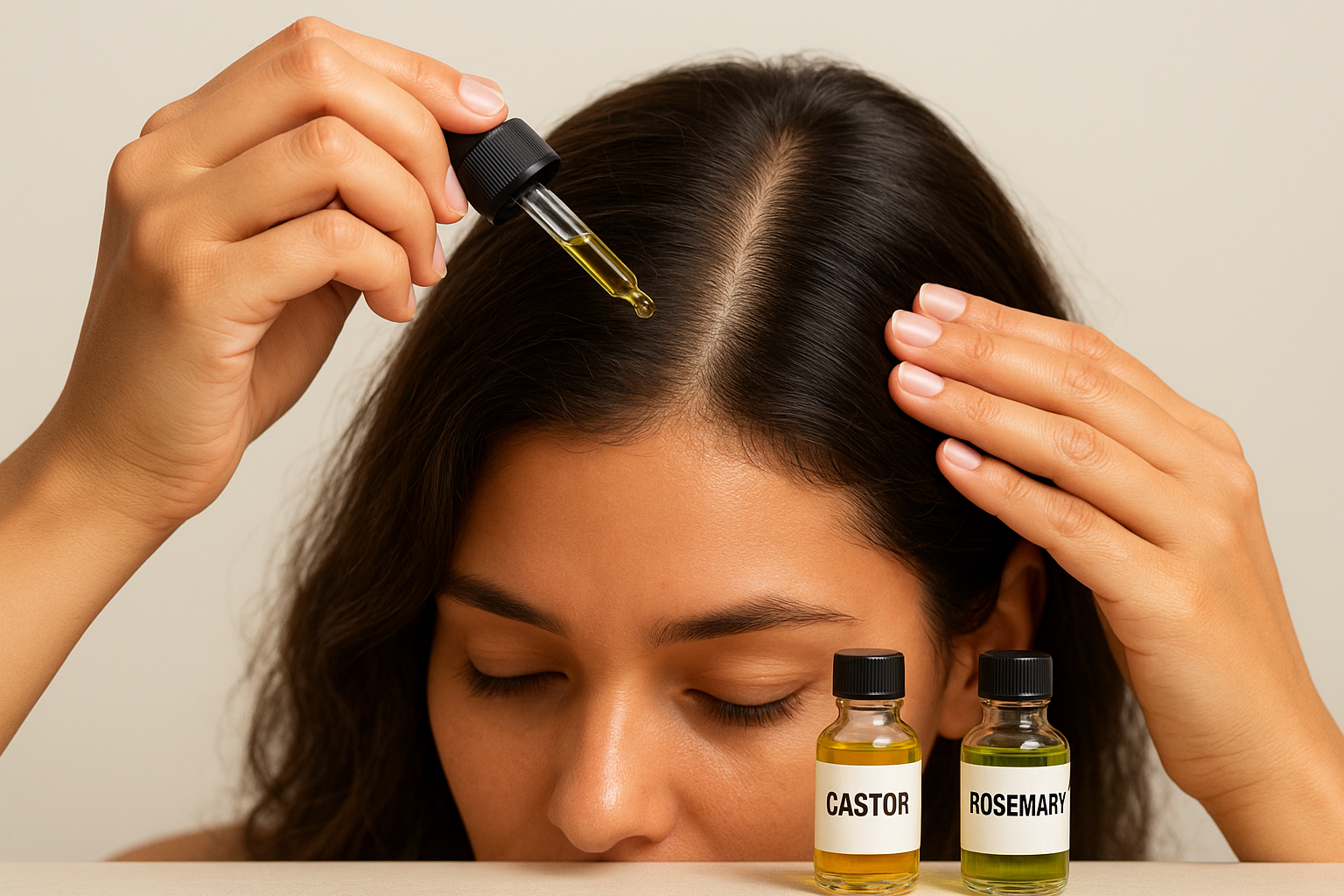
Choisir la mauvaise huile pour votre type de cuir chevelu peut aggraver les problèmes existants. C'est une étape que la plupart des gens sautent, mais qu'il ne faut pas négliger.
| Type de cuir chevelu | Huiles recommandées |
|---|---|
| Sec ou squameux | Huile de ricin, huile d'argan |
| Gras ou sujet aux accumulations | Huile de jojoba, huile de menthe poivrée |
| Équilibré ou mixte | Huile de romarin, mélanges botaniques |
Ce qu'il faut rechercher sur l'étiquette
La lecture de la liste des ingrédients est le moyen le plus fiable d'évaluer si un produit fonctionnera réellement. Les formulations naturelles certifiées listent clairement leurs ingrédients botaniques sans les cacher derrière des mélanges propriétaires ou des noms de charges synthétiques. Recherchez les huiles qui contiennent des ingrédients actifs sous leurs formes pures et non diluées en haut de la liste, car cela indique une concentration significative plutôt qu'une quantité infime ajoutée uniquement à des fins marketing.
Évitez les produits qui s'appuient fortement sur les huiles minérales ou les silicones comme ingrédients de base. Ceux-ci recouvrent la tige du cheveu plutôt que de la pénétrer, ce qui donne une apparence de douceur sans faire rien pour la santé à long terme du cuir chevelu ou le soutien folliculaire.
Comment utiliser l'huile de croissance capillaire en toute sécurité
Savoir ce qu'est l'huile de croissance capillaire est une chose, mais l'appliquer correctement détermine si vous verrez réellement des résultats. Beaucoup de gens utilisent trop de produit ou l'appliquent d'une manière qui empêche une absorption adéquate. Le cuir chevelu est l'endroit où chaque application doit atterrir, et non seulement les mi-longueurs ou les pointes de vos cheveux. Faire cela correctement dès le début signifie que chaque goutte fait ce pour quoi elle est conçue.
Comment appliquer l'huile sur votre cuir chevelu
Divisez vos cheveux en sections et appliquez quelques gouttes directement sur le cuir chevelu du bout des doigts. Massez l'huile en mouvements circulaires pendant deux à trois minutes pour stimuler la circulation sanguine et aider la formule à pénétrer le follicule. Vous n'avez pas besoin d'une grande quantité. Utiliser plus de produit que votre cuir chevelu ne peut en absorber recouvre simplement la surface sans apporter de bénéfice supplémentaire et peut laisser vos cheveux gras.
Appliquer l'huile sur un cuir chevelu légèrement humide après le lavage améliore souvent l'absorption par rapport à une application sur des cheveux complètement secs ou très mouillés.
Laissez l'huile agir pendant au moins 30 minutes avant de la rincer, ou appliquez-la pendant la nuit pour un traitement plus profond. Visez deux à trois applications par semaine pour des résultats constants plutôt qu'une utilisation quotidienne, qui peut surcharger votre cuir chevelu d'accumulation de produit.
Ce qu'il faut éviter pendant l'utilisation
N'appliquez jamais d'huiles essentielles non diluées comme le romarin ou la menthe poivrée directement sur votre cuir chevelu sans une huile de support, car cela peut provoquer des irritations ou des brûlures. Vérifiez toujours que la formule choisie est testée par des dermatologues et adaptée à votre type de peau, surtout si vous avez un cuir chevelu sensible. Tester un nouveau produit sur une petite zone d'abord réduit le risque de toute réaction inattendue.
La constance compte plus que la fréquence. Utiliser l'huile tous les jours n'accélère pas les résultats et provoque souvent une accumulation qui obstrue les ouvertures folliculaires. Maintenir votre routine pendant au moins huit à douze semaines donne à vos follicules suffisamment de temps pour réagir au traitement.
Points clés à retenir et prochaines étapes
Les huiles de croissance capillaire fonctionnent, mais seulement si vous choisissez la bonne formule et l'appliquez de manière cohérente. Comprendre ce qu'est l'huile de croissance capillaire à un niveau fondamental signifie reconnaître que ces produits soutiennent l'environnement de votre cuir chevelu plutôt que de forcer des changements spectaculaires du jour au lendemain. Les huiles de romarin, de ricin et de menthe poivrée apportent chacune des bienfaits spécifiques et étudiés qui s'accumulent au fil des semaines d'utilisation régulière plutôt qu'en quelques jours.
Votre type de cuir chevelu guide les ingrédients qui donneront les meilleurs résultats pour votre situation. Les formulations naturelles certifiées avec des listes d'ingrédients transparentes vous donnent confiance dans ce que vous appliquez et réduisent le risque d'irritation ou d'accumulation. Adapter votre huile à l'état de votre cuir chevelu, l'appliquer aux bonnes zones et rester cohérent pendant au moins huit à douze semaines sont les trois étapes qui distinguent les vrais résultats de la déception.
Prêt à mettre cela en pratique ? Explorez les produits de soins capillaires naturels fabriqués au Royaume-Uni et trouvez la formule adaptée à votre cuir chevelu dès aujourd'hui.

