


You've got the rosemary oil. You've heard the hype. But now you're staring at the bottle wondering how often to apply rosemary oil to hair without overdoing it or wasting your time. It's a fair question, because frequency matters just as much as the oil itself when it comes to seeing real hair growth results.
Ready to put this into practice? Our Rosemary Oil for Hair Growth is a solid place to start.
Too little, and nothing happens. Too much, and you risk irritating your scalp or weighing your hair down with buildup. The sweet spot sits somewhere in between, and it depends on factors like your scalp sensitivity, hair type, and washing routine. At Xquisit Luxe, we formulate our natural hair care products, including our rosemary-enriched hair oils, with exactly this balance in mind: effective results without compromise.
This guide breaks down a clear weekly routine for applying rosemary oil, backed by practical advice you can actually stick to. You'll know exactly how many times per week to use it, how to fit it around your wash days, and what to expect as you stay consistent. Let's get into the specifics that actually matter.
What changes the ideal frequency for rosemary oil
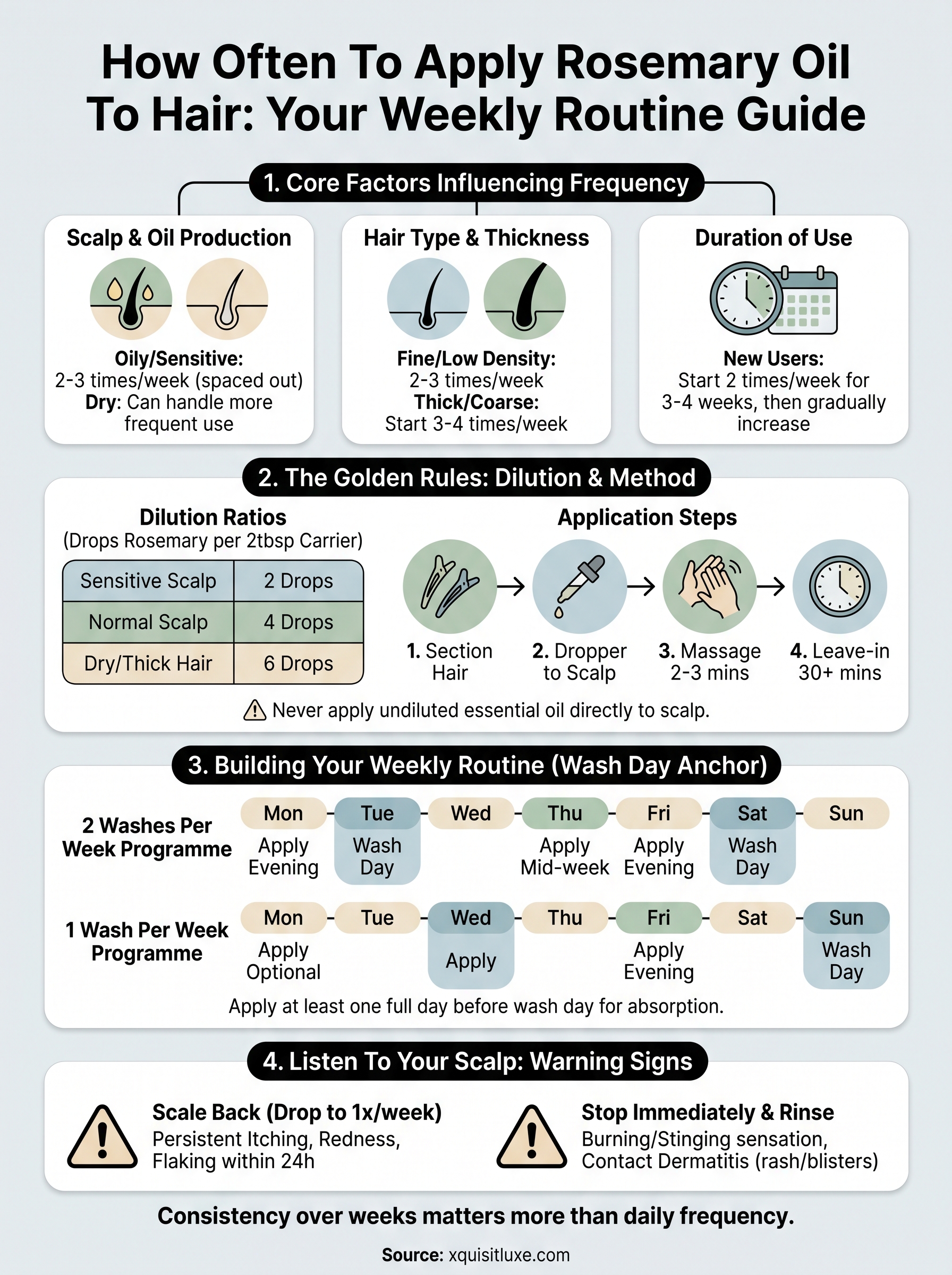
There is no single answer to how often to apply rosemary oil to hair that works for every person. Your ideal frequency depends on a handful of key variables, and understanding them before you start saves you weeks of guesswork. Applying it too often wastes product and risks irritating your scalp, while applying it too rarely means slower, less consistent results. The three factors below have the biggest influence on where your personal frequency should land.
Your scalp sensitivity and oil production
If your scalp tends to get oily quickly, applying rosemary oil every day will make the problem worse. Oily or sensitive scalps generally respond better to two or three applications per week, spaced out to prevent product buildup and congestion. Dry scalps, on the other hand, can handle more frequent use without the same greasy side effects. After each session, give your scalp 24 to 48 hours to settle and watch for redness, persistent itching, or excess greasiness, because these are clear signals to cut back before the irritation sets in.
If your scalp feels irritated after applying rosemary oil, drop to once a week for two full weeks before you consider increasing again.
Your hair type and thickness
Fine or low-density hair absorbs oil quickly and shows greasiness faster, so applying rosemary oil more than two or three times per week will flatten your strands and make them look unwashed. Thick or coarse hair has more structure to work with, making three to four sessions per week a reasonable starting point. Curly and textured hair types, which tend to run drier along the length, can often handle slightly more frequent application without the same buildup concern.
How long you have been using rosemary oil
Jumping straight into daily use is one of the most common mistakes new users make. Start with two applications per week and hold that schedule for the first three to four weeks, even if your hair feels fine. This gives your scalp time to adjust and lets you catch any sensitivity early before it becomes a setback. Once your scalp is clearly comfortable, you can increase gradually to three or four times per week if your hair type supports it. Skipping this build-up phase does not speed up growth; it mainly raises your risk of irritation and forces you to start over.
Pick your application method and dilution
Before you settle on how often to apply rosemary oil to hair, you need to get the method right. Applying undiluted rosemary oil directly to your scalp is one of the fastest ways to cause irritation, so the ratio you use matters as much as the frequency.
Diluting rosemary oil correctly
Pure rosemary essential oil is highly concentrated and must always be mixed with a carrier oil before it touches your scalp. Jojoba, coconut, or sweet almond oil all work well as carriers. The table below shows recommended dilution ratios based on your scalp type.
| Scalp type | Rosemary oil | Carrier oil |
|---|---|---|
| Sensitive | 2 drops | 2 tablespoons |
| Normal | 4 drops | 2 tablespoons |
| Dry or thick hair | 6 drops | 2 tablespoons |
Never apply undiluted rosemary essential oil directly to your scalp, as this can cause burns or contact dermatitis.
How to apply it to your scalp
Once your mixture is ready, section your hair into parts to reach the scalp directly rather than just coating the surface strands. Follow these steps for a consistent application every session:

- Divide your hair into four or five sections using clips.
- Use a dropper or your fingertips to place the oil along each parting.
- Massage in small circular motions for two to three minutes.
- Leave the oil on for at least 30 minutes, or overnight if possible.
Applying this way ensures the oil reaches your hair follicles rather than sitting on top of your hair, which is where the growth-stimulating work actually happens.
Create a weekly routine that fits your wash days
Your wash schedule is the easiest anchor point for figuring out how often to apply rosemary oil to hair without disrupting your normal routine. The goal is to time applications so the oil has enough contact time with your scalp before you rinse, and to avoid applying it right after washing when your scalp may be more sensitive.
Apply rosemary oil at least one full day before your wash day so the oil has time to absorb properly before you rinse it out.
If you wash your hair twice a week
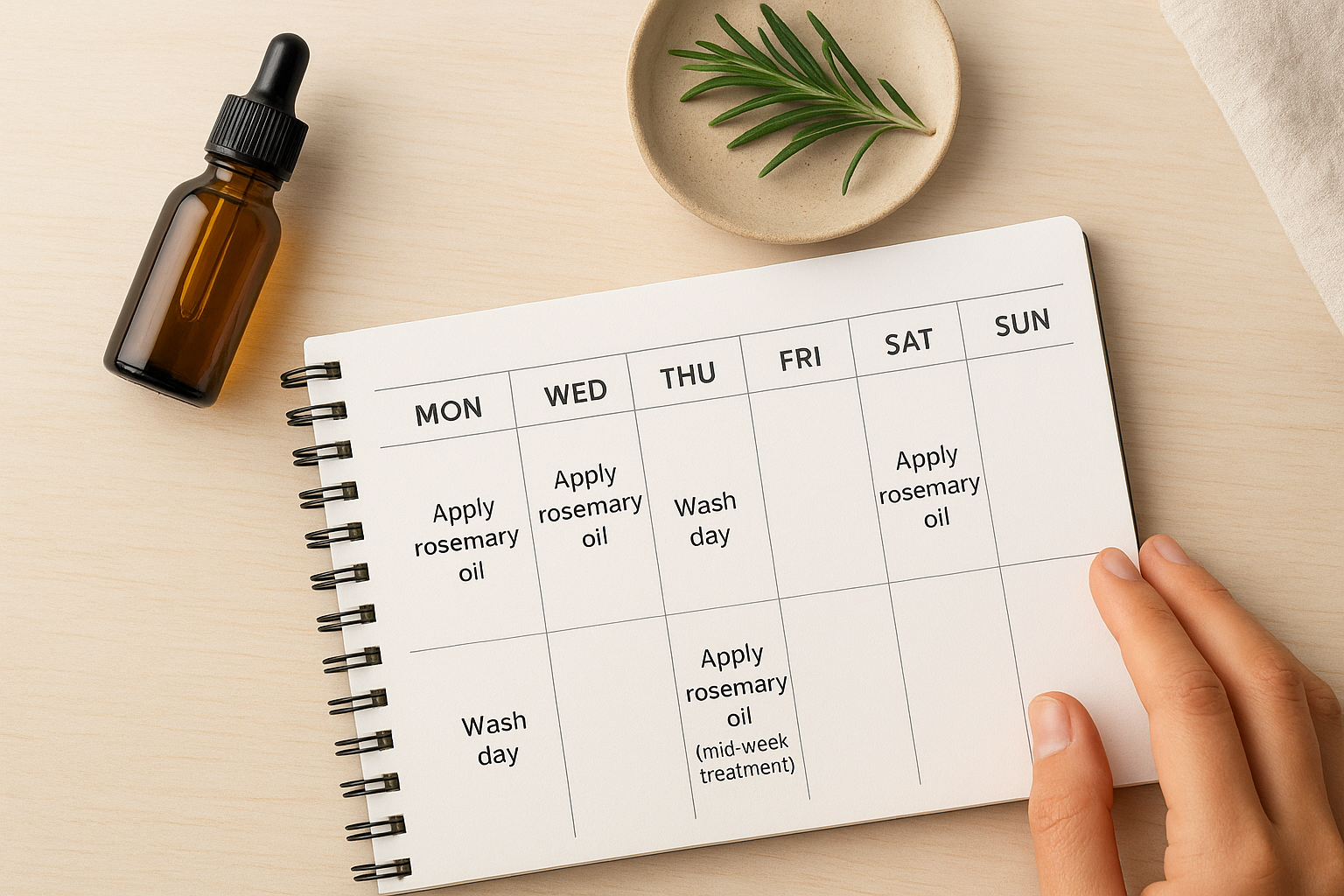
Two wash days per week gives you a natural framework for three applications spread across the week. Apply the oil the evening before each wash day, and add one standalone treatment mid-week. The template below shows how this looks in practice.
| Day | Action |
|---|---|
| Monday | Apply rosemary oil in the evening |
| Tuesday | Wash day |
| Thursday | Apply rosemary oil (mid-week treatment) |
| Friday | Apply rosemary oil in the evening |
| Saturday | Wash day |
If you wash your hair once a week
One wash day per week means your routine needs a bit more intention to reach two to three applications. Apply the oil two days before your wash, then add one or two sessions on the days furthest from wash day to space them evenly. For example, if you wash on Sunday, apply on Friday evening, Wednesday, and optionally Monday.
Keep each session consistent in terms of massage time and leave-in duration so your scalp gets a reliable stimulus rather than patchy, irregular treatment.
When to scale back or stop using rosemary oil
Knowing how often to apply rosemary oil to hair also means knowing when to pull back. Rosemary oil suits most people well, but using it at the wrong frequency can turn a useful habit into a scalp problem. Watching for specific signals helps you course-correct early rather than dealing with weeks of irritation or setting your progress back.
Signs your scalp needs a break
Your scalp will usually tell you when something is off before it becomes a serious issue. Persistent itching, redness, or flaking that appears within 24 hours of an application is a clear sign you need to reduce your frequency immediately. Drop back to once a week and hold that pace for two full weeks before you consider increasing again.
Other warning signs worth tracking include:
- Scalp tenderness or a burning sensation after application
- Increased hair shedding beyond your normal baseline
- Greasy buildup that does not clear after washing
- Headaches triggered by the scent during or after a session
If you experience any burning or stinging during application, rinse the oil off immediately with a gentle shampoo and skip your next scheduled session.
When to stop completely
Some reactions go beyond sensitivity and signal that rosemary oil is not the right fit for you at this point. If contact dermatitis develops, characterised by a spreading rash, blistering, or swollen skin around the hairline, stop use entirely and consult a dermatologist. Hormonal changes, certain medications, and existing scalp conditions can all affect how your skin responds to topical botanicals, so professional guidance is worth seeking before you restart.
Common questions and quick fixes
Even with a clear routine in place, a few practical questions tend to come up once you start using rosemary oil consistently. The answers below address the most common points of confusion around how often to apply rosemary oil to hair and what to do when your routine hits a snag.
Can you use rosemary oil every day?
Technically you can, but for most people it is not the most effective approach. Daily use raises your risk of product buildup and scalp sensitivity, particularly if you have normal to oily skin. Three to four sessions per week gives your scalp adequate stimulation while allowing recovery time between applications. If you are determined to use it daily, drop your dilution ratio by half and monitor your scalp closely after each session.
Consistency over weeks matters far more than frequency on any single day, so a steady three-times-a-week habit will outperform sporadic daily use every time.
What if you miss an application?
Missing one session will not undo your progress. Skip it entirely and carry on with your next scheduled application rather than trying to double up on the same day. Doubling applications does not compensate for a missed session; it just increases the load on your scalp.
Why is your hair still greasy after washing?
Greasiness that persists after washing usually points to two causes: applying too much oil per session or not massaging your shampoo in long enough to fully dissolve the residue. Try halving the amount of oil you use and leaving your shampoo on for two full minutes before rinsing. If the problem continues, add a clarifying wash once a month to clear accumulated buildup from your scalp.
Next steps for healthier hair
Now you have a clear picture of how often to apply rosemary oil to hair and what a sustainable weekly routine actually looks like. The next move is straightforward: pick your starting frequency based on your scalp type, set your first application for this week, and track your scalp's response after each session. Consistency over the next eight to twelve weeks will give you the honest results that sporadic use never will.
Beyond frequency, the quality of what you apply makes a real difference to what your scalp receives. Pairing your routine with a well-formulated, natural hair oil designed specifically for growth support gives your follicles a stronger foundation to work from. If you want products built around certified natural ingredients and developed for visible results, explore the full Xquisit Luxe hair care range and find the right fit for your routine.
