

Hair thinning affects roughly half of all men by the age of 50, and if you're noticing more scalp than you'd like in the mirror, you're far from alone. The good news? The right hair growth oil for men can make a genuine difference, stimulating follicles, nourishing the scalp, and helping to slow or even reverse thinning when used consistently.
Our Rosemary Oil for Hair Growth is built around exactly this approach — worth a look if you're ready to try it for yourself.
But with dozens of oils flooding the UK market, each promising miracle results, separating what actually works from pure marketing hype takes real effort. Some oils are backed by clinical research and centuries of traditional use. Others? Not so much. What matters is the ingredients, how they interact with your scalp, and whether the formulation is designed with men's hair loss patterns in mind.
At Xquisit Luxe, we've spent years developing certified natural, dermatologist-tested hair care products right here in the UK, including our own Hair Growth Oil that's become a best-seller among men dealing with thinning and receding hairlines. That hands-on experience with ingredients and formulation gives us a solid foundation to evaluate what's out there.
Below, we've rounded up the 12 best hair growth oils for men available in the UK in 2026, products that deliver real, visible results. We'll break down what makes each one effective, which ingredients to look for, and how to choose the right oil for your specific hair concerns.
1. Xquisit Luxe Hair Care Oils and Hair Regrowth Bundle
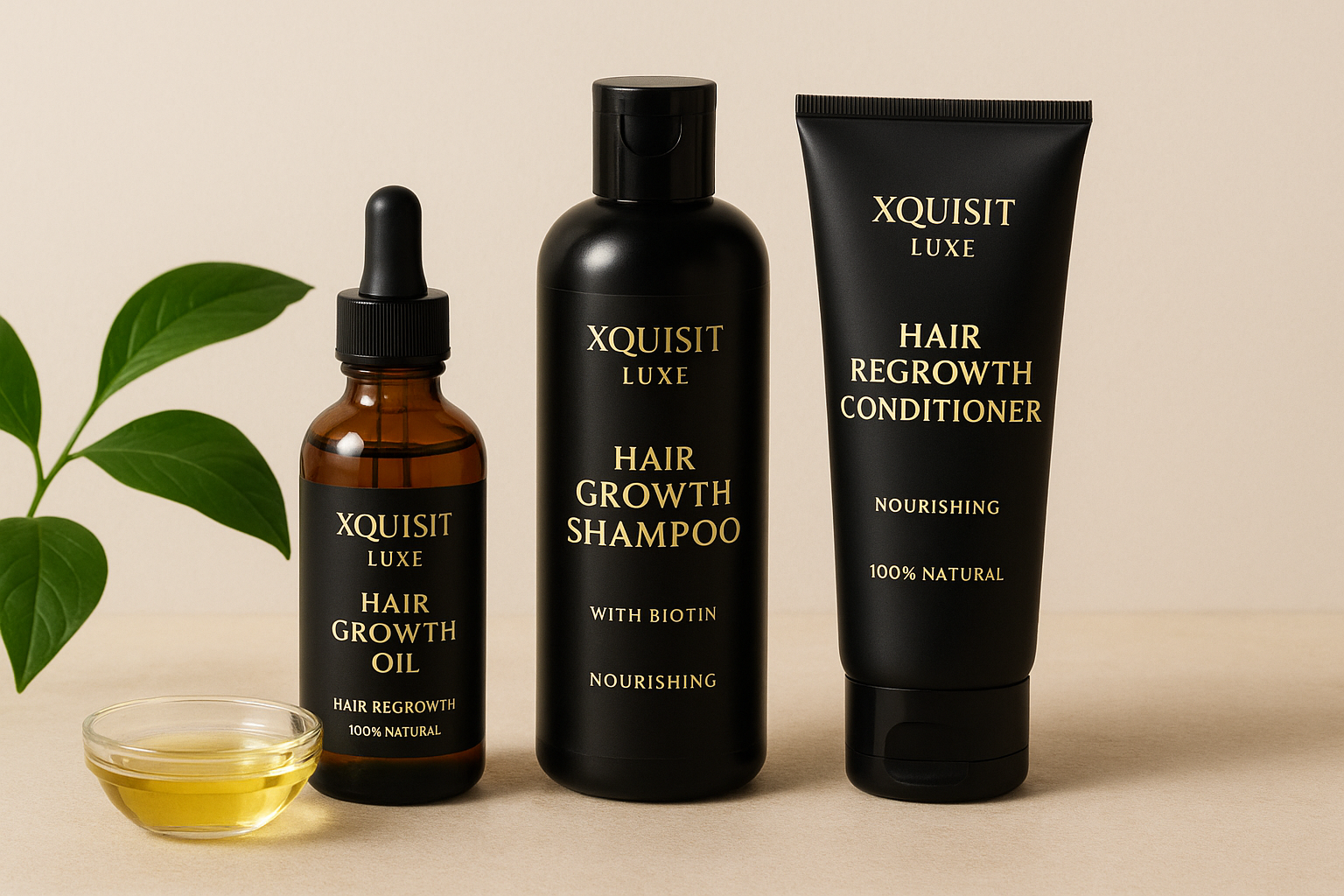
When it comes to a purpose-built hair growth oil for men, the Xquisit Luxe Hair Regrowth Bundle stands out because it was developed specifically for the UK market using certified natural, dermatologist-tested ingredients. Rather than offering a single generic oil, this bundle combines a targeted Hair Growth Oil with complementary hair care products, so your scalp receives nourishment and stimulation from multiple angles rather than just one.
Why It Can Help
The Xquisit Luxe Hair Growth Oil is formulated to address the root causes of thinning hair in men, including poor scalp circulation, follicle stress, and dryness that weakens hair at the shaft. The blend draws on natural botanical ingredients known to support follicle health, rather than relying on harsh synthetic compounds that can irritate a sensitive scalp.
Consistent use of a properly formulated hair oil, applied directly to the scalp, is one of the most effective ways to support the conditions your follicles need to produce stronger, healthier hair.
How to Use It in a Men's Routine
Apply a small amount of the oil directly to your scalp two to three times per week, working it in with your fingertips using circular motions for two to three minutes. This technique encourages blood flow to the follicles while ensuring the active ingredients absorb into the scalp rather than sitting on the hair surface. Leave it on for at least 30 minutes before washing, or apply it overnight for deeper conditioning.
What to Check on the Ingredient List
Look for cold-pressed or unrefined carrier oils as the base, which retain more of their active compounds than processed alternatives. The Xquisit Luxe formula avoids parabens, sulphates, and synthetic fragrances, which is exactly what you want if your scalp is reactive or prone to irritation. Natural botanicals and plant-derived actives should appear near the top of the ingredient list, not buried at the bottom in trace amounts.
Hair Regrowth Bundle — £50.99
A targeted Hair Growth Oil paired with complementary hair care products, so your scalp gets nourishment and stimulation from multiple angles rather than just one. Made in the UK, dermatologist tested and cruelty-free.
Free UK delivery on orders over £25, and a 30-day money-back guarantee. New customers get 10% off a first order with the Xquisit Club newsletter.
2. Rosemary Oil Blend for Thinning at the Crown and Temples
Rosemary oil has become one of the most talked-about options in the hair growth oil for men space, and for good reason. A 2015 study published in the journal Skinmed found rosemary oil performed comparably to minoxidil 2% in supporting hair count over six months, with less scalp irritation reported in the rosemary group.
Why It Can Help
Rosemary oil works primarily by improving circulation to the scalp, which brings more oxygen and nutrients to follicles that may be struggling due to reduced blood flow. This makes it particularly relevant for men experiencing thinning at the crown and temples, where follicle activity often slows first.
Rosemary oil is one of the few natural ingredients with published clinical data directly comparing it to a pharmaceutical hair loss treatment.
How to Use It in a Men's Routine
Mix three to five drops of rosemary essential oil into a tablespoon of a carrier oil such as jojoba or argan before applying it to your scalp. Never apply undiluted essential oil directly to skin. Massage it into the thinning areas for two to three minutes, then leave it on for at least 30 minutes before washing out.
What to Check on the Ingredient List
Look for Rosmarinus officinalis (rosemary) leaf oil listed near the top of the blend. Avoid products that use rosemary extract or fragrance as a substitute, since these lack the active compounds responsible for the scalp benefits.
How it compares
Rosemary has the strongest published evidence of any single natural ingredient here, so a plain rosemary blend is a sound starting point for crown and temple thinning. The trade-off is that you are buying one raw ingredient: you have to dilute it correctly yourself every time, and quality varies a great deal between blends, with some relying on rosemary extract or fragrance rather than the leaf oil that carries the actives. A finished UK-made natural formula has the dilution and sourcing settled for you, and pairs rosemary with other scalp ingredients instead of leaning on it alone.
3. Pumpkin Seed Oil for Men with Pattern Thinning
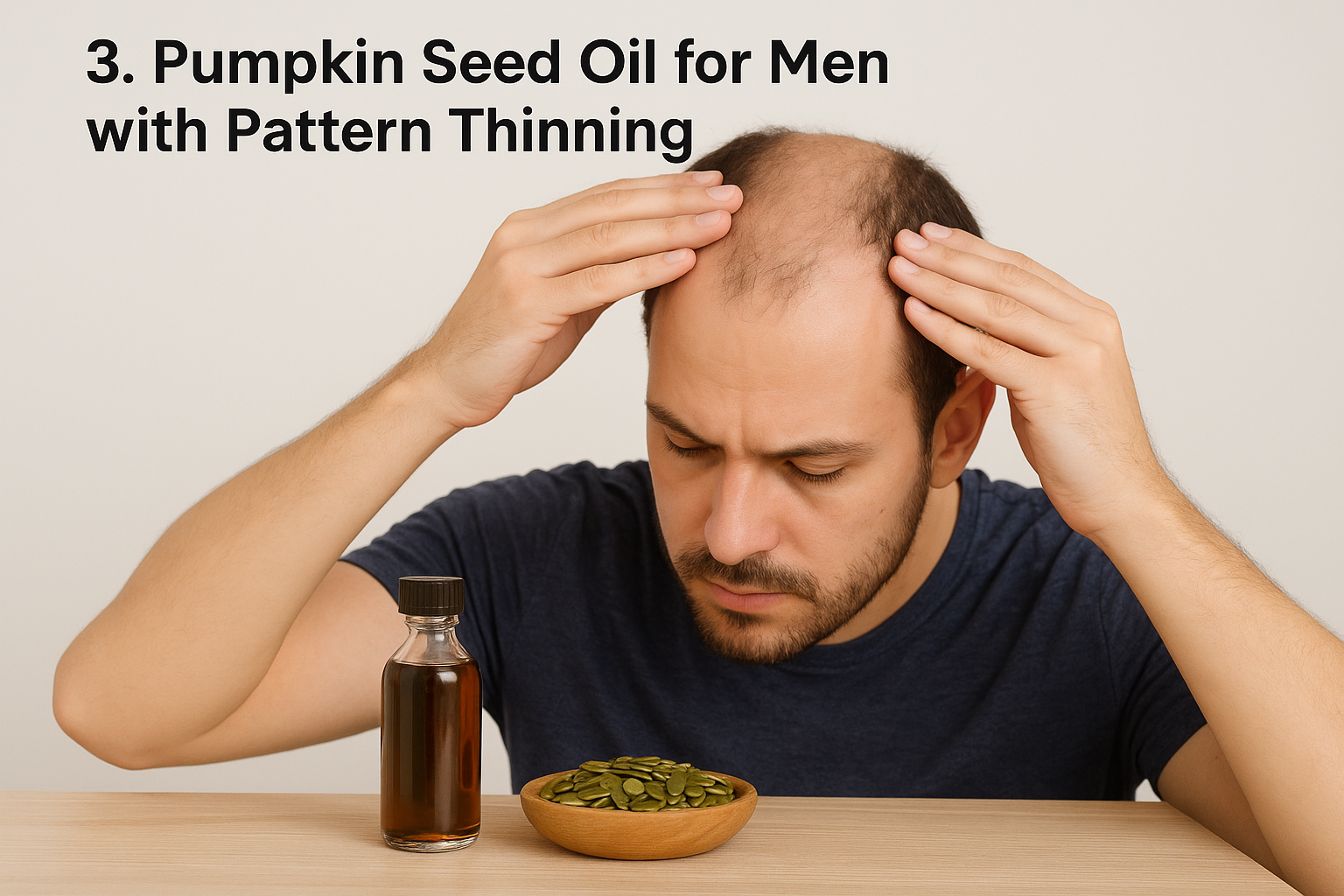
Pumpkin seed oil is one of the more scientifically grounded natural options available for men dealing with androgenetic alopecia (male pattern baldness). A 2014 randomised controlled trial published in Evidence-Based Complementary and Alternative Medicine found men taking pumpkin seed oil experienced significantly greater hair count increases than those in the placebo group over 24 weeks.
Why It Can Help
Pumpkin seed oil is rich in phytosterols and zinc, two compounds that may help inhibit 5-alpha reductase, the enzyme responsible for converting testosterone into DHT. Since DHT is the primary driver of follicle miniaturisation in male pattern thinning, reducing its activity at the scalp level can slow or pause recession over time.
Of all the natural oils studied for male hair loss, pumpkin seed oil has one of the strongest direct links to DHT-related thinning supported by published clinical data.
How to Use It in a Men's Routine
Warm a small amount between your palms and massage it directly into the scalp two to three times per week. Because pumpkin seed oil is thicker than some alternatives, blending it with a lighter carrier oil like jojoba makes it easier to work in. Leave it on for at least 30 minutes before shampooing.
What to Check on the Ingredient List
Look for these key markers when choosing a product:
- Cucurbita pepo (pumpkin) seed oil listed as a primary ingredient
- Cold-pressed or unrefined on the label to retain active compounds
- No mineral oil, which can clog follicles and reduce absorption
How it compares
If DHT-driven pattern thinning is what you are actually dealing with, pumpkin seed oil is one of the better-evidenced natural ingredients you can reach for. On its own it is thick and slow to work into the scalp, usually needing a lighter carrier oil blended in, and it does little for the condition of the hair shaft itself. A purpose-built UK natural formula arrives with that blending already done and the cold-pressed, mineral-oil-free sourcing you would otherwise have to check label by label.
4. Peppermint Oil for Scalp Stimulation
Peppermint oil delivers one of the most noticeable sensations of any hair growth oil for men, and that tingling on your scalp is actually telling you something useful. Research published in Toxicological Research in 2014 found that peppermint oil produced significant hair growth effects in mice, outperforming both saline and jojoba oil treatments over a four-week period.
Why It Can Help
Peppermint oil's primary active compound, menthol, acts as a vasodilator, meaning it widens blood vessels and increases circulation to your scalp. Better blood flow means more oxygen and nutrients reaching your follicles, which supports the conditions your hair needs to grow stronger and more consistently over time.
The tingling sensation you feel when applying peppermint oil is a direct indicator that increased blood flow is occurring at the scalp surface.
How to Use It in a Men's Routine
Dilute three to five drops of peppermint essential oil into a tablespoon of a neutral carrier oil, such as jojoba or coconut oil, before applying it to your scalp. Massage it in for two minutes, focusing on areas where thinning is most noticeable, then leave it on for 20 to 30 minutes before washing out.
What to Check on the Ingredient List
Look for Mentha piperita (peppermint) oil listed explicitly rather than "fragrance" or "mint flavouring," since these contain none of the active compounds responsible for scalp benefits. A concentration of around 3% in a pre-made blend is effective without causing irritation to a sensitive scalp.
How it compares
Peppermint is a genuinely useful circulation booster, and the fact that you can feel it working makes it easy to stay consistent with. Its evidence base is animal research rather than human trials, and as a neat essential oil it has to be diluted carefully — too strong and it will irritate a reactive scalp. In a finished natural formula the concentration is set for you at a level that stimulates without stinging, and it sits alongside ingredients that do the follicle work peppermint on its own does not.
5. Castor Oil for the Look of Thicker Hair and Less Breakage
Castor oil has been a staple in hair care for generations, and it remains one of the most popular choices for men who want thicker-looking hair and fewer broken strands. Its dense, viscous texture sets it apart from lighter oils, making it especially useful for coating the hair shaft and reducing moisture loss at the follicle level.
Why It Can Help
Castor oil is exceptionally high in ricinoleic acid, a fatty acid that helps improve scalp circulation and lock moisture into the hair shaft. This combination supports stronger hair that holds on longer rather than snapping off mid-length. As a hair growth oil for men, it works best for those who notice their hair feels brittle or sparse rather than experiencing significant recession at the hairline.
Ricinoleic acid is one of the more unique fatty acids found in plant oils, and castor oil contains roughly 90% of it, making it a highly concentrated option for scalp and hair conditioning.
How to Use It in a Men's Routine
Because castor oil is thick, warming a small amount between your palms before applying it makes the process far easier. Work it through the scalp and along the hair shaft two to three times per week, then wash it out thoroughly after 30 to 45 minutes.
What to Check on the Ingredient List
Choose cold-pressed, hexane-free castor oil to ensure you're getting the full concentration of ricinoleic acid without residual solvents from processing.
How it compares
Castor oil is very good at the job it actually does: coating the shaft, holding moisture in and cutting down breakage, which makes hair look denser over time. What it does not do is act on the hormonal drivers behind male pattern recession, so it suits brittle or sparse hair far more than a receding hairline. It is also heavy, slow to work in and needs a thorough wash out, where a lighter UK-made natural blend delivers scalp conditioning with much less effort around wash day.
6. Batana Oil for Brittle, Dry, Over-Processed Hair
Batana oil is extracted from the nut of the American palm tree, native to Central America, and it has only recently gained wider attention in the UK as a hair growth oil for men dealing with serious dryness and breakage. If heat styling, chemical treatments, or years of harsh products have left your hair feeling crispy and fragile, batana oil is worth serious consideration.
Why It Can Help
Batana oil is packed with oleic acid and tocopherols (vitamin E), both of which penetrate the hair shaft to restore flexibility and reduce brittleness caused by repeated damage. It also carries natural antioxidants that protect follicles from oxidative stress, which accelerates thinning in men whose scalps have endured prolonged product build-up.
Batana oil is one of the few natural oils that addresses both the scalp environment and the structural integrity of the hair shaft simultaneously.
How to Use It in a Men's Routine
Apply a small amount directly to dry or towel-dried hair, working it from the scalp down to the ends. Use it two to three times per week as a pre-wash treatment, leaving it on for at least 30 minutes before shampooing thoroughly.
What to Check on the Ingredient List
Look for 100% pure, unrefined batana oil with no added mineral oil or silicones, which can coat the shaft and prevent proper absorption of the active compounds.
How it compares
Batana is a strong repair option if heat, chemicals or years of harsh products have left your hair brittle, and it is unusual in working on both the scalp environment and the hair shaft. Its weakness is consistency: purity grades vary widely and some versions are cut with mineral oil or silicones that block the absorption you are paying for. A certified natural UK formula gives you comparable nourishing fatty acids with the sourcing and formulation already verified rather than left to the label.
7. Argan Oil for Strength, Shine, and Frizz Control
Argan oil is pressed from the kernels of the Moroccan argan tree and has become a trusted ingredient in professional hair care globally. If your hair feels rough, looks dull, or fights back every time you try to style it, argan oil addresses all three issues without leaving your hair greasy or weighed down.
Why It Can Help
This oil is rich in oleic acid, linoleic acid, and vitamin E, which work together to strengthen the hair shaft and smooth the cuticle layer that surrounds each strand. A smoother cuticle reflects light more effectively, giving hair visible shine, while also sealing in moisture to reduce frizz throughout the day. As a hair growth oil for men, it works best as part of a broader routine rather than a standalone follicle treatment.
Consistently protecting the hair shaft reduces breakage over time, which means your existing hair holds on longer and the overall density of your style improves.
How to Use It in a Men's Routine
Apply two to three drops to damp or dry hair after washing, working it through from mid-length to the ends. You can also use a single drop as a finishing treatment to smooth flyaways and control frizz before heading out.
What to Check on the Ingredient List
Look for these markers before buying:
- Argania spinosa kernel oil listed near the top of the ingredient list
- "Cold-pressed" or "100% pure" on the label
- No silicones or mineral oil masking as the active ingredient
How it compares
Argan reliably delivers strength, shine and frizz control, and it is light enough that it will not flatten your hair. It is a hair-shaft product rather than a follicle treatment, though, so it belongs in a wider routine rather than being the thing you rely on for regrowth. A dedicated UK-made scalp formula works at the follicle, which is where thinning actually begins, and pairs naturally with an argan finish if you like the way it leaves your hair looking.
8. Jojoba Oil for Oily Scalps and Lightweight Scalp Moisturising
Jojoba oil is technically a liquid wax rather than a true oil, and that distinction matters more than most people realise. Its molecular structure closely resembles human sebum, which makes it the most scalp-compatible option on this list, particularly for men whose scalp already produces excess oil.
Why It Can Help
Because jojoba mimics your scalp's natural sebum, applying it sends a signal that adequate moisture is present, which can actually reduce overproduction of oil over time. This makes it a genuinely useful hair growth oil for men with oily scalps who avoid heavier oils because they leave hair looking greasy or flat. It also carries anti-inflammatory compounds that help keep the follicle environment calm and clear.
Jojoba is one of the only scalp oils that actively communicates with your sebaceous glands rather than simply coating the surface.
How to Use It in a Men's Routine
Apply three to five drops directly to your scalp two to three times per week, massaging it in with your fingertips for two minutes. Because it absorbs so quickly, you can leave it on overnight without the residue that heavier oils leave on your pillow.
What to Check on the Ingredient List
Look for Simmondsia chinensis (jojoba) seed oil listed as the primary or sole ingredient. Cold-pressed and unrefined are the labels to prioritise, as refined versions lose some of their active compounds during processing.
How it compares
For an oily scalp, jojoba is hard to beat as a lightweight moisturiser that absorbs cleanly and helps calm sebum overproduction rather than adding to it. It is a scalp conditioner first and foremost, though — it settles the follicle environment without directly targeting the causes of thinning. That makes it an excellent carrier alongside a purpose-built UK natural formula rather than a substitute for one.
9. Coconut Oil as a Pre-Wash Treatment for Dryness and Damage
Coconut oil is one of the most widely used natural hair care ingredients in the world, and it earns its place on this list as a pre-wash treatment rather than a leave-in product. Used correctly, it protects your hair from the drying effects of shampooing and significantly reduces the protein loss your strands experience during washing.
Why It Can Help
Coconut oil contains a high concentration of lauric acid, a medium-chain fatty acid with a molecular structure small enough to penetrate the hair shaft rather than simply coating it. This penetration ability means coconut oil actively strengthens the hair from the inside, reducing breakage and helping existing strands last longer between washes. As a supporting ingredient in a broader hair growth oil for men routine, it works particularly well for men with dry, coarse, or damage-prone hair.
Coconut oil is one of the few plant-based oils proven to reduce protein loss in hair during both washing and heat styling.
How to Use It in a Men's Routine
Apply a generous amount to dry hair, focusing on the lengths and scalp, then leave it on for at least 30 minutes before shampooing. Using it the night before wash day gives it more time to penetrate and condition deeply.
What to Check on the Ingredient List
Choose virgin, cold-pressed, unrefined coconut oil to retain the full concentration of lauric acid. Refined versions are processed at high heat and lose much of their active conditioning properties.
How it compares
Coconut oil has real evidence behind it for reducing protein loss during washing, and as a pre-wash treatment it protects hair that is already dry or coarse. It is not a follicle treatment, it feels heavy on the hair, and it has to be washed out thoroughly, so it plays a supporting role at best in a thinning routine. A UK-made scalp formula designed to stay on the scalp does the growth-supporting work that a wash-day oil is not built for.
10. Tea Tree Oil for Flaky, Itchy Scalps and Build-up
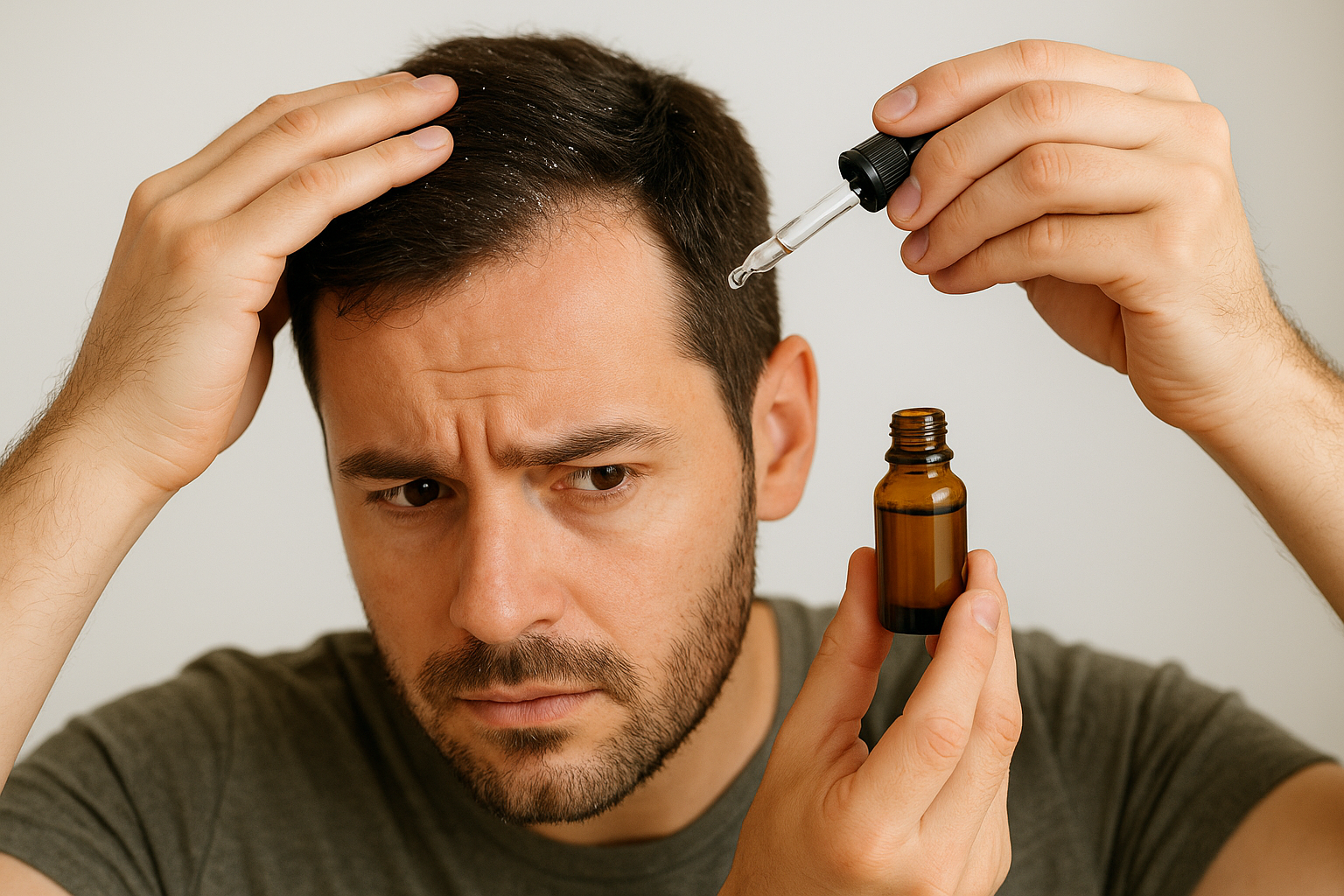
Tea tree oil earns its place on this list not as a direct follicle stimulator, but as a scalp-clearing agent that removes the build-up and inflammation that block healthier hair growth. If dandruff, product residue, or a persistently itchy scalp is part of your daily experience, addressing that issue first makes every other oil you use far more effective.
Why It Can Help
Tea tree oil contains terpinen-4-ol, its primary active compound, which carries well-documented antifungal and antibacterial properties. Many cases of flaking and scalp irritation are driven by Malassezia, a naturally occurring fungus that becomes overactive in certain scalp conditions. By reducing that fungal load, tea tree oil clears the follicle environment so your hair can grow without chronic inflammation working against it.
A clean, settled scalp is the foundation that every other hair growth oil for men performs best on.
How to Use It in a Men's Routine
Add three to five drops of tea tree essential oil to your regular shampoo or blend it into a carrier oil before massaging it into your scalp. Leave it on for five to ten minutes before rinsing thoroughly. Use it two to three times per week rather than daily, since overuse can dry out the scalp.
What to Check on the Ingredient List
Look for Melaleuca alternifolia (tea tree) leaf oil listed clearly, not "fragrance" or "botanical extract," which carry none of the active compounds responsible for its scalp benefits.
How it compares
When flaking, itching or build-up is the immediate problem, tea tree is the right tool, and clearing that up genuinely makes everything else you apply work better. It does not stimulate follicles itself, and used too often it dries the scalp out, so it is scalp housekeeping rather than a growth treatment. It sits sensibly ahead of a nourishing UK-made natural formula in a routine, not in place of one.
11. Black Seed Oil for Scalp Comfort and Healthier-Feeling Hair
Black seed oil, pressed from the seeds of Nigella sativa, has been used in traditional medicine across the Middle East and North Africa for centuries. More recently, it has drawn attention in the hair growth oil for men conversation because of its rich concentration of thymoquinone, an active compound with well-documented anti-inflammatory and antioxidant properties.
Why It Can Help
Chronic scalp inflammation is one of the less-discussed contributors to follicle stress and hair thinning, and black seed oil addresses this directly. Thymoquinone helps calm the scalp environment and reduce oxidative damage that weakens follicles over time, creating conditions where your hair can grow with less resistance.
A settled, inflammation-free scalp responds far better to any hair growth routine than one under constant immune or oxidative stress.
How to Use It in a Men's Routine
Massage three to five drops of black seed oil directly into your scalp two to three times per week, focusing on areas that feel most irritated or sensitive. Leave it on for at least 30 minutes before washing out with a gentle shampoo.
What to Check on the Ingredient List
Look for Nigella sativa seed oil listed clearly as a primary ingredient. Cold-pressed and unrefined versions retain the highest concentration of thymoquinone, so check for those terms on the label before buying.
How it compares
Black seed oil has a long traditional record and a credible anti-inflammatory case through thymoquinone, which matters if your scalp runs irritated or sensitive. Its evidence as a direct regrowth treatment is thinner than what sits behind rosemary or pumpkin seed oil, and its potency depends heavily on whether the version you buy is genuinely cold-pressed and unrefined. A certified natural UK blend gives you calming botanicals alongside ingredients aimed squarely at follicle health, without the label detective work.
12. Saw Palmetto Oil Blends for Men Worried About DHT
Saw palmetto is one of the most studied natural alternatives for men dealing with DHT-related thinning, making it a credible addition to any serious hair growth oil for men routine. It comes from the berry of the Serenoa repens plant and has been used for decades in supplements targeting prostate and hormonal health.
Why It Can Help
Saw palmetto works by inhibiting 5-alpha reductase, the same enzyme that converts testosterone into DHT. Since DHT is the primary driver of follicle miniaturisation in male pattern baldness, slowing that conversion reduces the pressure on your follicles over time. A 2020 review published in the Journal of Dermatological Treatment found saw palmetto showed comparable results to finasteride in some studies, with a significantly better tolerability profile.
Saw palmetto is one of the few plant-based ingredients that targets the hormonal mechanism behind male pattern thinning rather than simply nourishing the scalp surface.
How to Use It in a Men's Routine
Because saw palmetto extract is difficult to work with as a standalone oil, most men use it as part of a pre-formulated blend containing carrier oils like jojoba or argan. Massage the blend into your scalp two to three times per week, leaving it on for at least 30 minutes before rinsing.
What to Check on the Ingredient List
Look for Serenoa repens fruit extract listed clearly as an active ingredient, not buried in a proprietary blend at the bottom of the label. The extract should appear alongside a quality carrier oil rather than water or synthetic filler as the base.
How it compares
Saw palmetto goes after the hormonal mechanism behind male pattern thinning, which very few natural ingredients attempt, and it tolerates well compared with pharmaceutical routes. Because it is hard to use on its own you are entirely dependent on how well a given blend is put together, and it often turns up in trace amounts inside a proprietary blend at the bottom of the label. A transparent UK-made natural formula lets you see exactly what you are putting on your scalp and in what proportion.
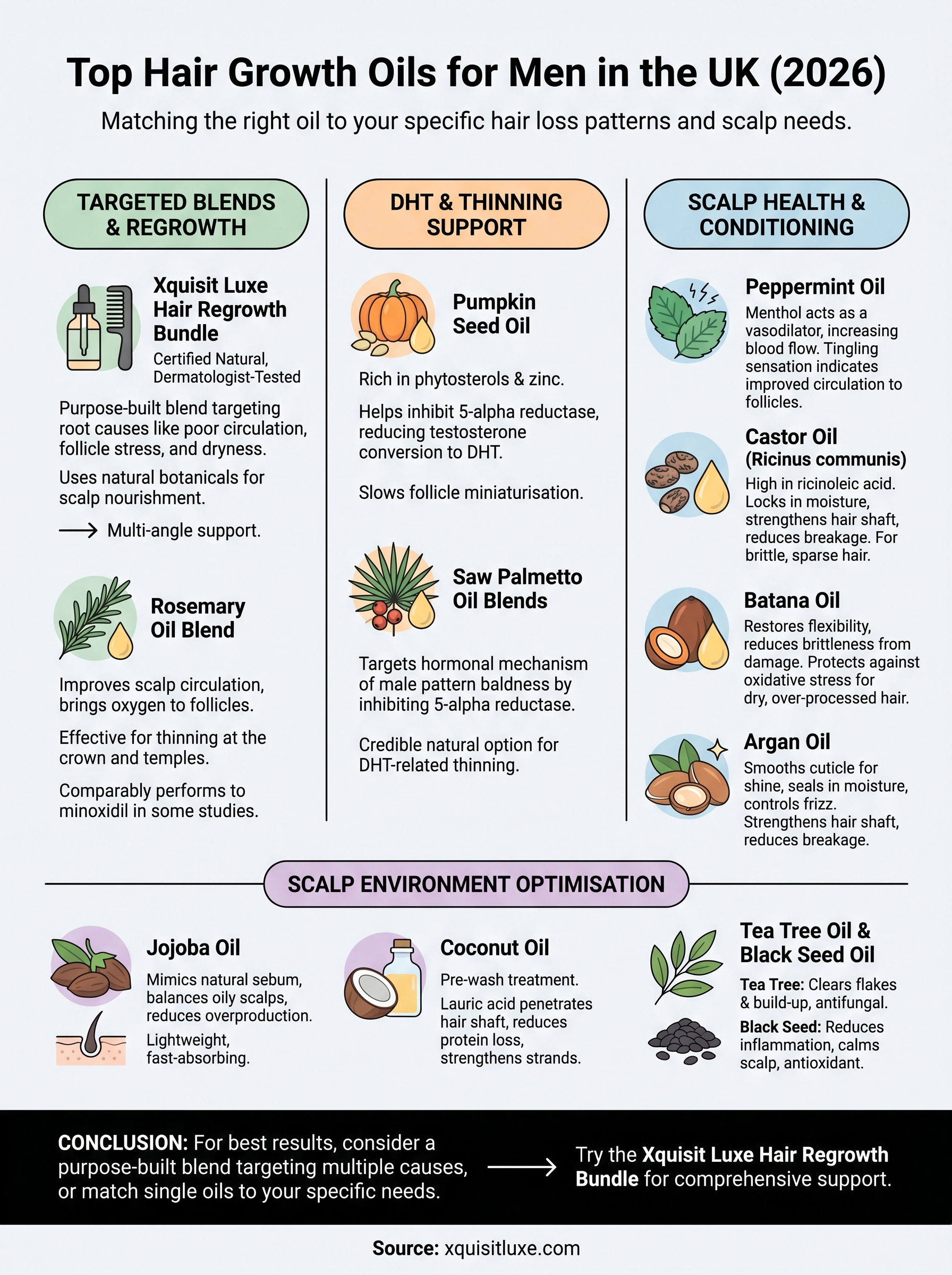
Conclusion
Finding the right hair growth oil for men comes down to matching the oil to your specific scalp condition and hair loss pattern. If DHT-driven thinning is your main concern, saw palmetto and pumpkin seed oil are your strongest natural options. If dryness, breakage, or scalp irritation is driving the problem, batana, black seed, or tea tree oil will do more meaningful work.
That said, the most reliable results come from a purpose-built formulation rather than a single-ingredient oil applied in isolation. A well-designed blend targets multiple causes of thinning at once. Start with a dedicated scalp oil, give it a consistent three to six months, and step up to the full Hair Regrowth Bundle if you want shampoo and serum working alongside it.
Our pick for most people: Rosemary Oil for Hair Growth — £14.99
A purpose-built scalp oil built around rosemary, the natural ingredient with published clinical data behind it for thinning at the crown and temples, with no parabens, sulphates or synthetic fragrance. Made in the UK, dermatologist tested and cruelty-free.
Free UK delivery on orders over £25, and a 30-day money-back guarantee. New customers get 10% off a first order with the Xquisit Club newsletter.
