


Hair thinning affects roughly half of all men by age 50, and the search for alternatives to pharmaceutical treatments keeps growing. Rosemary oil for hair loss men has become one of the most talked-about natural remedies, but is the hype backed by actual science, or is it just another wellness trend with little evidence behind it?
The short answer: there is genuine clinical research worth paying attention to. A handful of studies have directly compared rosemary oil to minoxidil (the active ingredient in Regaine), and the results surprised even sceptics. But the full picture, how it works, who it works for, and what results you can realistically expect, requires a closer look at the data rather than the headlines. That's exactly what this article breaks down for you.
At Xquisit Luxe Self Care, we formulate our Hair Regrowth range with certified natural ingredients, including rosemary oil, because we believe effective hair care shouldn't require a trade-off between results and what you're putting on your body. Below, we'll walk through the evidence, compare rosemary oil head-to-head with minoxidil, and give you practical guidance on how to use it properly.
Why men use rosemary oil for hair loss
Rosemary oil has moved from kitchen herb to hair care staple for a straightforward reason: most men want results without the side effects that come with pharmaceutical options. Minoxidil and finasteride both carry well-documented risks, including scalp irritation, sexual dysfunction, and the requirement to keep using them indefinitely or lose any gains. That trade-off pushes many men to look for natural alternatives that fit into a daily routine without medical supervision.
The active compound behind the results
The key driver in rosemary oil is rosmarinic acid, a polyphenol with anti-inflammatory and antioxidant properties that researchers believe targets one of the root causes of male pattern hair loss. Androgenetic alopecia, the clinical term for male pattern baldness, is largely driven by dihydrotestosterone (DHT), a hormone that gradually shrinks hair follicles until they stop producing hair altogether. Rosmarinic acid appears to inhibit the enzyme that converts testosterone into DHT, which is the same mechanism finasteride uses, though rosemary oil works through a gentler topical pathway rather than systemic hormonal interference.
Reducing DHT activity at the scalp level is the most direct way to slow androgenetic alopecia, and rosemary oil targets this process without the systemic side effects associated with oral treatments.
Beyond DHT inhibition, rosemary oil also improves scalp circulation when massaged in regularly. Better blood flow means hair follicles receive more oxygen and nutrients, which supports the active growth phase of the hair cycle. This dual action, reducing DHT while nourishing follicles, is precisely why rosemary oil for hair loss men has attracted genuine scientific attention rather than being dismissed outright.
Why men prefer it over synthetic options
The appeal goes beyond the science. You get a treatment that slots into your existing routine without disruption, whether you add it to a shampoo, apply it as a scalp treatment, or blend it with a carrier oil before bed. There's no prescription needed, no blood tests, and no ongoing cost increases tied to branded pharmaceutical products.
Your body also responds differently to what you can understand. With rosemary oil, you know exactly what you're applying, and that matters especially if you have a sensitive scalp or have experienced reactions to synthetic topicals in the past. The low barrier to entry combined with credible clinical research makes it a logical starting point before committing to stronger treatments, rather than simply a placebo that smells pleasant.
What the evidence says for male pattern baldness
The most cited study on rosemary oil for hair loss men comes from a 2015 randomised controlled trial published in SKINmed Journal. Researchers split 100 men with androgenetic alopecia into two groups: one applied rosemary oil to their scalp twice daily, the other applied 2% minoxidil solution using the same routine. After six months, both groups showed a statistically similar increase in hair count from baseline.
The rosemary oil group also reported significantly less scalp itching compared to the minoxidil group, suggesting a better tolerability profile for men with sensitive scalps.
What the trial actually measured
The researchers measured hair count at a marked scalp site at the three-month and six-month intervals. At three months, neither treatment showed notable results, which matters because it sets realistic expectations. By the six-month mark, both groups had gained comparable numbers of new hairs, and the difference between them was not statistically significant. This means rosemary oil performed on par with a clinically approved pharmaceutical, not merely as a supportive add-on.
One limitation worth knowing: the study used a standardised rosemary oil preparation at a consistent concentration. Results from diluted or low-quality products sold without transparency around ingredient sourcing may not replicate these findings, which is why the quality of what you apply directly affects what you experience.
Where the evidence still has gaps
Research in this area remains relatively early-stage, with most trials involving small sample sizes and short follow-up periods. No large-scale, multi-year studies have tracked long-term regrowth or confirmed whether consistent use prevents further follicle miniaturisation over time. That said, the existing evidence is credible enough that rosemary oil deserves serious consideration rather than dismissal, particularly for men in the early stages of hair thinning.
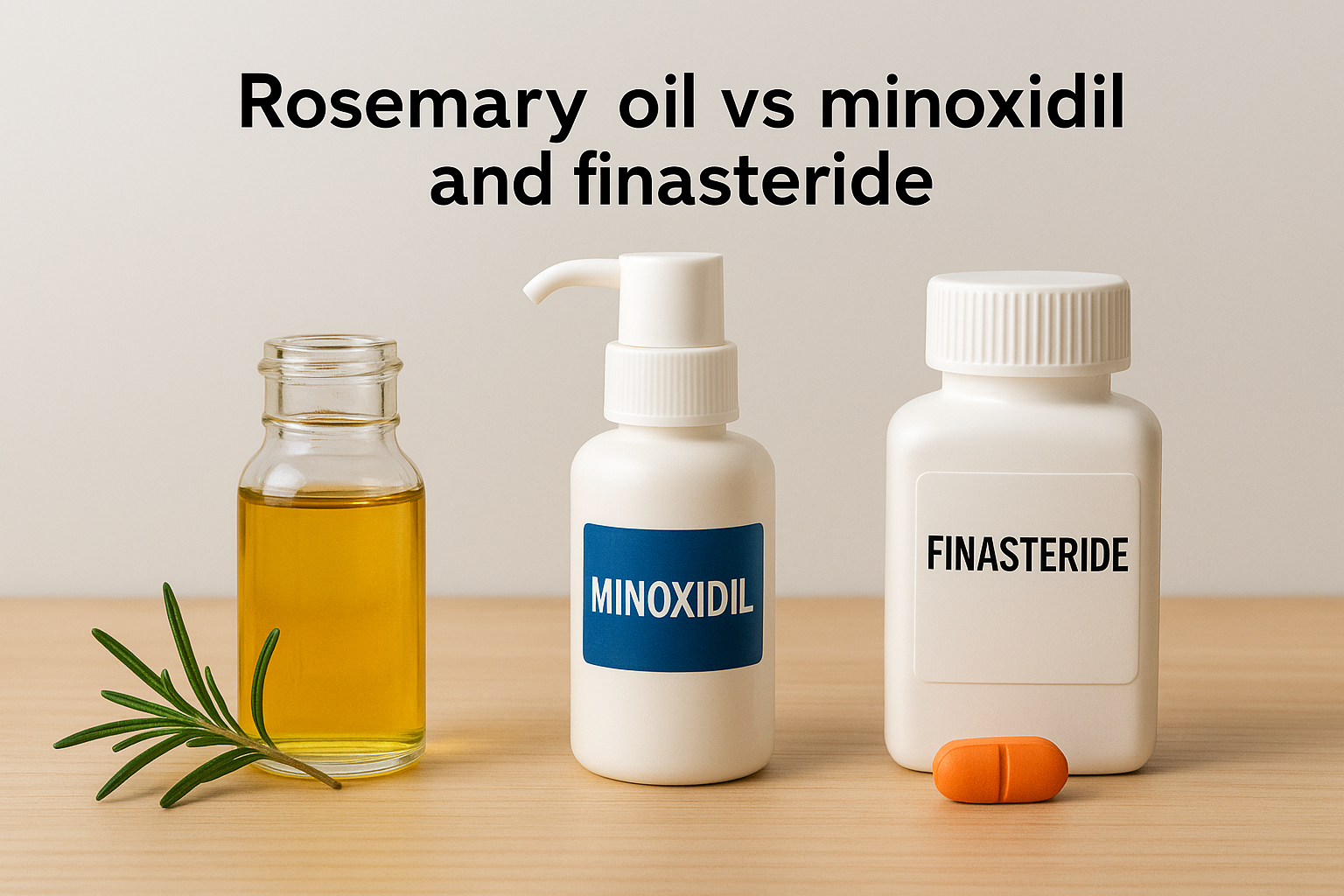
Rosemary oil vs minoxidil and finasteride
Understanding how these three treatments compare helps you make an informed choice rather than guessing based on marketing claims. Minoxidil and finasteride are the two clinically approved treatments for male pattern baldness in the UK, and both carry a clear mechanism, a proven track record, and a set of drawbacks that push many men toward natural alternatives.
How minoxidil and finasteride work
Minoxidil is a topical vasodilator applied directly to the scalp, improving blood flow to hair follicles and extending the active growth phase of the hair cycle. Finasteride is an oral tablet that blocks the 5-alpha reductase enzyme, cutting DHT production throughout the body rather than just at the scalp. Both require continuous use: stop either treatment, and the hair you gained will shed within months.
The systemic nature of finasteride is why some men report side effects including reduced libido and mood changes, which rosemary oil avoids entirely by working only at the scalp level.
Where rosemary oil fits in the comparison
Rosemary oil for hair loss men targets DHT activity at the scalp level and improves local circulation, covering similar ground to both minoxidil and finasteride without systemic involvement. The 2015 SKINmed trial demonstrated it matched 2% minoxidil for hair count increase at six months, placing it in credible clinical territory rather than the realm of unverified wellness claims.
The practical differences matter as much as the science. Rosemary oil requires no prescription, costs considerably less than branded pharmaceutical options over time, and integrates easily into a regular grooming routine. It suits men in the early stages of thinning particularly well, where slowing progression carries more weight than aggressive regrowth efforts.
How to use rosemary oil safely on the scalp
Applying rosemary oil correctly determines whether you get results or simply a fragrant scalp treatment with no real impact. Pure rosemary essential oil is far too concentrated to apply directly to skin, so you always need to dilute it in a carrier oil first. Jojoba, coconut, and castor oil all work well as carriers, with jojoba being the closest match to your scalp's natural sebum and the least likely to clog follicles.
The right dilution and application method
Mix 3 to 5 drops of rosemary essential oil per tablespoon (15ml) of carrier oil for a safe, effective concentration. Apply this blend directly to your scalp rather than your hair strands, and section your hair first so the oil reaches the skin. Massage the blend in for at least two minutes using circular motions, which stimulates blood circulation independently of the oil itself.
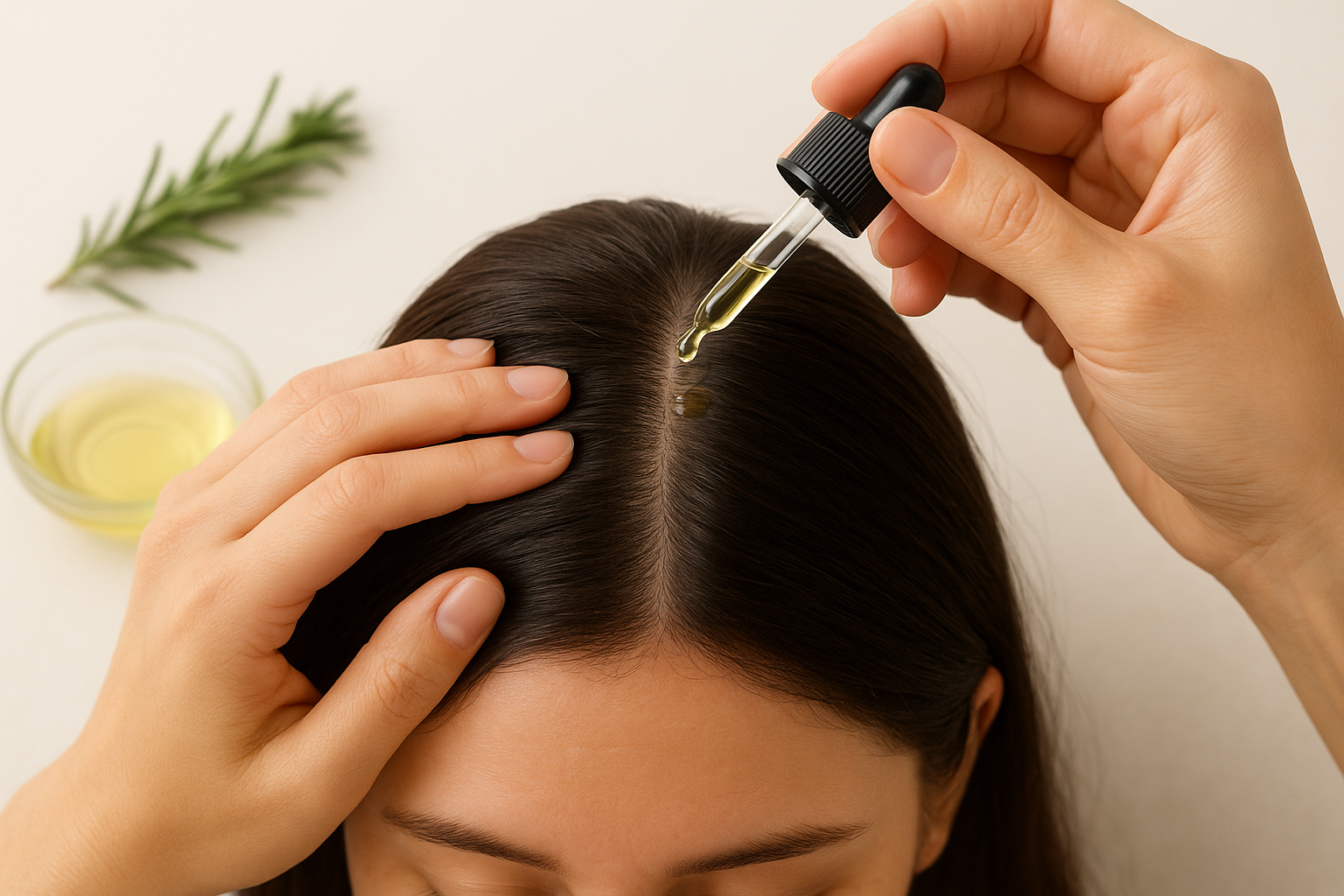
Consistency matters more than quantity: applying a well-diluted blend twice daily for at least six months gives you the kind of results the clinical trials on rosemary oil for hair loss men actually measured.
Leave the oil on your scalp for a minimum of four hours, or overnight if your routine allows. Wash it out with a gentle, sulphate-free shampoo to avoid stripping the scalp barrier. If you prefer a simpler approach, adding rosemary oil to your shampoo or conditioner at the same 3 to 5 drop ratio per use works as a practical alternative, though direct scalp application delivers more targeted contact with the follicles.
Using rosemary oil in a pre-formulated product
Products that already contain rosemary oil as a listed ingredient remove the guesswork around dilution entirely. Check that rosemary oil appears near the top of the ingredient list, which signals a meaningful concentration rather than a trace amount added for label appeal only.
Side effects, red flags, and when to see a GP
Rosemary oil is well-tolerated by most people, but that doesn't mean it's risk-free for everyone. Understanding what side effects are normal, which ones signal a problem, and when to involve a GP gives you the confidence to use it safely rather than guessing if something is wrong.
Common side effects to watch for
Mild scalp tingling is normal when you first start using rosemary oil, particularly if you massage it in vigorously. This sensation usually settles within the first week or two of regular use. What you want to avoid is persistent redness, burning, or a rash, which signals either an allergic reaction or a concentration that's too high for your scalp.
Conduct a patch test before your first full application: apply a small amount of your diluted blend to the inside of your wrist or elbow, wait 24 hours, and check for any reaction. If you notice swelling, intense itching, or hives, stop using the product entirely and avoid further contact with rosemary oil going forward.
Rosemary oil for hair loss men is generally safe when properly diluted, but skipping the patch test is the most common reason men experience avoidable reactions.
When to see a GP
Book an appointment with your GP if you notice sudden or patchy hair loss rather than the gradual thinning typical of androgenetic alopecia. Sudden shedding can indicate thyroid dysfunction, nutritional deficiencies, or alopecia areata, none of which rosemary oil will address on its own.
You should also consult a GP if your scalp reaction persists beyond 48 hours after stopping use, or if your hair loss accelerates significantly despite consistent treatment. A GP can rule out underlying health conditions and, if needed, refer you to a dermatologist for a targeted plan.
Key takeaways
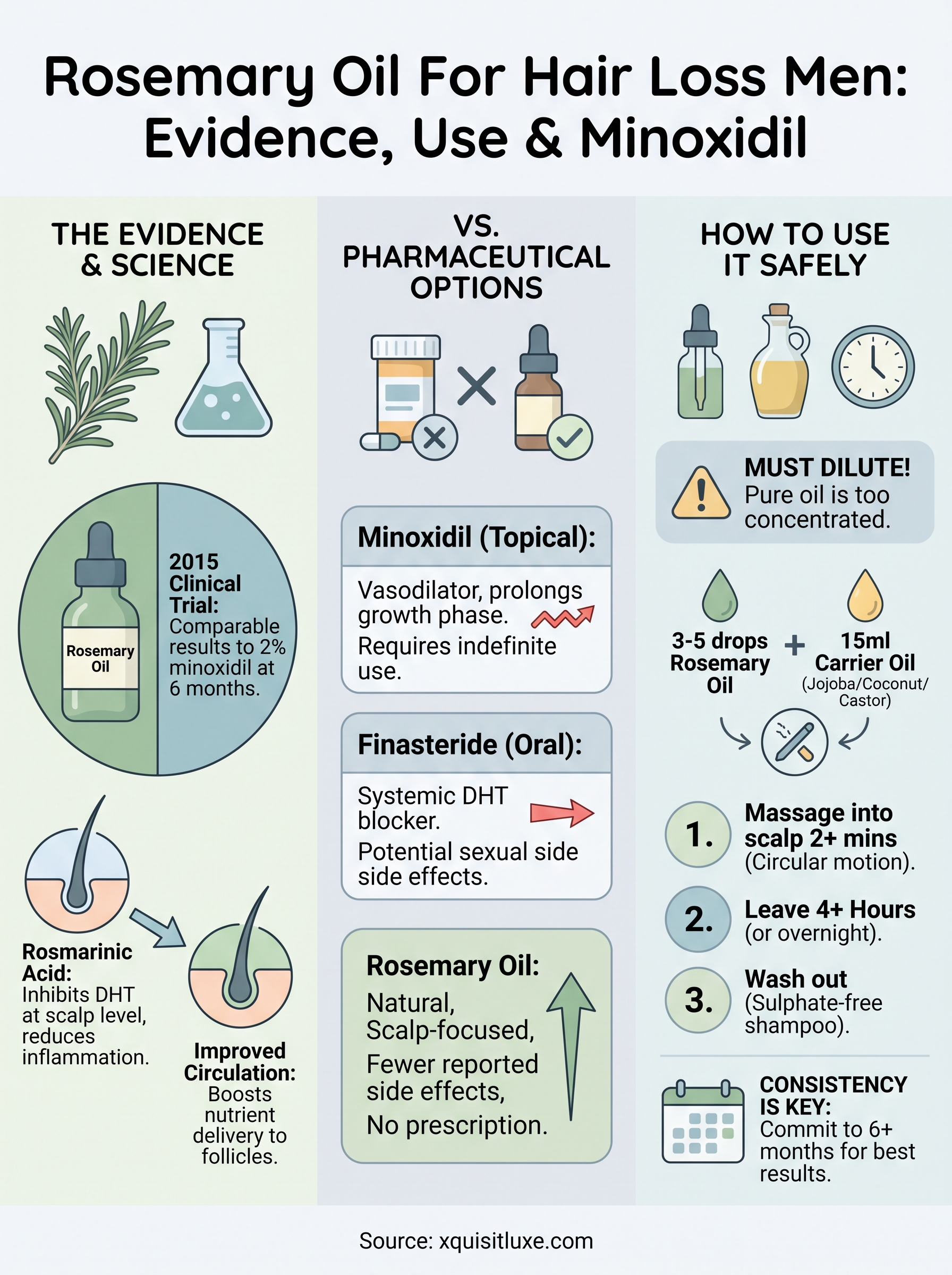
Rosemary oil for hair loss men stands up to genuine scientific scrutiny. A 2015 clinical trial matched it against 2% minoxidil over six months and found comparable hair count results, with fewer reports of scalp irritation. The active compound, rosmarinic acid, inhibits DHT at the scalp and improves blood flow to follicles, targeting two core drivers of male pattern baldness through a single natural treatment.
Results take time. Six months of consistent, twice-daily application is the minimum you should commit to before judging whether it works for you. Always dilute rosemary oil in a carrier oil, do a patch test first, and use a product with a meaningful concentration of rosemary oil listed clearly on the label.
If you want a straightforward starting point, explore the natural hair care range at Xquisit Luxe Self Care, formulated with certified natural ingredients so you know exactly what you're applying to your scalp.

