


Vous avez probablement déjà fait défiler des dizaines de produits promettant de faire repousser vos cheveux du jour au lendemain. La réalité ? La plupart d'entre eux contiennent des agents de remplissage synthétiques qui n'apportent que très peu de bénéfices à votre cuir chevelu. Ce qui fait vraiment la différence, ce sont les ingrédients naturels des huiles de croissance capillaire soutenus par la science, ceux qui nourrissent les follicules, améliorent la circulation et créent les bonnes conditions pour des cheveux plus forts et plus épais au fil du temps.
Cependant, toutes les huiles naturelles ne méritent pas une place dans votre routine. Certains ingrédients ont des recherches cliniques solides derrière eux, tandis que d'autres ne reposent que sur la tradition et un marketing astucieux. Connaître la différence vous permet d'économiser de l'argent et, plus important encore, de vous rapprocher de vrais résultats. Que vous soyez confronté à des cheveux clairsemés, à une ligne frontale en recul ou à des cassures persistantes, la bonne combinaison d'ingrédients peut faire une différence visible en quelques semaines d'utilisation constante.
Chez Xquisit Luxe, nous formulons notre gamme de soins capillaires en utilisant des ingrédients naturels certifiés, testés dermatologiquement et sans cruauté animale, ce sujet est donc au cœur de notre activité. Dans cet article, nous allons détailler huit ingrédients naturels prouvés qui devraient figurer dans votre huile de croissance capillaire, en expliquant ce que la recherche dit de chacun d'entre eux et comment les repérer dans les produits que vous envisagez d'acheter. C'est parti.
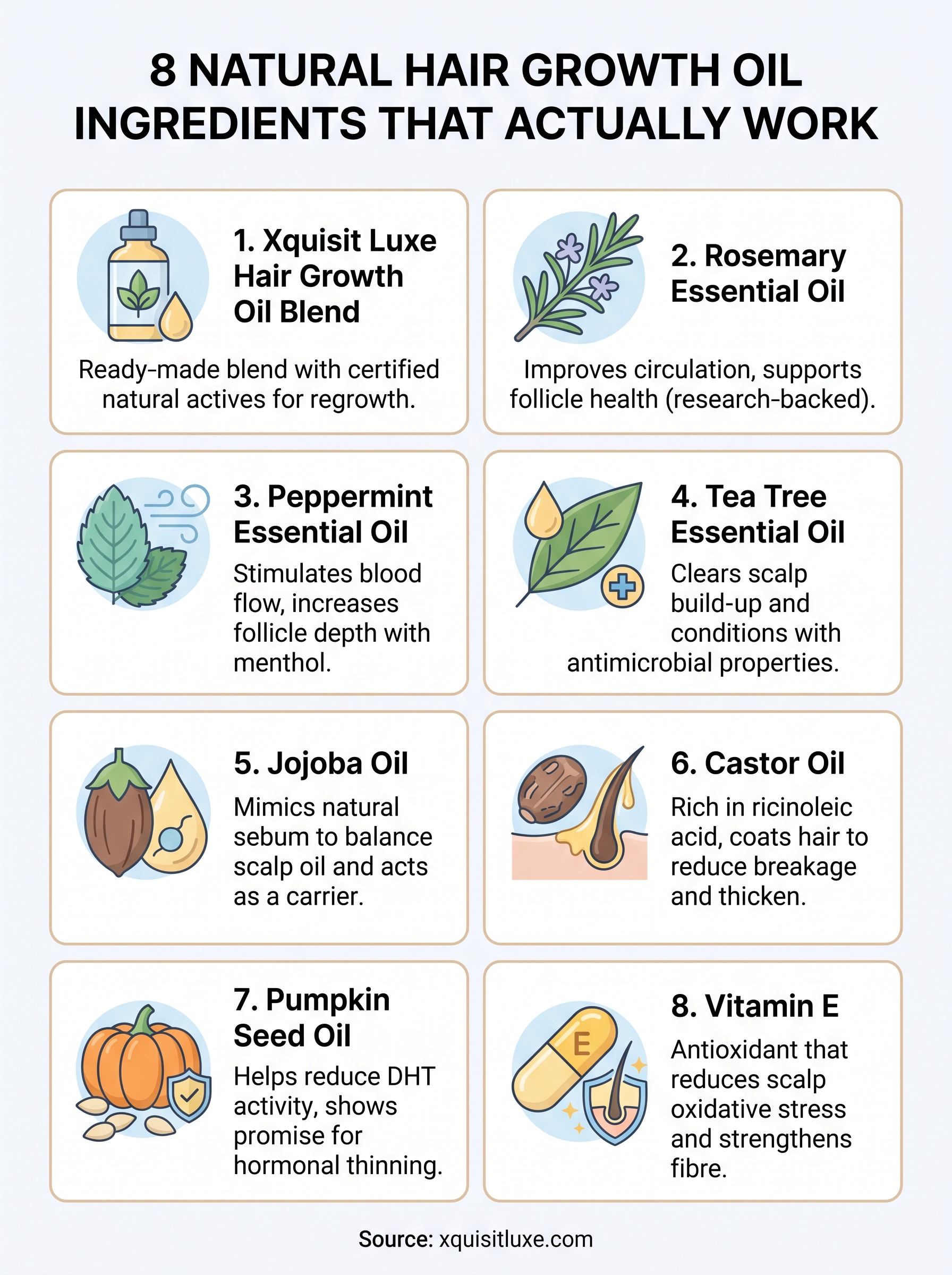
1. Mélange d'huiles pour la croissance capillaire Xquisit Luxe
Avant d'entrer dans les détails des ingrédients individuels des huiles naturelles pour la croissance capillaire, il est bon de savoir qu'un mélange prêt à l'emploi bien formulé combine déjà plusieurs de ces éléments dans des proportions soigneusement calibrées, ce qui vous évite d'avoir à faire vos propres mélanges. L'huile de croissance capillaire Xquisit Luxe réunit des actifs naturels certifiés qui agissent en combinaison pour nourrir le cuir chevelu, renforcer les fibres capillaires et favoriser une repousse visible avec une utilisation constante.
Ce qu'elle contient et pourquoi elle favorise la croissance
Le mélange s'appuie sur des huiles et extraits d'origine botanique choisis pour leur effet démontré sur le cuir chevelu et le follicule pileux. Les principaux actifs ciblent la circulation à la surface du cuir chevelu, ce qui est l'une des conditions les plus importantes pour une fonction folliculaire saine. Plutôt que de s'appuyer sur un ingrédient unique, la formule superpose plusieurs actifs de sorte que chacun renforce le suivant.
Une approche multi-ingrédients surpasse constamment les applications à ingrédient unique car le cuir chevelu et le follicule répondent à plusieurs signaux biologiques à la fois, et non à un seul.
Chaque composant de la formule est certifié naturel et sans cruauté animale, sans agents de remplissage synthétiques qui diluent l'effet des composants actifs. Le résultat est une huile légère qui absorbe proprement sans laisser de résidu lourd sur votre cuir chevelu ou vos mèches.
Comment utiliser un mélange prêt à l'emploi pour de meilleurs résultats
Appliquez trois à cinq gouttes directement sur votre cuir chevelu deux à trois fois par semaine. Faites pénétrer l'huile du bout des doigts par petits mouvements circulaires pendant environ deux minutes, ce qui aide les actifs à pénétrer vers le follicule tout en stimulant la circulation sanguine à la surface. Laissez agir pendant au moins 30 minutes ou toute la nuit avant de rincer.
La régularité est bien plus importante que la fréquence. L'utilisation de l'huile régulièrement pendant huit à douze semaines produit des résultats nettement meilleurs que de l'appliquer tous les jours pendant quinze jours puis d'arrêter. Votre cuir chevelu a besoin d'une exposition soutenue aux ingrédients actifs pour réagir.
À qui convient le mieux un mélange prêt à l'emploi
Un mélange prêt à l'emploi convient à toute personne qui souhaite des ingrédients naturels éprouvés sans le temps, le coût et la complexité de l'approvisionnement et du mélange d'huiles individuelles à la maison. C'est également un excellent choix pour les personnes ayant un cuir chevelu sensible ou réactif, car chaque ingrédient a déjà été testé dermatologiquement plutôt que d'être auto-sélectionné à partir d'une source non vérifiée.
Si vous voyagez souvent ou avez une routine chargée, une huile pré-formulée vous évite de devoir transporter plusieurs flacons. Elle constitue également un point de départ fiable si vous débutez avec les huiles capillaires et ne savez pas quel ingrédient unique privilégier en premier.
2. Huile essentielle de Romarin
Parmi tous les ingrédients naturels d'huiles de croissance capillaire soutenus par la recherche clinique, l'huile essentielle de romarin se distingue. Une étude de 2015 a révélé qu'elle produisait des résultats comparables à ceux du minoxidil après six mois pour l'alopécie androgénétique, ce qui la place fermement dans le haut du classement des actifs naturels étayés par des preuves.
Comment le romarin favorise la croissance et la santé du cuir chevelu
Le romarin agit en améliorant la circulation sanguine du cuir chevelu, ce qui apporte plus d'oxygène et de nutriments aux follicules dormants ou affaiblis. Il possède également des propriétés anti-inflammatoires et antimicrobiennes qui aident à maintenir le cuir chevelu propre et calme, une condition clé pour une croissance capillaire sans entrave.
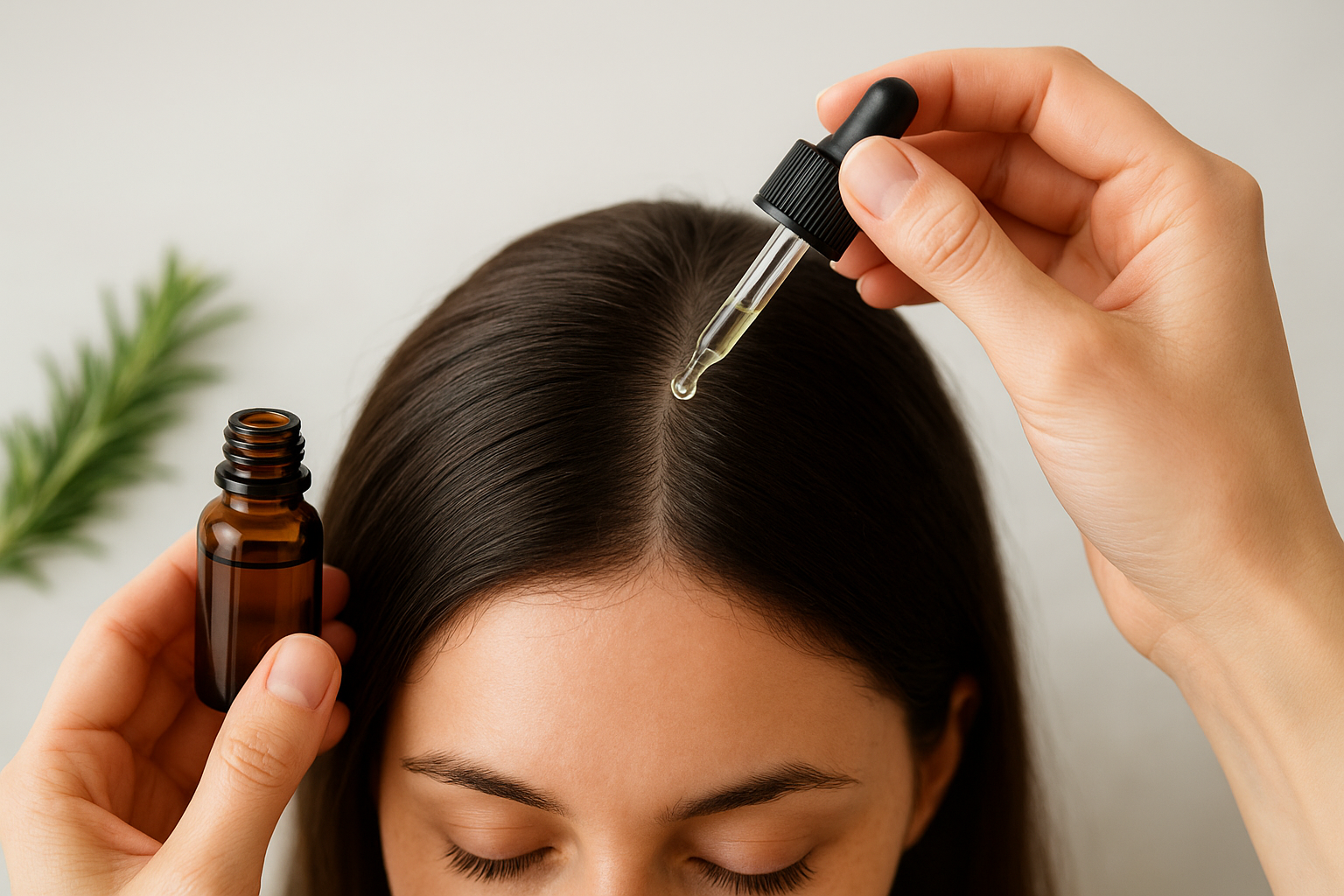
La recherche suggère que l'acide rosmarinique, le composé actif du romarin, inhibe la liaison de la DHT au follicule, ce qui le rend particulièrement utile pour l'éclaircissement d'origine hormonale.
Comment le diluer et l'utiliser dans une huile capillaire
N'appliquez jamais l'huile essentielle de romarin directement sur votre cuir chevelu sans l'avoir diluée au préalable. Mélangez deux à trois gouttes par cuillère à soupe d'une huile porteuse telle que l'huile de jojoba ou de ricin avant d'appliquer. Massez le mélange sur votre cuir chevelu deux à trois fois par semaine, en vous concentrant sur les zones où l'éclaircissement est le plus visible.
Précautions d'emploi et personnes à éviter
Cette huile est généralement bien tolérée lorsqu'elle est correctement diluée. Cependant, si vous êtes enceinte ou si vous allaitez, consultez un professionnel de la santé avant de l'utiliser. Les personnes souffrant d'épilepsie ou d'hypertension artérielle devraient également demander un avis médical, car le romarin peut interagir avec certaines conditions. Toujours tester un mélange dilué sur votre avant-bras avant de l'appliquer sur votre cuir chevelu.
3. Huile Essentielle de Menthe Poivrée
L'huile essentielle de menthe poivrée gagne sa place parmi les ingrédients naturels d'huiles de croissance capillaire les plus étudiés grâce à son effet mesurable sur l'activité folliculaire. Une étude de 2014 comparant l'huile de menthe poivrée au minoxidil, à l'huile de jojoba et à une solution saline a révélé que le groupe menthe poivrée montrait la plus forte augmentation du nombre et de la profondeur des follicules, ce qui en fait une option solide pour toute personne confrontée à un amincissement visible.
Comment la menthe poivrée peut favoriser la circulation et la croissance
Le composé actif de l'huile de menthe poivrée est le menthol, qui crée un léger effet vasodilatateur lorsqu'il est appliqué sur le cuir chevelu. Cet élargissement des vaisseaux sanguins augmente le flux sanguin vers le follicule, apportant plus d'oxygène et de nutriments directement à la zone de croissance. La sensation de fraîcheur que vous ressentez n'est pas seulement superficielle; elle signale que l'huile agit à la surface du cuir chevelu.
Des études suggèrent que l'huile de menthe poivrée pourrait rivaliser avec les options pharmaceutiques pour stimuler la profondeur et la densité des follicules lorsqu'elle est utilisée de manière constante pendant quatre semaines.
Comment la diluer et l'associer à des huiles végétales
La menthe poivrée est une huile essentielle très concentrée, il faut donc toujours la diluer avant de l'appliquer sur le cuir chevelu. Ajoutez deux gouttes par cuillère à soupe d'une huile végétale légère comme le jojoba, puis massez votre cuir chevelu deux à trois fois par semaine. L'association de menthe poivrée et d'huile de romarin dans la même base porteuse augmente l'effet circulatoire et rend les deux actifs plus efficaces ensemble.
Notes de sécurité et personnes à éviter
Évitez d'appliquer de l'huile de menthe poivrée près des enfants de moins de deux ans ou autour des yeux et du visage. Si vous avez un cuir chevelu réactif ou sensible, réduisez à une goutte par cuillère à soupe et testez toujours sur votre avant-bras avant une application complète.
4. Huile Essentielle d'Arbre à Thé
L'huile essentielle d'arbre à thé gagne sa place parmi les ingrédients naturels efficaces pour la croissance capillaire non pas en stimulant directement les follicules, mais en éliminant les problèmes du cuir chevelu qui bloquent la croissance en premier lieu. Un cuir chevelu obstrué, enflammé ou affecté par des champignons empêche les cheveux de pousser à leur rythme naturel, et l'arbre à thé s'attaque de front à chacun de ces problèmes.
Comment l'arbre à thé favorise un cuir chevelu plus propre et plus calme
Le principal avantage de l'arbre à thé réside dans ses propriétés antimicrobiennes et antifongiques, qui ciblent l'accumulation de champignons, de bactéries et d'excès de sébum qui se déposent à la surface du cuir chevelu. Lorsque votre cuir chevelu est congestionné ou irrité, les follicules ont du mal à fonctionner correctement et la croissance des cheveux ralentit en conséquence.
Une surface du cuir chevelu plus calme et plus propre est l'un des facteurs les plus souvent négligés pour soutenir une croissance capillaire constante, et l'huile d'arbre à thé y répond plus directement que la plupart des actifs naturels.
Une utilisation régulière réduit cette congestion et cette inflammation de surface, créant un environnement où les follicules peuvent fonctionner sans obstruction.
Comment l'utiliser pour les cuirs chevelus sujets aux pellicules
Mélangez deux gouttes d'huile d'arbre à thé par cuillère à soupe d'un support tel que l'huile de jojoba ou de noix de coco avant de l'appliquer sur votre cuir chevelu. Les étapes clés pour les cuirs chevelus sujets aux pellicules sont les suivantes :
- Massez le mélange dilué sur votre cuir chevelu avant le lavage
- Laissez agir pendant 15 à 20 minutes avant de shampouiner
- Répétez deux à trois fois par semaine pour des résultats constants
Précautions d'emploi et personnes à éviter
L'huile d'arbre à thé peut provoquer des irritations ou des réactions allergiques chez certaines personnes, en particulier celles ayant une peau sensible ou réactive. Testez toujours un mélange dilué sur votre avant-bras avant de l'appliquer sur votre cuir chevelu, et gardez l'huile loin de vos yeux et de votre bouche à tout moment. N'appliquez jamais d'huile d'arbre à thé non diluée directement sur votre cuir chevelu.
5. Huile de Jojoba
L'huile de jojoba est unique parmi les ingrédients naturels pour la croissance des cheveux car ce n'est pas techniquement une huile. C'est une cire liquide qui imite le sébum naturel de votre cuir chevelu plus fidèlement que tout autre ingrédient végétal. Cette similitude structurelle est ce qui la rend si efficace à la fois comme huile de support et comme traitement autonome pour le cuir chevelu.
Pourquoi le jojoba fonctionne comme une huile porteuse respectueuse du cuir chevelu
Le jojoba pénètre le follicule pileux sans le bloquer, ce qui en fait l'une des rares huiles porteuses qui soutient véritablement la santé du follicule plutôt que de simplement recouvrir la surface. Sa structure moléculaire lui permet de dissoudre l'excès de sébum et d'éliminer l'accumulation autour de l'ouverture du follicule, ce qui maintient le chemin de croissance dégagé.
Parce que le jojoba ressemble beaucoup au sébum, votre cuir chevelu le reconnaît et ajuste sa propre production d'huile en conséquence, ce qui en fait l'une des huiles porteuses les plus polyvalentes disponibles.
Comment l'utiliser pour équilibrer les cuirs chevelus secs ou gras
Appliquez trois à cinq gouttes d'huile de jojoba directement sur votre cuir chevelu deux à trois fois par semaine. Pour les cuirs chevelus secs, utilisez-la seule. Pour les cuirs chevelus gras, mélangez-la avec une à deux gouttes de romarin ou de menthe poivrée pour ajouter un composant actif pendant que le jojoba régule la production de sébum en surface.
À qui le jojoba convient le mieux
Le jojoba convient à presque tous les types de cuir chevelu, mais il est particulièrement précieux si vous avez la peau sensible ou réagissez facilement aux huiles plus épaisses comme le ricin ou la noix de coco. Il absorbe rapidement, ne laisse aucun résidu gras et fonctionne bien comme base dans n'importe quel mélange personnalisé.
6. Huile de Ricin
L'huile de ricin est l'un des ingrédients naturels d'huiles de croissance capillaire les plus reconnus pour une raison simple : elle donne des résultats visibles. Sa forte teneur en acide ricinoléique la distingue de la plupart des autres huiles végétales, lui conférant une combinaison unique de propriétés qui soutiennent à la fois le cuir chevelu et la fibre capillaire elle-même.
Ce que l'huile de ricin fait de bien pour l'épaisseur et la casse
L'acide ricinoléique représente environ 90 % du profil d'acides gras de l'huile de ricin, et il agit en améliorant la circulation sanguine vers le cuir chevelu tout en formant un revêtement protecteur autour de la tige capillaire qui réduit la perte d'humidité et la casse. Avec une utilisation constante, cette combinaison produit des cheveux plus épais et plus résistants.
Des études suggèrent que les propriétés anti-inflammatoires de l'acide ricinoléique pourraient aider à réduire les affections du cuir chevelu qui ralentissent l'activité des follicules, ajoutant une autre couche de bénéfices au-delà du simple conditionnement de surface.
Comment l'utiliser sans accumulation
L'huile de ricin est épaisse et lourde, donc en appliquer trop à la fois entraîne une accumulation difficile à rincer. Suivez ces étapes pour garder votre cuir chevelu propre :
- Mélangez une part d'huile de ricin avec deux parts de jojoba ou d'huile d'argan pour diluer la consistance
- Appliquez le mélange sur votre cuir chevelu une fois par semaine, pas plus
- Rincez abondamment avec un shampoing doux après 30 à 60 minutes
Qui devrait l'utiliser avec prudence
Les personnes ayant des cheveux fins ou à faible porosité devraient utiliser l'huile de ricin avec parcimonie, car sa densité peut alourdir les mèches et les faire paraître plates plutôt que plus volumineuses. Commencez par une très petite quantité mélangée à un support plus léger et n'augmentez que si votre cuir chevelu la tolère bien.
7. Huile de graines de citrouille
L'huile de graines de citrouille est l'un des ingrédients naturels d'huiles de croissance capillaire les plus récemment étudiés, mais les premières recherches sont réellement prometteuses. Une étude de 2014 publiée dans Evidence-Based Complementary and Alternative Medicine a révélé que les hommes utilisant de l'huile de graines de citrouille ont connu une augmentation de 40 % du nombre de cheveux après 24 semaines, contre seulement 10 % dans le groupe placebo.
Pourquoi l'huile de graines de citrouille est prometteuse pour la perte de cheveux
Riche en phytostérols et en zinc, l'huile de graines de citrouille est liée à une activité réduite de la DHT au niveau du follicule. La DHT est l'hormone la plus responsable de la miniaturisation des follicules dans la chute de cheveux de type androgénétique, donc l'inhiber au niveau du cuir chevelu peut ralentir l'éclaircissement et soutenir la repousse avec une utilisation constante.
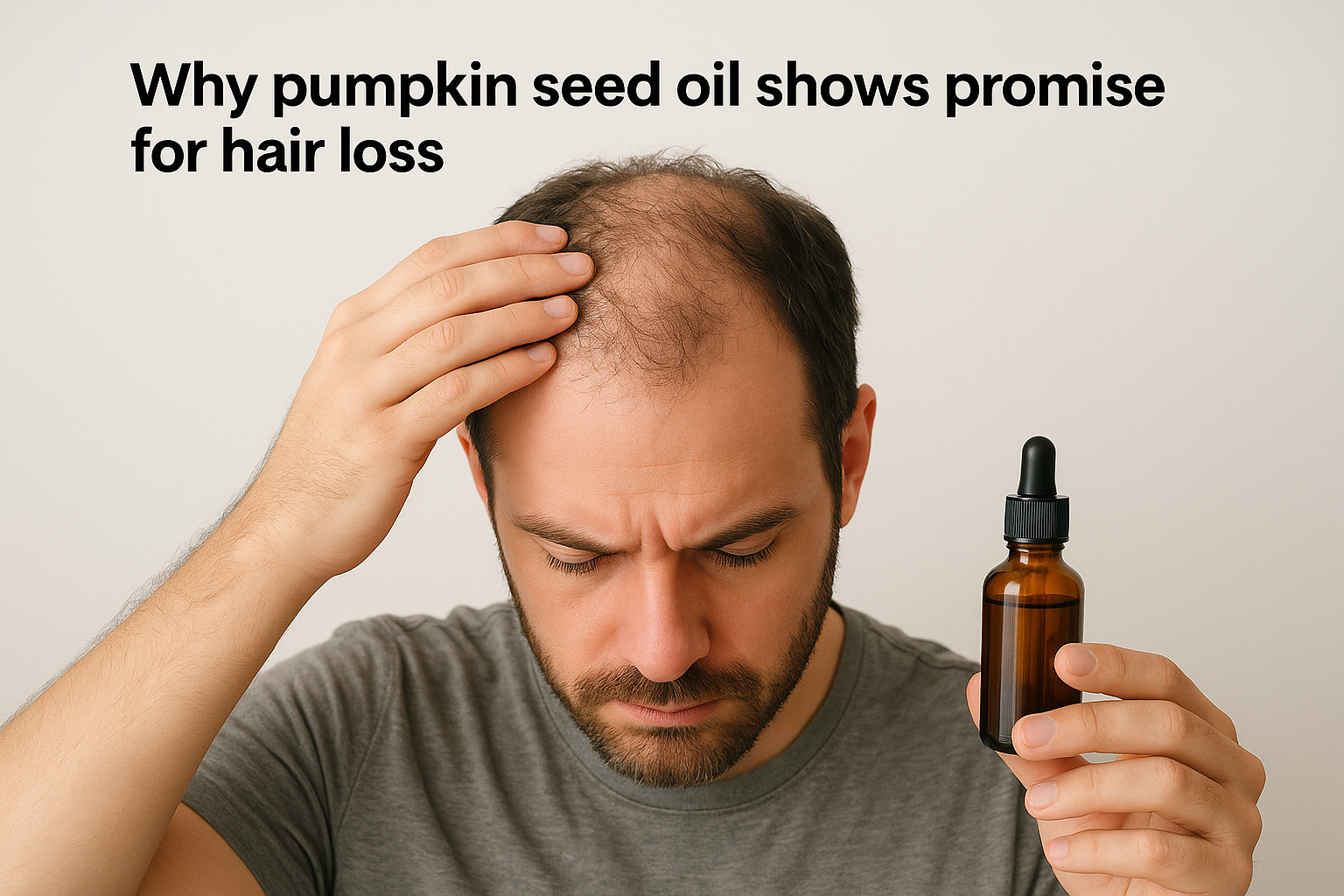
Les premières preuves cliniques suggèrent que l'huile de graines de citrouille pourrait agir par une voie similaire à certains traitements pharmaceutiques contre la chute des cheveux, mais sans les effets secondaires associés.
Comment l'ajouter aux mélanges sans qu'elle ne graisse
Sa texture plus légère que l'huile de ricin facilite son incorporation dans les mélanges existants sans alourdir vos cheveux. Mélangez une part d'huile de graines de citrouille avec deux parts de jojoba comme base, puis ajoutez vos huiles essentielles préférées par-dessus. Ce rapport maintient le mélange suffisamment fluide pour s'étaler uniformément sur votre cuir chevelu sans laisser de résidus lourds.
Qui pourrait en bénéficier le plus
Cet ingrédient convient aux personnes souffrant d'un amincissement d'origine hormonale ou d'une perte de cheveux de type androgénétique spécifiquement. Si votre perte de cheveux suit un schéma prévisible plutôt que d'être diffuse ou liée au stress, l'huile de graines de citrouille vaut la peine d'être ajoutée à votre routine.
8. Vitamine E
La vitamine E est l'un des ingrédients naturels d'huiles de croissance capillaire les plus polyvalents que vous puissiez ajouter à votre routine. Elle agit comme un antioxydant liposoluble, neutralisant les radicaux libres qui endommagent les tissus du cuir chevelu et affaiblissent les cellules folliculaires au fil du temps.
Comment la vitamine E soutient le cuir chevelu et la fibre capillaire
La vitamine E agit en réduisant le stress oxydatif sur le cuir chevelu, que la recherche relie directement à une perte de cheveux accélérée. Une étude a révélé que les participants utilisant de la vitamine E connaissaient une augmentation de 34,5 % du nombre de cheveux sur huit mois par rapport à un groupe placebo.
L'activité antioxydante de la vitamine E protège la couche lipidique du cuir chevelu, la rendant résiliente et mieux à même de soutenir la fonction folliculaire active.
Au-delà du cuir chevelu, la vitamine E renforce également la fibre capillaire elle-même, formant une couche protectrice autour de la cuticule qui réduit la casse et ajoute une brillance notable à chaque mèche.
Comment ajouter de la vitamine E à un mélange sans irritation
Ajoutez deux à trois gouttes de tocophérol par cuillère à soupe d'un support léger tel que l'huile de jojoba. L'appliquer une ou deux fois par semaine prévient l'accumulation tout en offrant une protection antioxydante constante au cuir chevelu sans laisser de résidus lourds.
Qui devrait l'éviter et conseils de test cutané
Les personnes ayant un cuir chevelu gras ou à tendance acnéique devraient utiliser la vitamine E avec parcimonie, car elle peut obstruer les follicules à des concentrations plus élevées. Suivez ces étapes de test cutané avant une application complète :
- Appliquez un mélange dilué sur votre avant-bras
- Laissez agir pendant 24 heures sans laver
- Vérifiez l'absence de rougeurs ou de démangeaisons avant de l'appliquer sur votre cuir chevelu
Vos prochaines étapes
Vous avez maintenant une idée claire des ingrédients d'huiles naturelles pour la croissance des cheveux qui ont de véritables preuves scientifiques et comment chacun d'eux agit différemment pour soutenir votre cuir chevelu et vos follicules. Le principal enseignement est qu'aucun ingrédient unique ne fait tout, c'est pourquoi la combinaison des bons actifs dans les bonnes proportions donne toujours de meilleurs résultats que la rotation entre des traitements à ingrédient unique.
Choisissez deux ou trois ingrédients de cette liste qui correspondent à votre préoccupation spécifique, qu'il s'agisse de l'éclaircissement, de la casse ou de l'accumulation sur le cuir chevelu, et engagez-vous à les utiliser pendant au moins huit semaines avant de juger les résultats. La constance est le facteur le plus important qui sépare les personnes qui voient des progrès de celles qui abandonnent trop tôt.
Si vous souhaitez une option prête à l'emploi, testée par des dermatologues, qui combine plusieurs de ces actifs prouvés sans les essais et erreurs du mélange de vos propres produits, jetez un coup d'œil à la gamme de soins capillaires Xquisit Luxe et trouvez le mélange qui correspond à votre routine.
