


Si vous recherchez une solution naturelle pour les cheveux clairsemés, la croissance lente ou un cuir chevelu sec, vous êtes probablement tombé sur l'huile de romarin pure pour les cheveux. Et pour cause, cette huile essentielle a des siècles d'utilisation traditionnelle derrière elle, ainsi qu'un corpus croissant de recherches cliniques qui confirment ce que les herboristes ont longtemps affirmé.
L'huile de romarin agit en stimulant la circulation sanguine vers les follicules pileux, ce qui peut favoriser une croissance plus forte et plus épaisse au fil du temps. Certaines études ont même comparé son efficacité au minoxidil, un traitement pharmaceutique courant contre la chute des cheveux, avec des résultats prometteurs et moins d'effets secondaires. Mais toutes les huiles de romarin ne sont pas égales. La pureté, l'approvisionnement et la formulation sont des éléments importants pour obtenir de vrais résultats.
Chez Xquisit Luxe Self Care, nous prenons au sérieux la vitalité des cheveux. Notre gamme de soins capillaires certifiée naturelle et sans cruauté animale est fabriquée ici même au Royaume-Uni, et l'huile de romarin occupe une place prépondérante dans notre approche de la santé du cuir chevelu et de la repousse des cheveux. Chaque produit que nous créons est testé par des dermatologues et formulé avec des ingrédients auxquels vous pouvez réellement faire confiance.
Ce guide couvre tout ce que vous devez savoir : ce qu'est réellement l'huile de romarin pure, comment elle agit sur vos cheveux, les preuves scientifiques qui la soutiennent et exactement comment l'appliquer pour obtenir les meilleurs résultats. Que vous soyez confronté à des cheveux clairsemés ou que vous souhaitiez simplement améliorer la santé globale de vos cheveux, vous repartirez avec un plan clair et pratique.
Ce qu'est l'huile de romarin pure et ce que « pure » signifie
L'huile de romarin est une huile essentielle extraite des feuilles et des sommités fleuries du Rosmarinus officinalis, une herbe ligneuse originaire de la Méditerranée. L'huile est produite par distillation à la vapeur, un processus où la vapeur traverse le matériel végétal et entraîne les composés volatils avec elle, qui sont ensuite condensés en un liquide concentré. Le résultat est une huile puissante et aromatique qui contient les composés actifs responsables des effets bien documentés du romarin sur la santé des cheveux et du cuir chevelu.
Ce que l'huile essentielle de romarin contient réellement
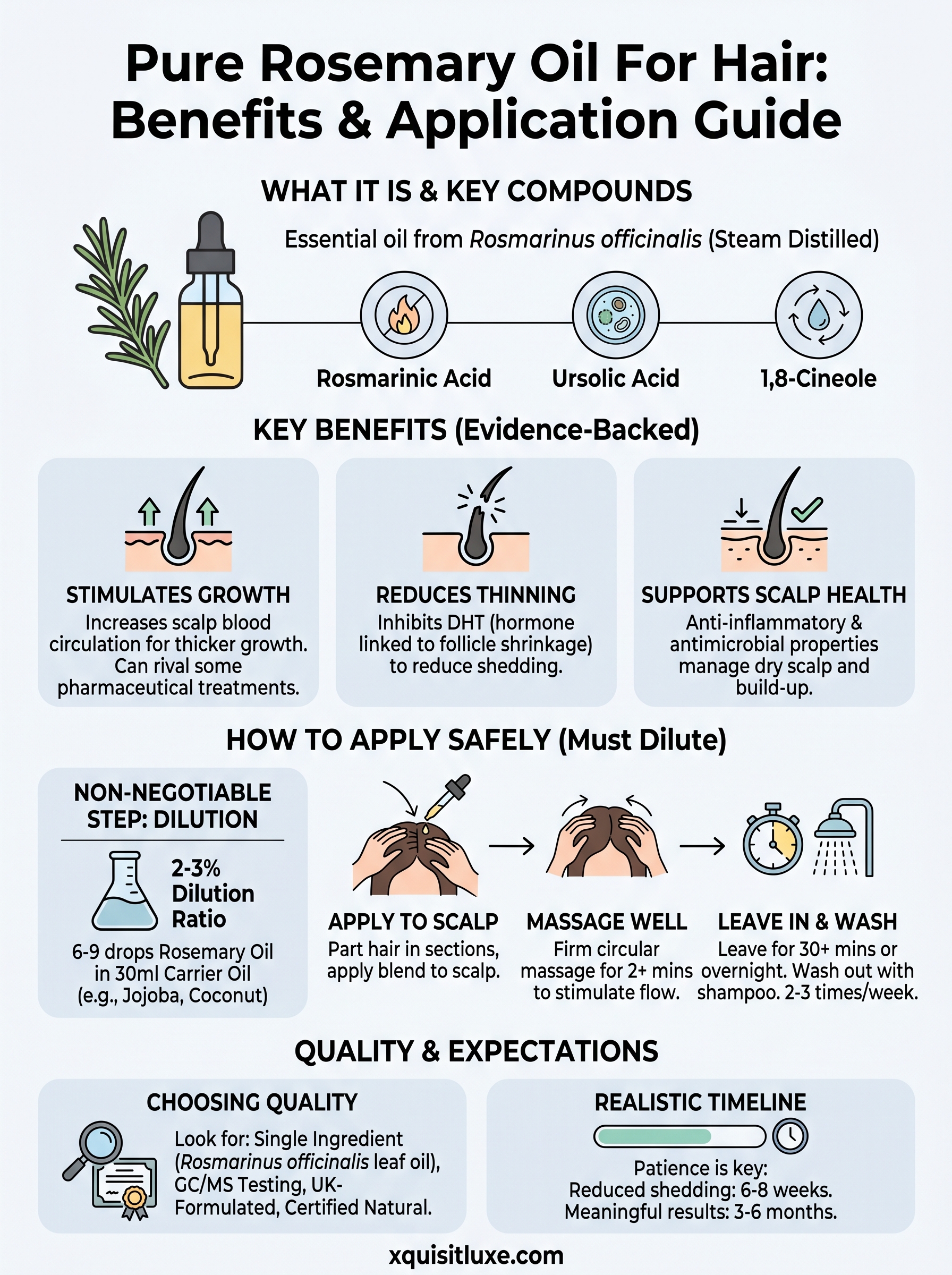
La raison pour laquelle l'huile de romarin pure pour les cheveux attire tant l'attention des chercheurs et des dermatologues tient à sa composition chimique. Les principaux composés actifs comprennent l'acide rosmarinique, l'acide ursolique et le 1,8-cinéole. Ceux-ci agissent ensemble pour améliorer la circulation sanguine au niveau du cuir chevelu, réduire l'inflammation et inhiber l'enzyme DHT (dihydrotestostérone), qui est l'un des principaux moteurs de la perte de cheveux androgénétique chez les hommes et les femmes. Lorsque vous appliquez une huile véritablement pure, vous obtenez la pleine concentration de ces composés sans rien qui dilue leur effet.
Les composés actifs du romarin ont été étudiés pour leur capacité à rivaliser avec les traitements pharmaceutiques contre la chute des cheveux, ce qui fait de la pureté un facteur essentiel pour que l'huile agisse réellement sur vous.
Ce que "pur" signifie réellement sur une étiquette
L'étiquetage dans l'industrie de la beauté et du bien-être utilise le mot "pur" de manière assez lâche. Une huile essentielle de romarin véritablement pure ne contient rien d'autre que l'huile elle-même, extraite de la plante sans aucun support ajouté, parfum synthétique, conservateur ou agent de dilution. Ce que vous recherchez est une bouteille qui ne contient qu'un seul ingrédient : l'huile de feuille de Rosmarinus officinalis, ou l'huile essentielle de romarin distillée à la vapeur.
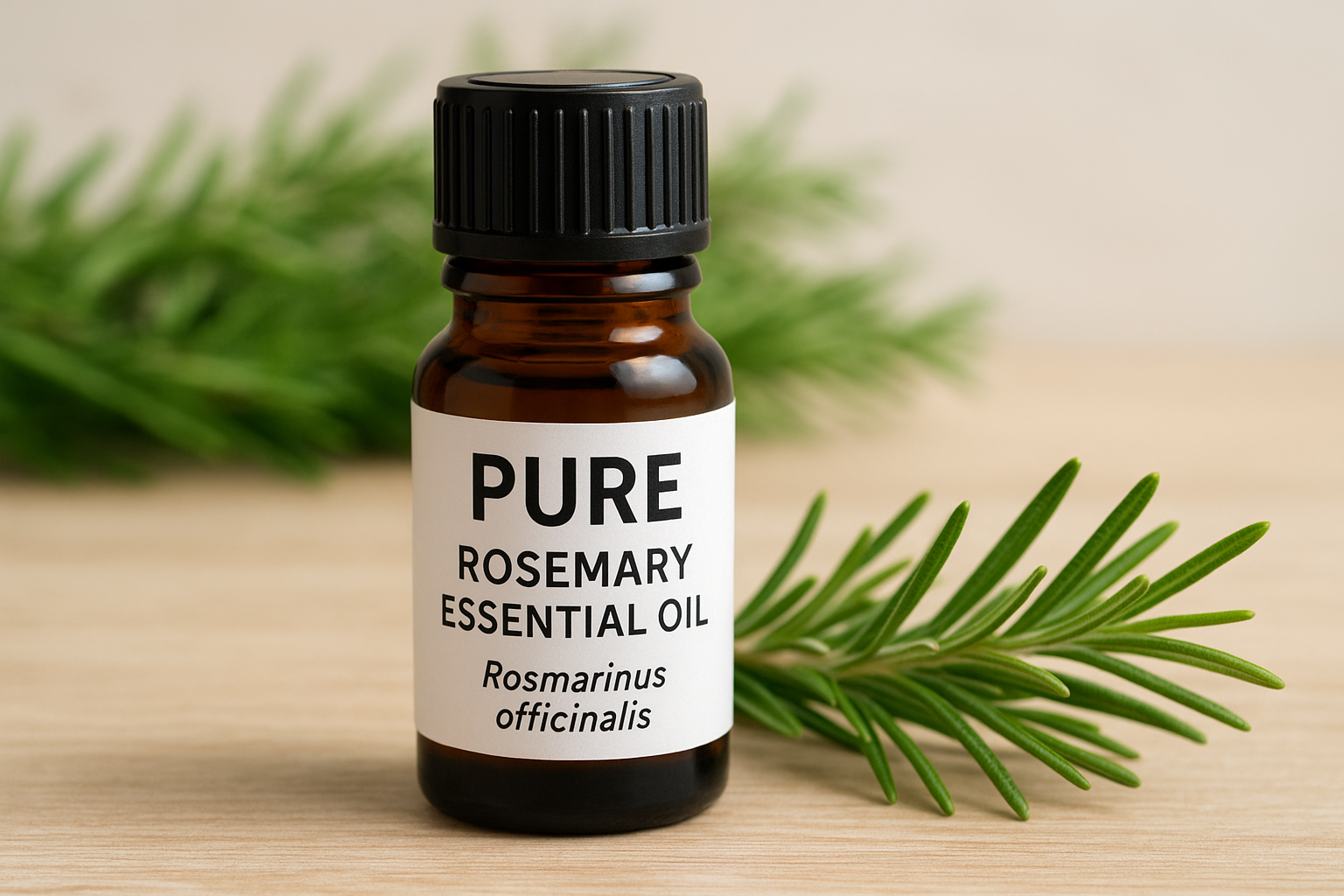
Certains produits étiquetés « purs » ou « naturels » sont en fait prémélangés avec une huile porteuse telle que le jojoba ou l'huile de coco fractionnée. Ce n'est pas nécessairement un problème, car l'huile essentielle de romarin doit de toute façon être diluée avant d'être appliquée sur le cuir chevelu. Cependant, un mélange prédilué est un produit différent d'une huile essentielle pure à 100 % non diluée, et les deux ne sont pas interchangeables lorsqu'il s'agit de calculer le taux de dilution correct pour une utilisation sûre.
Comment repérer l'huile de romarin frelatée
L'adultération est plus courante sur le marché des huiles essentielles que la plupart des gens ne le réalisent. Les fournisseurs ajoutent parfois des composés synthétiques ou des huiles moins chères pour augmenter le volume et réduire les coûts. Le test CPG/SM (chromatographie en phase gazeuse-spectrométrie de masse) est la méthode de référence pour vérifier la pureté de l'huile, et les marques réputées vous fourniront ces résultats sur demande ou les publieront directement sur leur site Web.
Il est également utile de prêter attention au prix. Une huile essentielle de romarin véritablement pure nécessite une quantité importante de matière végétale pour être produite, donc un prix inhabituellement bas est souvent un signal d'alarme. Recherchez les marques qui sont transparentes sur leurs méthodes d'approvisionnement et d'extraction, et traitez avec prudence tout produit qui manque de ces informations.
Pourquoi les gens utilisent l'huile de romarin pure pour les cheveux
Les gens se tournent vers l'huile de romarin pure pour les cheveux pour diverses raisons, mais les plus courantes sont l'amincissement des cheveux, la croissance lente et les affections du cuir chevelu qui perturbent le cycle capillaire. Contrairement à de nombreux traitements capillaires commerciaux qui contiennent une longue liste d'ingrédients synthétiques, l'huile de romarin offre un composé naturel unique et bien étudié qui cible les causes profondes d'une mauvaise santé capillaire plutôt que de masquer les symptômes.
Stimuler la croissance des cheveux et réduire l'amincissement
La raison la plus souvent citée pour laquelle les gens utilisent l'huile de romarin est de lutter contre la perte et l'amincissement des cheveux, en particulier l'alopécie androgénétique, qui est la perte de cheveux en plaques qui affecte les hommes et les femmes. Un essai clinique de 2015 publié dans la revue SKINmed a comparé directement l'huile de romarin au minoxidil à 2 % sur une période de six mois. Les deux groupes ont montré une augmentation statistiquement similaire du nombre de cheveux, mais le groupe utilisant l'huile de romarin a signalé beaucoup moins de démangeaisons du cuir chevelu, suggérant un meilleur profil de tolérabilité.
La capacité de l'huile de romarin à inhiber la DHT, l'hormone liée au rétrécissement des follicules, la rend particulièrement pertinente pour toute personne souffrant d'amincissement des cheveux lié à un motif.
L'huile favorise la circulation sanguine vers le cuir chevelu, ce qui apporte plus d'oxygène et de nutriments aux follicules pileux. Des follicules plus forts et mieux nourris produisent des mèches plus épaisses et sont moins susceptibles d'entrer prématurément dans une phase de repos. C'est pourquoi de nombreuses personnes qui l'utilisent régulièrement signalent non seulement moins de perte, mais des cheveux visiblement plus denses et plus sains au fil du temps.
Soutenir la santé du cuir chevelu et réduire l'inflammation
Votre cuir chevelu est une peau, et il réagit aux mêmes types d'irritants et de déséquilibres qui affectent la peau ailleurs sur votre corps. L'huile de romarin contient de l'acide rosmarinique, un composé aux propriétés anti-inflammatoires et antimicrobiennes bien documentées. Ces qualités la rendent utile pour gérer les pellicules, un cuir chevelu sec ou squameux, et l'irritation qui accompagne parfois l'accumulation de produits ou les changements hormonaux.
Un environnement de cuir chevelu plus sain favorise directement une meilleure rétention et croissance des cheveux, car les follicules enflammés ou congestionnés ne peuvent pas produire de cheveux efficacement. Traiter la santé du cuir chevelu est souvent l'étape que les gens négligent lorsqu'ils se concentrent uniquement sur la mèche de cheveux elle-même.
Comment appliquer l'huile de romarin pure en toute sécurité
Appliquer correctement l'huile de romarin pure pour les cheveux fait la différence entre de vrais résultats et une irritation inutile. L'huile essentielle de romarin est très concentrée, et l'appliquer non diluée directement sur votre cuir chevelu peut provoquer des rougeurs, des brûlures ou une sensibilisation. C'est vrai même pour les personnes ayant une peau non sensible. Chaque méthode d'application sûre commence par la même étape non négociable : la dilution dans une huile porteuse.
Diluer correctement votre huile
Avant d'appliquer l'huile de romarin sur votre cuir chevelu, vous devez la mélanger avec une huile porteuse telle que l'huile de jojoba, d'amande douce ou de noix de coco. La dilution sûre standard pour une utilisation sur le cuir chevelu est de 2 à 3 %, ce qui correspond à environ 6 à 9 gouttes d'huile essentielle de romarin par 30 ml d'huile porteuse. Si vous avez la peau sensible, commencez à 1 % et augmentez progressivement pour permettre à votre cuir chevelu de s'adapter au cours des premières semaines.
Bien diluer est plus important que la fréquence d'application. Un mélange bien dilué utilisé de manière constante sera plus efficace qu'une huile non diluée utilisée sporadiquement.
Les huiles végétales ne se contentent pas de réduire la concentration. L'huile de jojoba imite de près le sébum naturel du cuir chevelu, ce qui en fait un excellent choix pour les cuirs chevelus gras ou mixtes. L'huile de coco pénètre la tige capillaire et réduit la perte de protéines, ajoutant une couche supplémentaire de bienfaits à votre mélange de traitement.
Application sur le cuir chevelu
Une fois votre mélange dilué prêt, séparez vos cheveux en petites sections et appliquez quelques gouttes directement sur le cuir chevelu à l'aide de vos doigts ou d'un compte-gouttes. Faites pénétrer l'huile par un massage circulaire ferme pendant au moins deux minutes. Cette étape est importante car elle stimule activement le flux sanguin vers les follicules, ce qui est essentiel pour que l'huile de romarin délivre ses bienfaits.
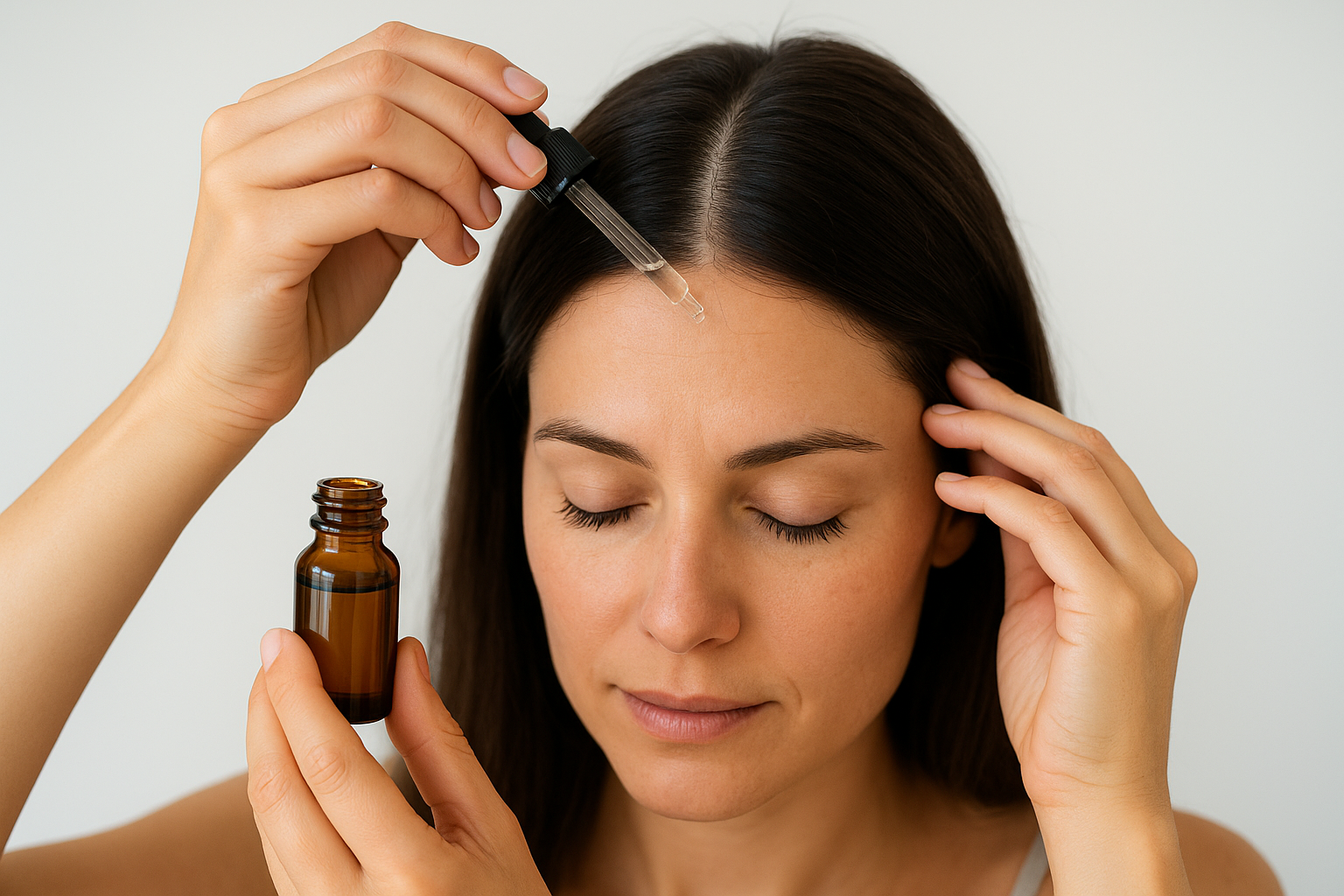
Vous n'avez pas besoin d'enduire les longueurs de vos cheveux. Le cuir chevelu est votre cible, pas les mèches elles-mêmes. Laissez l'huile agir pendant un minimum de 30 minutes, ou toute la nuit si votre type de cheveux le permet, avant de la laver avec votre shampoing habituel. Visez à répéter cela deux à trois fois par semaine, car une utilisation quotidienne peut entraîner une accumulation de produit ou une sensibilité progressive du cuir chevelu.
Comment choisir une huile de romarin véritablement pure au Royaume-Uni
Le marché britannique est inondé de produits à base d'huile de romarin, et la variation en termes de qualité, de pureté et de transparence est significative. Choisir le bon produit ne consiste pas à trouver la bouteille la plus chère ou l'emballage le plus attrayant. Il s'agit de savoir ce qu'il faut rechercher sur l'étiquette et quelles questions poser avant d'acheter.
Lisez attentivement la liste des ingrédients
Votre première étape est toujours la liste des ingrédients. Une huile essentielle de romarin véritablement pure ne devrait contenir qu'un seul ingrédient : l'huile de feuille de Rosmarinus officinalis. Si vous voyez des ingrédients supplémentaires tels que de l'huile minérale, du myristate d'isopropyle ou des composants de parfum synthétiques, le produit n'est pas une huile essentielle pure. Les mélanges prédilués ne sont pas un problème en soi, mais ils doivent être clairement étiquetés comme tels, et le pourcentage de dilution doit être indiqué afin que vous puissiez ajuster votre application en conséquence. Si cette information est absente, passez votre chemin.
Recherchez des tests effectués par des tiers
Les fournisseurs réputés d'huile de romarin pure pour les cheveux mettront à disposition les résultats des tests GC/MS (chromatographie en phase gazeuse-spectrométrie de masse). Ces rapports confirment la composition chimique de l'huile et vérifient qu'aucun adultérant ou composé synthétique n'a été ajouté. Vous devriez pouvoir trouver ces résultats sur le site Web de la marque ou les demander directement au service client.
Les tests par des tiers constituent le moyen le plus fiable de confirmer que ce qui figure sur l'étiquette correspond réellement à ce qui se trouve dans le flacon.
Les tests spécifiques à chaque lot sont encore meilleurs, car ils signifient que chaque cycle de production est vérifié individuellement plutôt que de s'appuyer sur un seul test historique. Les marques qui investissent dans ce niveau de transparence démontrent un engagement envers la qualité que les affirmations marketing générales ne peuvent reproduire.
Choisissez des marques britanniques certifiées naturelles
Opter pour un produit formulé au Royaume-Uni d'une marque dotée de certifications naturelles crédibles vous offre une couche d'assurance supplémentaire. Les certifications d'organismes reconnus confirment que les produits répondent à des normes définies en matière d'approvisionnement en ingrédients et de pratiques de fabrication. Les marques qui sont également sans cruauté animale et testées par des dermatologues ajoutent une confiance supplémentaire, en particulier si vous avez le cuir chevelu sensible ou si vous débutez avec les huiles essentielles.
Quels résultats attendre et quand demander de l'aide
Fixer des attentes réalistes avant de commencer à utiliser l'huile de romarin pure pour les cheveux est l'une des choses les plus importantes que vous puissiez faire. Ce n'est pas une solution rapide. L'huile de romarin agit en améliorant les conditions dans lesquelles vos follicules opèrent, et ce genre de changement se produit progressivement sur des semaines et des mois, pas des jours.
À quoi ressemble un calendrier réaliste
La plupart des personnes qui utilisent l'huile de romarin régulièrement deux à trois fois par semaine commencent à remarquer une réduction de la chute des cheveux en six à huit semaines. C'est généralement le premier signe que le traitement fonctionne. Des améliorations visibles de la densité et de l'épaisseur des cheveux prennent généralement plus de temps, avec des résultats significatifs apparaissant entre trois et six mois d'utilisation régulière. L'essai clinique SKINmed de 2015 qui a comparé l'huile de romarin au minoxidil a utilisé une fenêtre de six mois spécifiquement parce que les chercheurs comprenaient que les cycles de croissance des cheveux nécessitent une intervention soutenue pour montrer des changements mesurables.
La patience n'est pas une option avec l'huile de romarin. Le processus de stimulation des follicules est graduel, et arrêter le traitement avant la marque des trois mois ne vous donne aucune donnée fiable sur son efficacité.
Pendant les premières semaines, vous remarquerez peut-être que votre cuir chevelu est légèrement plus sensible ou picote après l'application, en particulier si vous êtes nouveau aux huiles essentielles. C'est normal en petites quantités, mais une brûlure ou une rougeur persistante signifie que vous devez immédiatement réduire votre taux de dilution.
Quand consulter un professionnel
L'huile de romarin est un outil de soutien, pas un traitement médical. Si votre perte de cheveux est soudaine, par plaques ou accompagnée d'autres symptômes tels que fatigue, changements cutanés ou douleurs du cuir chevelu, vous devriez consulter un médecin généraliste ou un dermatologue avant de vous fier à un remède topique. Une chute soudaine peut signaler des affections comme l'alopécie areata, un dysfonctionnement thyroïdien ou des carences nutritionnelles qui nécessitent un diagnostic approprié.
Vous devriez également consulter un professionnel si vous avez utilisé l'huile de romarin correctement pendant six mois sans aucune amélioration notable. Un dermatologue peut évaluer si une affection sous-jacente est à l'origine de votre perte de cheveux et recommander un plan de traitement ciblé en complément ou à la place des options naturelles.
Dernières réflexions
Utiliser de l'huile de romarin pure pour les cheveux est l'un des choix les plus étayés par des preuves que vous pouvez faire si vous souhaitez soutenir la croissance des cheveux et la santé du cuir chevelu avec des ingrédients naturels. La recherche est solide, la méthode d'application est simple et le risque d'effets secondaires est faible si vous diluez correctement et restez constant. Ce qui sépare les personnes qui obtiennent des résultats de celles qui n'en obtiennent pas est presque toujours la patience et la constance, et non l'huile elle-même.
Votre meilleur résultat provient de l'association d'une huile véritablement pure, certifiée naturelle, à une routine fiable et à des délais réalistes. Si vous souhaitez un point de départ prêt à l'emploi qui combine des ingrédients de qualité avec des formulations testées par des dermatologues et fabriquées au Royaume-Uni, explorez la gamme de soins capillaires naturels chez Xquisit Luxe Self Care. Tout ce qui se trouve dans cette gamme est construit sur le même engagement en faveur de la transparence et des résultats que ce guide a souligné dès le début.

