


You bought a hair growth oil, you're excited to see results, and now you're wondering how often to use hair growth oil without overdoing it. It's a fair question, and the answer isn't one-size-fits-all. Apply too little and you won't see progress. Apply too much and you risk clogging your scalp with buildup that actually slows growth down.
The right frequency depends on your hair type, your scalp's oil production, and the kind of oil you're using. Someone with a dry, coarse texture needs a completely different schedule than someone with fine, oily hair. Getting this wrong is one of the main reasons people give up on hair oils before they ever see results, and that's a waste of both time and money.
At Xquisit Luxe Self Care, we formulate certified natural hair growth oils here in the UK, and our customers regularly ask us this exact question. So we put together a clear, practical guide with specific application schedules broken down by hair type, plus tips on technique, common mistakes to avoid, and how to tell if your routine is actually working.
What hair growth oil does and what it cannot do
Hair growth oil works by nourishing your scalp and creating the right environment for healthy hair to grow. That's the short version. The longer version is that most hair growth oils combine plant-based active ingredients like castor oil, rosemary oil, peppermint oil, and argan oil, each of which contributes something different to scalp health and hair strength.
How hair growth oil works on your scalp
When you apply a well-formulated hair growth oil, it penetrates the outer scalp layer and delivers nutrients directly to your hair follicles. Ingredients like rosemary oil have been studied for their ability to improve blood circulation in the scalp, which helps carry oxygen and nutrients to follicle cells. Better circulation means follicles stay active longer in their growth phase, which over time can lead to thicker, fuller hair.
Castor oil, another common ingredient, is thick and rich in ricinoleic acid, a fatty acid that helps reduce scalp inflammation and may help unclog follicles blocked by sebum or product buildup. Peppermint oil creates a mild tingling sensation that signals increased blood flow to the application area. These are not marketing claims; there is peer-reviewed research supporting these mechanisms.
Regular, consistent application is what drives results. A single use will not transform your hair, but a steady routine maintained over 8 to 12 weeks often produces visible improvement in thickness and growth rate.
Understanding how the oil works also helps you understand why frequency matters so much. Apply it too rarely and the active ingredients never build up enough presence on your scalp to make a meaningful impact. Apply it every single day without washing your hair and you risk suffocating follicles with excess oil, which creates the exact buildup conditions that slow growth rather than support it.
What hair growth oil cannot do
It is important to be honest here: hair growth oil is not a medical treatment for conditions like alopecia areata or severe androgenetic alopecia, which is pattern baldness driven by hormonal factors. If you are experiencing significant or sudden hair loss, the right first step is speaking with a dermatologist or trichologist rather than reaching for a bottle of oil.
What oil can genuinely do is support the hair you already have, help reduce shedding caused by breakage or a dry, irritated scalp, and encourage healthier growth cycles when used consistently. Think of it as a preventative and supportive tool rather than a rescue treatment. Knowing this helps you set realistic expectations and stick with your routine long enough to see genuine results, which is ultimately what figuring out how often to use hair growth oil is really all about.
Pick your frequency by hair type and scalp needs
Your hair type is the single biggest factor in deciding how often to use hair growth oil. Fine, oily hair gets weighed down quickly and is prone to scalp congestion, while dry or coarse hair needs more frequent application to prevent breakage and lock in moisture. Getting this right from the start saves you weeks of guesswork.
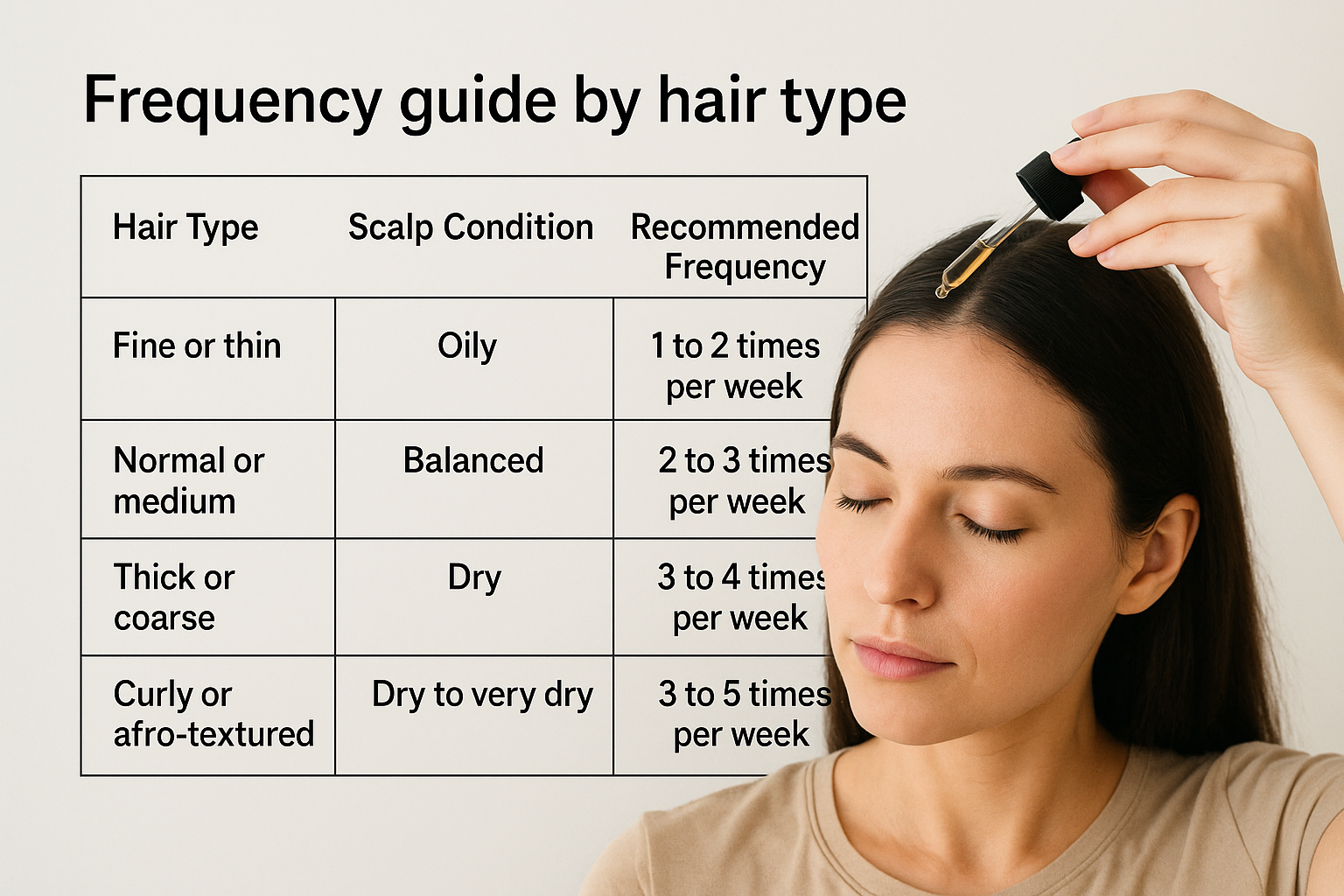
Frequency guide by hair type
The table below gives you a clear, practical starting point based on your hair type and scalp condition. Treat it as a baseline rather than a strict rule, and revisit it after two to three weeks once you can see how your scalp is responding.
| Hair Type | Scalp Condition | Recommended Frequency |
|---|---|---|
| Fine or thin | Oily | 1 to 2 times per week |
| Normal or medium | Balanced | 2 to 3 times per week |
| Thick or coarse | Dry | 3 to 4 times per week |
| Curly or afro-textured | Dry to very dry | 3 to 5 times per week |
If your hair looks greasy before your next wash day, reduce your application frequency by one session per week until your scalp settles.
Adjusting for scalp sensitivity
A sensitive or reactive scalp changes the equation regardless of your hair type. Even if your hair is thick and dry, which would normally call for more frequent oiling, it is smarter to start with one application per week and build up gradually over a fortnight. Rushing the process risks triggering inflammation rather than supporting growth.
Potent ingredients like rosemary oil and peppermint oil are effective precisely because they are biologically active, and that same potency can cause redness or flaking if you overuse them on a sensitive scalp. Pay attention to any itching, tightness, or irritation in your first week and treat those signals as useful feedback about your ideal starting frequency rather than a reason to abandon the routine.
Apply hair growth oil correctly for best results
Knowing how often to use hair growth oil is only half the picture. The technique you use matters just as much as frequency, because applying oil incorrectly can mean the active ingredients never reach the follicles where they are actually needed.
Prepare your scalp before applying
Your scalp absorbs oil best when it is clean and slightly warm. Apply your hair growth oil on wash day, after shampooing but before conditioning, or on dry hair on a non-wash day. Applying to a dirty scalp layered with old product residue creates a barrier that blocks absorption and reduces how effective the oil can be.
Slightly warming the oil in your palms for 10 to 15 seconds before application also helps. Warm oil flows more easily and penetrates the scalp more readily than cold oil applied straight from the bottle.
Apply directly to the scalp, not the lengths
Many people make the mistake of running oil through their hair lengths and ends. For hair growth purposes, your focus should be the scalp and roots, not the mid-lengths or tips. Your follicles sit in your scalp, and that is where the active ingredients need to work.
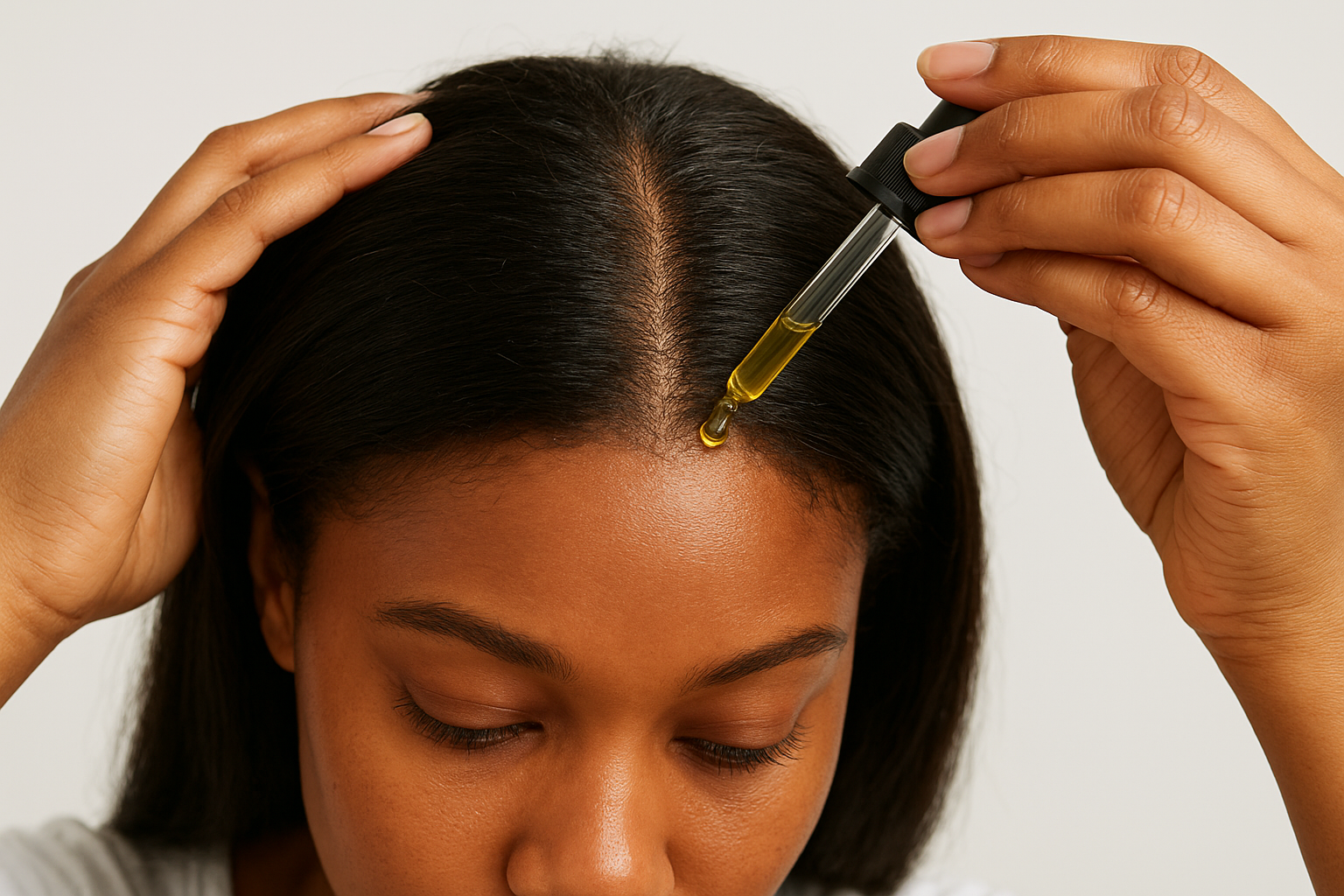
Use a dropper or your fingertips to apply the oil in sections across your scalp. Divide your hair into four to six partings, apply a small amount along each parting, then use your fingertips to massage the oil in using small circular motions for two to three minutes.
Scalp massage during application improves blood circulation and helps active ingredients absorb more effectively, which makes it worth spending the extra two minutes.
How much oil to use per session
Three to five drops per application is a reliable starting point that covers the scalp without oversaturating it. Fine hair types should stay closer to 3 drops, while thicker or coarser hair can go up to 5 or 6 drops per session. Adjust based on how your scalp feels the following day.
Prevent buildup, dandruff, and irritation
Consistent oiling is great for your scalp, but without a proper wash routine to balance it, you will end up with product and sebum buildup that blocks follicles and creates exactly the conditions that hold back growth. Understanding how often to use hair growth oil means understanding not just how often to apply it, but how often to wash it out properly.
Recognise the signs of buildup early
Your scalp communicates clearly when something is off. The key is knowing which signs to watch for so you can adjust before a minor issue becomes a persistent one.
- Greasy roots that return within 24 hours of washing signal over-oiling or insufficient cleansing
- Flaking that looks waxy or clumped rather than dry and powdery often points to product buildup rather than dandruff
- Persistent itching along the hairline or crown suggests your scalp is congested or reacting to an ingredient
- A dull, heavy feeling at the roots even after washing indicates your shampoo is not clearing oil residue effectively
If you notice two or more of these signs at the same time, reduce your oiling frequency by one session per week and switch to a clarifying shampoo for the next two wash days.
Adjust your wash routine to match your oiling schedule
Your wash frequency needs to scale with how often you oil. If you oil three times per week, washing twice per week is a practical minimum to prevent buildup. Use a gentle, sulphate-free shampoo on regular wash days to cleanse without stripping your scalp's natural barrier, and reserve a clarifying shampoo for once every two to three weeks as a deeper reset.
Apply your shampoo directly to the scalp first rather than distributing it through the lengths. Work it in with your fingertips using the same circular motion you use during oiling, then rinse thoroughly before conditioning. This targeted approach removes oil residue and dead skin cells without over-drying the mid-lengths of your hair.
Common questions and quick fixes
Even with a clear schedule in place, a few practical questions tend to come up once you start your routine. The answers below cover the situations most readers run into when figuring out how often to use hair growth oil for their specific hair type.
What if I am not seeing results after 8 weeks?
Results vary depending on your scalp's condition at the start, the consistency of your routine, and whether your application technique is correct. Before assuming the oil is not working, run through this quick checklist:
- Are you applying to the scalp and roots rather than the hair lengths?
- Are you massaging for at least two minutes per session?
- Are you washing thoroughly enough to prevent follicle-blocking buildup?
- Have you been applying at your recommended frequency consistently, with no long gaps?
If you can answer yes to all four, give your routine another four weeks. Most people underestimate how long a genuine growth cycle takes to show visible change.
Can I leave hair growth oil on overnight?
You can, and for dry or coarse hair types, an overnight treatment once per week can be genuinely beneficial. Apply your oil to a clean scalp before bed, cover your hair with a loose satin cap or towel, and wash it out thoroughly the following morning using a gentle shampoo. Do not count overnight treatments as extra sessions on top of your regular schedule. Count each overnight application as one of your weekly sessions to avoid over-oiling.
Overnight treatments work best on wash day eve so that you can rinse the oil out promptly and avoid extending the time oil sits on your scalp beyond eight hours.
What if my scalp feels itchy or greasy after applying?
Itchiness usually signals either sensitivity to a specific ingredient or that you applied too much product. Greasiness points directly to over-application or applying oil onto a scalp that was not clean enough to absorb it properly. In both cases, reduce your next application to two or three drops and ensure you start from a freshly washed scalp.
A simple routine to stick with
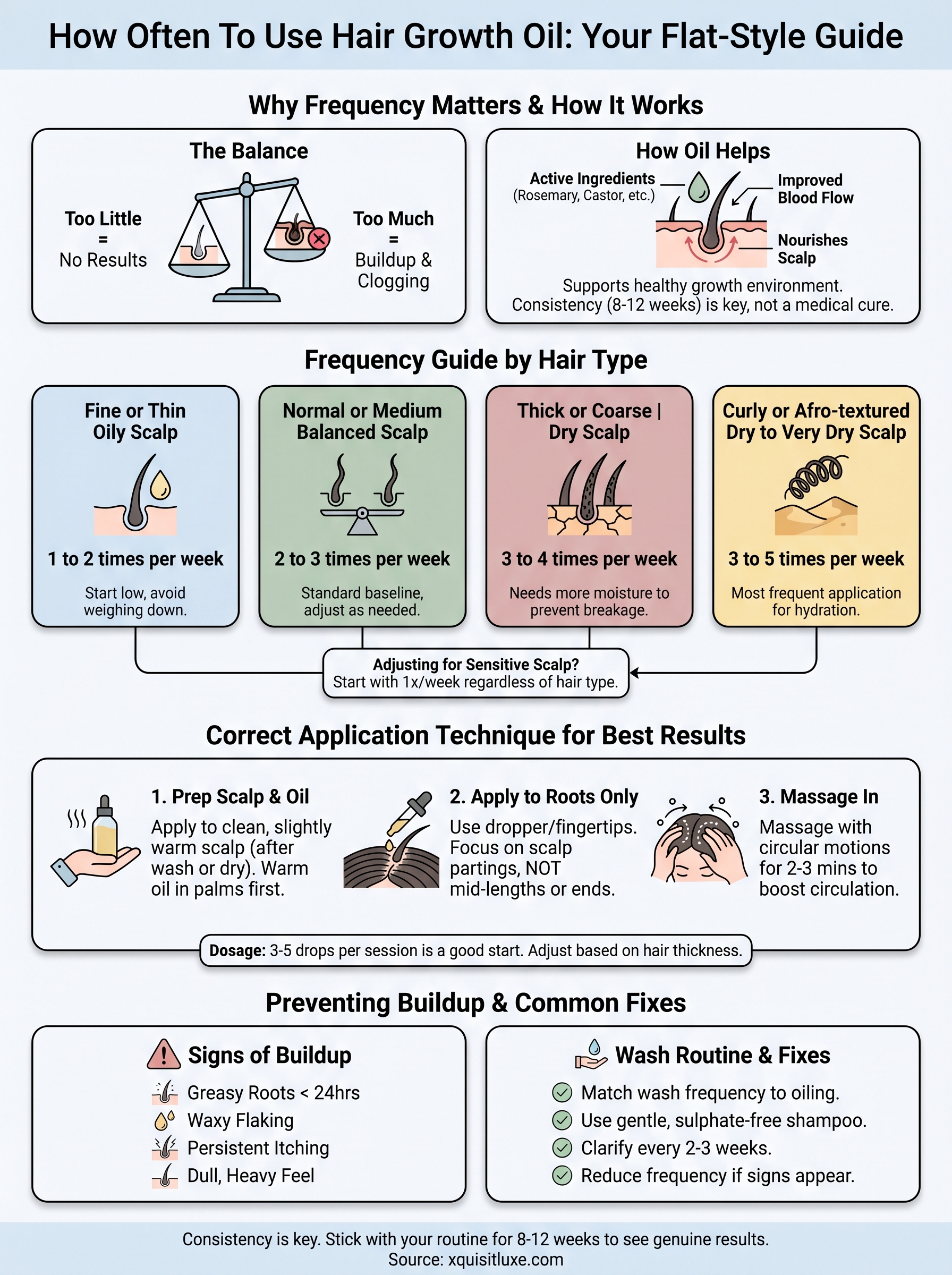
The answer to how often to use hair growth oil depends on your hair type, your scalp's oil production, and how consistently you wash the oil out between sessions. Start with the frequency range that matches your hair type from the guide above, apply directly to your scalp using the massage technique outlined in this article, and adjust based on how your roots and scalp feel after the first two to three weeks.
Stick with your routine for at least 8 to 12 weeks before deciding whether it is working. Most people see their best results when they treat oiling as a regular weekly habit rather than an occasional fix. If you want a certified natural hair growth oil formulated without harsh chemicals and made here in the UK, browse the Xquisit Luxe Self Care hair care range and find the right formula for your hair type.

