


If your skin flakes by lunchtime, stings when you apply a new product, or turns red at the slightest change in weather, you already know that off-the-shelf advice doesn't work. Getting skincare for dry and sensitive skin right means understanding what your barrier actually needs, not just piling on more moisturiser and hoping for the best. It's a specific problem that calls for a specific approach.
We put this thinking directly into our Facial Moisturiser for Sensitive Skin, if you'd like to try it yourself.
This guide gives you exactly that: a step-by-step routine built around gentle cleansing, barrier repair, and calming ingredients that won't trigger irritation. You'll learn which product categories matter most, in what order to apply them, and how to spot ingredients to avoid before they cause a reaction.
We'll walk through morning and evening routines, explain how to introduce new products without overwhelming reactive skin, and point out where certified natural, dermatologist-tested formulas make the biggest difference. By the end, you'll have a simple, repeatable routine you can actually stick to, one that calms irritation and keeps dryness under control without unnecessary steps or guesswork.
What dry, sensitive skin actually needs
Dry and sensitive skin isn't just "skin that needs more cream". It's usually a sign that your skin barrier (the outer layer of lipids and cells that locks in moisture and keeps irritants out) isn't doing its job properly. When that barrier is compromised, water escapes faster than it should, a process dermatologists call transepidermal water loss, and anything you put on your face, from fragrance to hard tap water, has an easier route to the nerve endings underneath. That's why the same product that leaves one person glowing can leave you red, tight, or stinging within minutes.
Your barrier comes first, always
Before you think about anti-ageing serums or brightening treatments, your first job is barrier repair. Skin that's constantly inflamed or dehydrated can't absorb actives properly anyway, so treating symptoms before fixing the foundation is a waste of money and patience. A repaired barrier feels calmer within days; a damaged one stays reactive no matter how many products you layer on top.
Fix the barrier first. Everything else in your routine works better once it does.
Know your triggers
Certain habits and ingredients aggravate dry, sensitive skin far more than others, and most people don't realise how many of them they're using daily. Watch out for:
- Hot water in the shower or when washing your face, which strips natural oils
- Alcohol-based toners and heavily fragranced products, common causes of stinging
- Physical exfoliants with rough beads that create micro-tears in already-thin skin
- Sulphates (sodium lauryl sulphate and similar) in cleansers, which over-clean and dehydrate
- Sudden product changes, introducing three new actives in one week rather than one at a time
Cutting even two or three of these out often makes a bigger difference than adding a new serum ever will.
What actually helps
Once you've removed the aggravators, focus on ingredients that rebuild and calm rather than exfoliate or stimulate. Look for humectants that draw water into the skin, emollients that soften and smooth, and occlusives that seal moisture in. This is where certified natural formulas tend to outperform heavily synthetic ones, since they typically skip the harsh preservatives and fragrance compounds that trigger flare-ups in reactive skin.
| Ingredient type | What it does | Examples to look for |
|---|---|---|
| Humectant | Pulls moisture into the skin | Glycerin, hyaluronic acid |
| Emollient | Softens and smooths the surface | Shea butter, plant oils |
| Occlusive | Seals in hydration, prevents water loss | Ceramides, squalane |
| Soothing agent | Calms redness and irritation | Oat extract, chamomile, aloe |
Asking these questions when you shop saves you from trial and error later.
Patch testing isn't optional
Sensitive skin doesn't forgive guesswork, so patch test every new product on your inner arm for 24 to 48 hours before it goes anywhere near your face. According to the NHS, allergic skin reactions can develop even from products you've used before without issue, so this step matters even for reformulated favourites. It takes two days, but it can save you two weeks of recovery.
Step 1. Cleanse without stripping your skin
Cleansing is where most dry and sensitive skin routines go wrong before they even start. A cleanser that foams heavily or leaves your face feeling "squeaky clean" has usually just stripped away the lipids your barrier needs to function. Gentle cleansing means removing dirt, oil, and sunscreen without touching the natural oils underneath, and that distinction matters far more than any fancy ingredient list on the bottle.
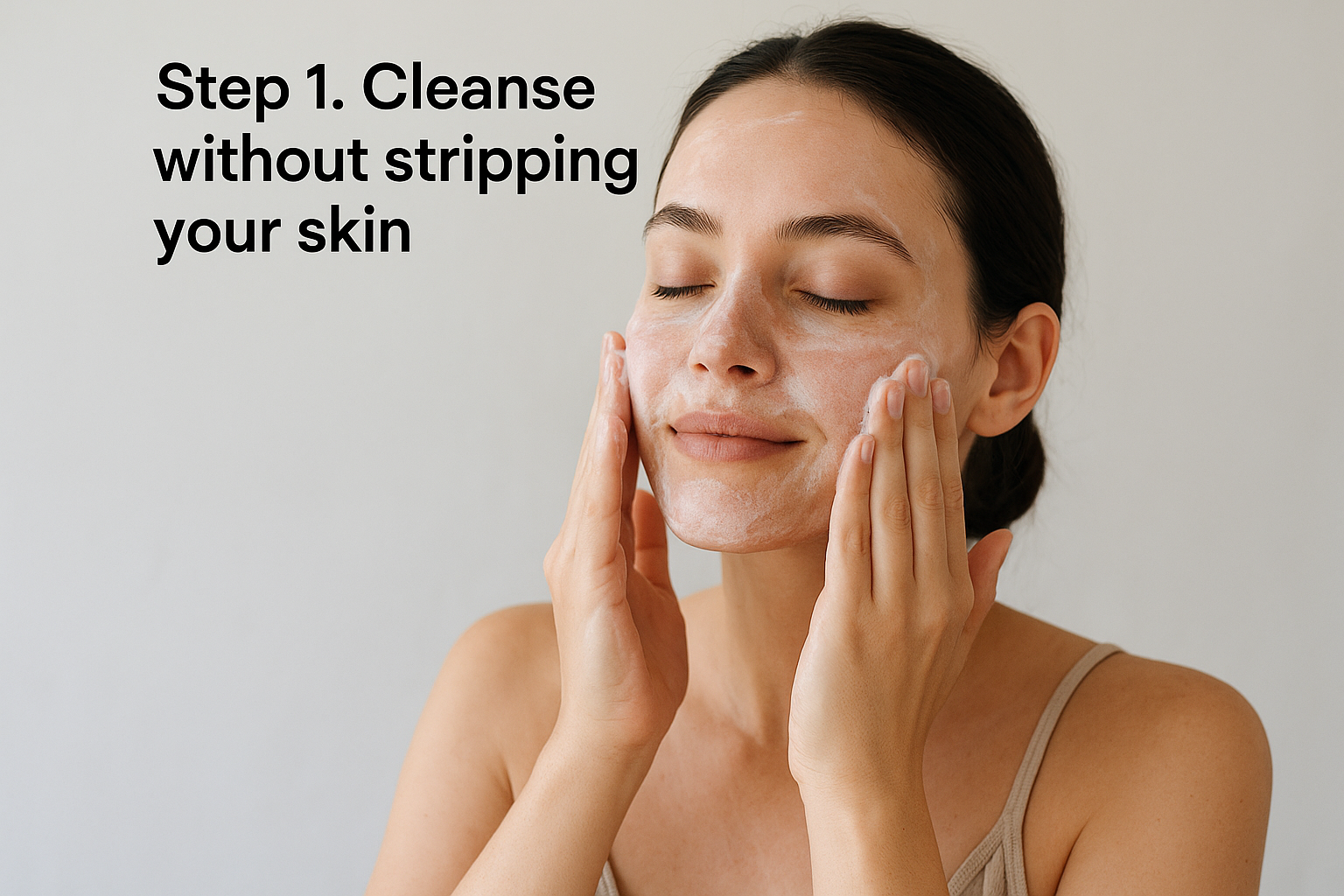
If your face feels tight after cleansing, the product is working against you, not for you.
What to look for in a cleanser
Swap foaming, sulphate-based formulas for a cream, oil, or milk cleanser that rinses off without lather. These formats clean effectively while leaving a light residue of emollients behind, which is exactly what compromised skin needs. Check the label for these markers before you buy:
- Fragrance-free or naturally scented with minimal essential oil content
- Low or no sulphates (avoid sodium lauryl sulphate)
- pH-balanced, close to your skin's natural pH of around 4.5 to 5.5
- Cream, milk, or oil texture rather than a foaming gel
- Certified natural formulation with a short, recognisable ingredient list
How to cleanse properly, twice a day
Technique matters just as much as product choice. Follow this routine morning and night:
- Use lukewarm water, never hot, to wet your face.
- Apply a small amount of cleanser with your fingertips, working in gentle circular motions for 30 to 60 seconds.
- Rinse thoroughly, making sure no residue is left along your hairline or jaw.
- Pat your face dry with a soft towel, don't rub.
- Move straight into toner while your skin is still slightly damp, since damp skin absorbs the next step more efficiently.
Double cleansing, popular in mainstream skincare advice, usually isn't necessary for dry and sensitive skin unless you're removing heavy makeup or SPF at night. One thorough cleanse is often gentler and just as effective.
Evening cleansing deserves a touch more attention than morning, since you're removing a full day's build-up of pollution, sunscreen, and product. Still, resist the urge to scrub harder when your skin looks dull. Persistence with a gentle formula, not extra pressure, is what clears congestion over time without triggering the redness and flaking that harsher cleansers cause.
Step 2. Tone to soothe and rebalance
Toner has an image problem. Most people remember the harsh, alcohol-heavy versions from decades past that left skin stinging and stripped, so they skip this step entirely. That's a mistake for dry and sensitive skin specifically, because the right toner doesn't strip anything. It rebalances your skin's pH after cleansing and delivers a first layer of hydration before your serum and moisturiser go on. Think of it as prepping the canvas rather than cleaning it again.
A good toner hydrates before it does anything else, it never leaves your skin feeling tighter than before you applied it.
What a toner should actually do for you
For reactive skin, a toner's job is calming and priming, not exfoliating or "deep cleaning". Look for a formula built around soothing botanicals and humectants rather than acids or astringents. The best options for sensitive skin toning typically contain:
- Rosewater or chamomile, both known for calming visible redness
- Aloe vera, which cools and hydrates without residue
- Hyaluronic acid, to start layering moisture immediately
- Zero alcohol, since alcohol is one of the most common triggers for stinging and dryness
- A light, non-sticky texture that absorbs within seconds
Skip anything labelled as a toning "treatment" with glycolic or salicylic acid in it. Those belong in a separate exfoliating step, used sparingly, not in your daily routine.
Applying toner the right way
How you apply toner matters almost as much as what's in the bottle. Cotton pads can drag across the skin and waste product, so switch to your hands instead:
- Pour a few drops of toner into your palms.
- Press, rather than wipe, onto your face and neck.
- Let it absorb for 30 seconds before moving to your next step.
- Reapply a second light layer if your skin still feels dry, especially in winter.
Using your palms instead of cotton pads means every drop goes onto your skin rather than into a pad, and it avoids the friction that can aggravate already-thin, reactive skin.
Once toning becomes part of your routine, you'll notice your skin takes serums and moisturisers better, almost like it's been softened up to receive them. That's the whole point of this step: it's not decorative, it's preparation. Consistent toning over a few weeks often reduces the tight, flaky feeling that shows up between cleansing and moisturising, which is usually a sign your skin was thirsty long before you noticed.
Step 3. Treat with a hydrating serum
Serums exist to deliver a concentrated dose of active ingredients past the surface layer, and for dry, sensitive skin, hydration is the active that matters most. Skip the brightening acids and retinol blends for now. Hyaluronic acid serums and similar humectant-rich formulas plump the skin from within, softening the fine lines that appear simply because skin is dehydrated rather than ageing. Applied correctly, a good serum makes the difference between skin that looks tired by mid-afternoon and skin that stays comfortable all day.
A hydrating serum works by holding water in your skin, not by fighting your skin.
Choosing the right hydrating serum
Not every serum labelled "hydrating" is gentle enough for reactive skin, so read past the front of the bottle. Prioritise formulas built around these ingredients:
- Hyaluronic acid, in multiple molecular weights for hydration at different skin depths
- Niacinamide at a low concentration (around 2 to 5%), which calms redness without irritating
- Panthenol (vitamin B5), known for supporting barrier repair
- Squalane, a lightweight oil that mimics your skin's own sebum
- Fragrance-free and alcohol-free formulation, non-negotiable for sensitive skin
Avoid serums that combine hydration with strong exfoliating acids or high percentages of vitamin C, since both can sting on compromised skin, at least until your barrier has recovered.
Applying serum for maximum absorption
Serum works best on slightly damp skin, straight after toner, while there's still moisture for the humectants to grab onto. Follow this order every time:
- Dispense two to three drops into your palm.
- Warm it between your palms for a few seconds.
- Press gently onto your face and neck, avoiding rubbing or dragging.
- Wait 60 seconds before applying moisturiser, giving the serum time to absorb properly.
Applying serum to bone-dry skin wastes most of its benefit, since there's no water left for those humectant molecules to bind to. Consistency counts here too: daily serum use for two to three weeks tends to show visibly plumper, less flaky skin, far more than sporadic use ever will. If your skin still feels tight after this step, that's usually a sign you need a richer moisturiser next, not a stronger serum.
Step 4. Moisturise to lock in hydration
Moisturiser is the step that actually seals in everything you've just applied. Toner and serum load your skin with water, but without a proper occlusive layer on top, that hydration evaporates within the hour. For dry and sensitive skin, this isn't the step to skimp on. Barrier repair happens largely through this layer, so choose a formula rich enough to hold moisture in without clogging pores or triggering breakouts on already-reactive skin.
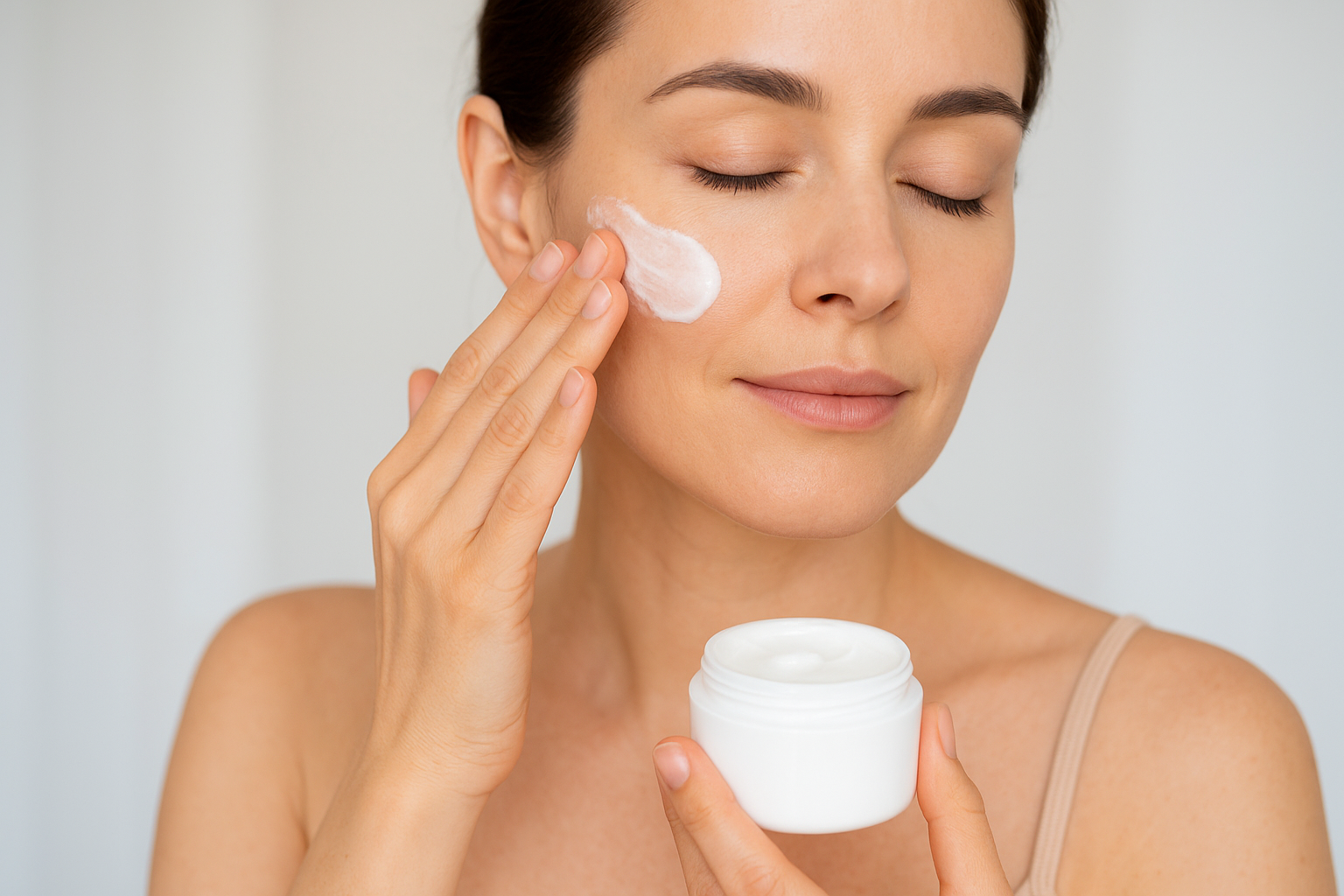
A moisturiser that disappears in ten minutes isn't rich enough for dry, sensitive skin.
What makes a moisturiser suitable for reactive skin
Thickness alone doesn't make a good moisturiser, ingredients do. Look past the texture and check the label for these markers before adding one to your basket:
- Ceramides, which rebuild the lipid layer your barrier depends on
- Shea butter or plant oils, for emollient softness without heaviness
- Squalane or dimethicone, occlusives that lock in the water beneath
- Fragrance-free, since scent is one of the most common triggers for facial redness
- Certified natural formulation, typically free from the harsh preservatives that irritate compromised skin
Cream-based formulas usually outperform lightweight lotions for dry skin, since lotions are mostly water and evaporate faster, leaving less behind to protect the surface overnight.
Applying moisturiser morning and night
Application technique affects how much benefit you actually get from the product, so don't just smear it on quickly. Follow this each time:
- Take a generous amount, more than you think you need, and warm it between your palms.
- Press it into your face and neck in upward motions, starting from the centre outward.
- Pay extra attention to drier patches around the cheeks, jaw, and eye area.
- Wait a minute before applying SPF or makeup, letting it fully settle.
At night, you can afford a thicker layer since there's no SPF or makeup to layer over it. Some people find a richer night cream or a few drops of facial oil pressed on top makes a noticeable difference by morning, especially during winter when central heating dries the air further. If your skin still feels tight by midday despite this step, you likely need a heavier formula, not more of the same one, or a barrier-repair balm applied just to the driest areas.
Step 5. Protect with a gentle SPF
Sunscreen is the step people with dry, sensitive skin skip most often, usually because past experience taught them SPF means stinging eyes and a chalky white cast. That reaction almost always comes down to the formula, not sunscreen itself. Daily SPF protects the barrier you've spent the rest of this routine repairing, since UV exposure breaks down collagen and worsens transepidermal water loss even on cloudy British days. Skipping it undoes a good chunk of the work you did in the previous four steps.
Skipping SPF undoes the barrier repair you just spent four steps building.
Choosing SPF that won't irritate
Mineral sunscreens, built around zinc oxide or titanium dioxide, tend to suit reactive skin far better than chemical filters, since they sit on top of the skin rather than being absorbed into it. Chemical filters like oxybenzone are common triggers for stinging and redness in people who already react easily. When you're comparing bottles, check for:
- Mineral (physical) filters, zinc oxide or titanium dioxide rather than chemical UV filters
- Broad spectrum protection, covering both UVA and UVB rays
- SPF 30 or higher, the minimum most dermatologists recommend for daily wear
- Fragrance-free formulation, again avoiding one of the most common irritants
- Lightweight, non-greasy finish that layers well over moisturiser without pilling
The NHS advises using at least SPF 30 with high UVA protection every day, regardless of skin type, and that guidance applies just as much on overcast days as bright ones since UV rays pass through cloud.
Layering SPF into your morning routine
Sunscreen always goes last, applied as the final step once your moisturiser has settled. Follow this order every morning:
- Wait a full minute after moisturiser before applying SPF, so it doesn't slide around.
- Use roughly a quarter teaspoon for your face and neck, most people apply far less than they need.
- Pat it in gently rather than rubbing, which helps avoid pilling over other products.
- Reapply midday if you're outdoors for extended periods, particularly in summer.
Mineral SPF can sit slightly heavier than chemical formulas, so give it those extra thirty seconds to settle before makeup goes on top.
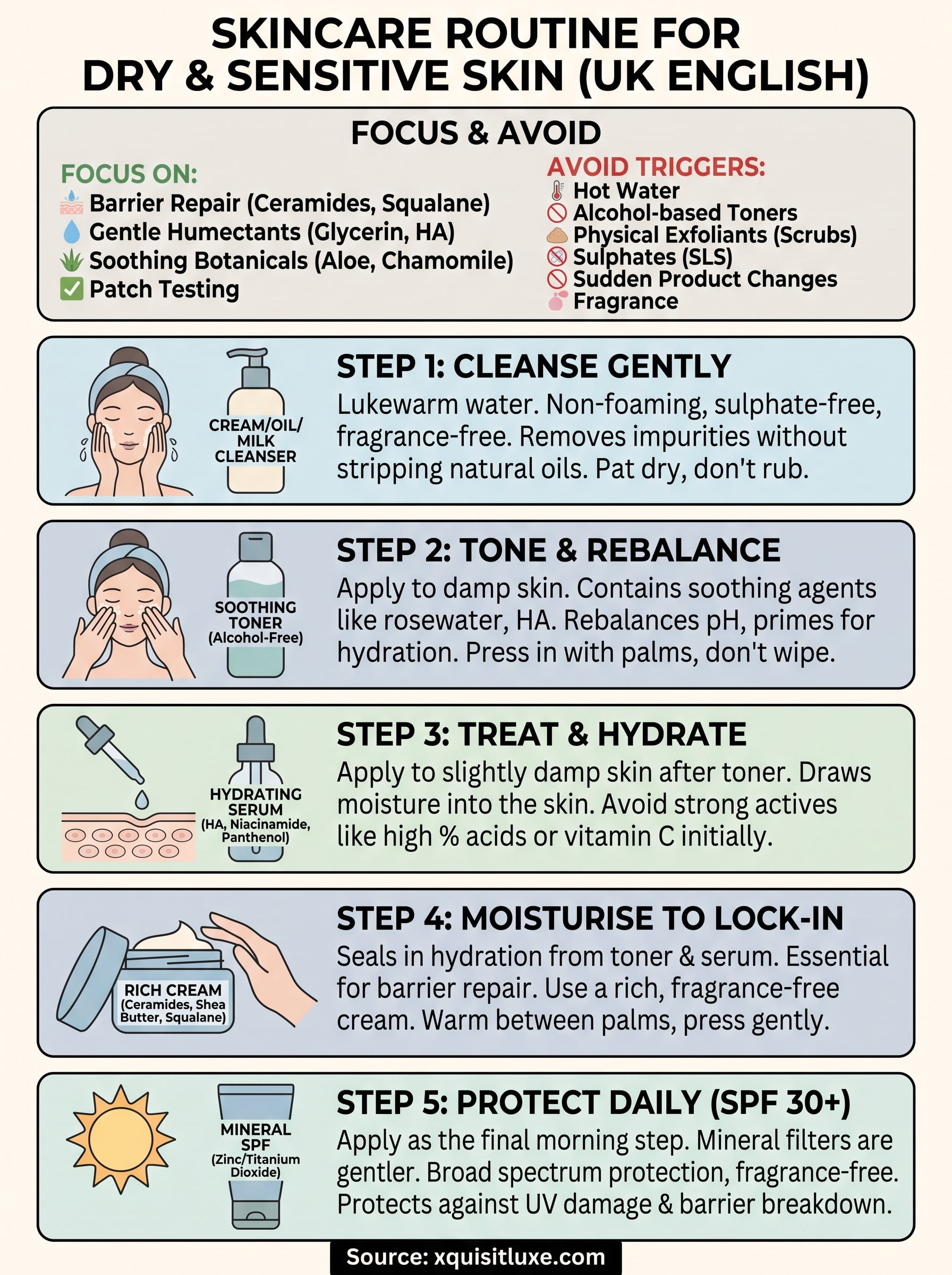
Sticking with your new routine
Five steps, done consistently, beat ten steps done occasionally. Cleanse, tone, treat, moisturise, protect, that's the whole routine, and dry, sensitive skin responds best when you repeat it daily rather than chasing new products every time you spot redness. Give each new addition two to three weeks before judging whether it works, and resist the urge to layer on extras the moment your skin looks calm again.
Give your skin the time it needs, and don't mistake a quiet week for a finished job. Barrier repair is gradual, not instant, and the biggest gains come from sticking with gentle, fragrance-free formulas rather than switching products at the first sign of a flare-up.
If you're ready to put this routine into practice, browse Xquisit Luxe's certified natural skincare range and build a routine your skin will actually thank you for.
