


Thinning hair on the crown, a receding parting, or a brush that fills up faster than it used to. If any of that sounds familiar, you've probably already typed hair growth serum for women into Google more than once. The market is crowded with promises, and half the bottles on the shelf are padded out with silicone and fragrance rather than anything that actually feeds a follicle.
We put this thinking directly into our Biotin Hair Serum with Caffeine 10%, if you'd like to try it yourself.
This guide cuts through that noise. We've compared the best-performing serums sold in the UK right now, looking at active ingredients, price per millilitre, and what real customers report after four to eight weeks of consistent use. You'll see how each one stacks up on ingredient transparency and whether it suits fine, thinning, or postpartum hair specifically.
We test and stock natural haircare ourselves at Xquisit Luxe, including our own Hair Regrowth Bundle, so we know how frustrating it is to sift through vague marketing claims. Below, you'll find eight serums worth your money in 2026, what makes each one different, and how to pick the right one for your hair type and budget.
1. Xquisit Luxe Hair Growth Serum
We're putting our own formula first because it's genuinely built for the exact problem this guide addresses: fine, thinning hair that needs a boost without harsh chemicals. It's the anchor product in our Hair Regrowth Bundle and the serum we hear about most from customers who've tried everything else first. Formulated and manufactured in the UK, it's certified natural, cruelty-free, and dermatologist tested, which matters if your scalp reacts badly to fragrance or sulphates.
Key ingredients
Biotin sits at the centre of the formula, paired with castor oil and rosemary extract, two ingredients with a long track record in scalp care. Peppermint oil adds a light cooling sensation on application, which also signals increased circulation at the follicle. Nothing in the bottle is synthetic filler; every ingredient earns its place on the label, and the full list is published on our product page rather than hidden behind vague terms like "proprietary blend."
How it works
The combination targets two things at once: it nourishes the follicle with biotin and fatty acids from castor oil, while rosemary extract is widely credited with improving scalp circulation, which helps deliver nutrients to hair roots. Peppermint oil supports that circulation boost and leaves the scalp feeling refreshed rather than greasy, a common complaint with heavier oil-based serums.
A hair growth serum for women only works if the scalp absorbs it and the ingredients actually reach the follicle, and that's exactly what this formula is built to do.
Who it's for
This serum suits women dealing with postpartum shedding, general thinning from stress or age, or a visibly widening parting. It's gentle enough for sensitive scalps and works well as a daily addition to an existing routine rather than a total overhaul. If you want a natural option without silicones or synthetic fragrance, it's worth starting here.
Biotin Hair Serum with Caffeine 10% — £16.99
A certified natural scalp serum built around biotin with castor oil, rosemary extract and peppermint oil, for fine or thinning hair that needs a boost without harsh chemicals. Made in the UK, dermatologist tested and cruelty-free.
Free UK delivery on orders over £25, and a 30-day money-back guarantee. New customers get 10% off a first order with the Xquisit Club newsletter.
2. UKLASH Hair Growth Serum
UKLASH built its reputation on lash serums before extending the same peptide science to scalp care, and that lineage shows in how the formula is marketed. It's a UK-based brand with a loyal following among women who've already had success with their lash products and want the same results on their hairline and crown.
Key ingredients
The formula leans on peptide complexes alongside panthenol and biotin, ingredients chosen to strengthen strands rather than just coat them. You'll also find hyaluronic acid in the mix, which helps hydrate the scalp surface, plus a handful of plant extracts included mainly for conditioning rather than active growth stimulation.
How it works
Peptides work by signalling to the follicle to support the hair's natural growth cycle, while panthenol and biotin feed the strand itself, improving strength and reducing breakage at the root. It's a supportive rather than aggressive approach.
Peptide-based serums tend to work best as a long-term strengthening tool, not a fast fix for visible bald patches.
Who it's for
This serum suits women with weakened, breakage-prone hair rather than significant thinning or bald patches. If your main concern is hair snapping mid-length or a lack of volume rather than a receding parting, UKLASH is worth considering. It's less suited to postpartum shedding or pattern thinning, where you need stronger circulation-boosting actives.
How it compares
UKLASH comes at thinning from a strengthening angle and does that part well: peptides with panthenol and biotin work on the strand itself, while hyaluronic acid hydrates the scalp surface. If hair is snapping mid-length or looks flat rather than sparse, that's where it earns its place. The limitation is that it's supportive rather than aggressive — a long-term strengthening tool rather than a fix for visible bald patches, and less suited to postpartum shedding or pattern thinning, which need stronger circulation-boosting actives. A ready-to-use UK-made formula built on biotin with rosemary and peppermint works on that circulation side directly.
3. Chāmpo Pitta Growth Serum
Chāmpo built its whole range around Ayurvedic dosha theory, and the Pitta Growth Serum is aimed at scalps that run hot, oily, or easily irritated. It's a distinctly different approach from the peptide and biotin formulas above, drawing on centuries-old Indian haircare traditions rather than lab-derived actives alone.
Key ingredients
Bhringraj and amla extract form the backbone of this serum, both staples in Ayurvedic scalp treatments for centuries. Caffeine is added for its known ability to stimulate follicle activity, while cooling agents like mint and rose extract calm scalps prone to redness or excess oil production. The blend avoids heavy oils, keeping the texture light enough for daily use without weighing hair down.
How it works
The formula pairs caffeine's stimulating effect on the follicle with traditional botanicals believed to balance scalp oil production and reduce irritation. Cooling ingredients soothe the scalp on contact, which matters if your thinning is linked to inflammation or an overactive Pitta scalp type rather than pure follicle fatigue.
A serum built to calm an irritated scalp works differently to one built purely to stimulate circulation, so match the formula to your actual scalp condition.
Who it's for
This serum suits women with oily, sensitive, or easily inflamed scalps, particularly if regular growth serums leave you itchy or greasy by midday. It's less suited to dry, flaky scalps, which need richer, more nourishing formulas instead.
How it compares
This is the most specific pick on the list, and that specificity is a strength when it matches you: bhringraj and amla alongside caffeine, with mint and rose to calm a scalp prone to redness or excess oil, in a light texture that won't weigh hair down. The flip side is the narrow use case — it's built for hot, oily, easily irritated scalps and is a poor match for dry, flaky ones that need something richer. A ready-to-use UK-made formula with biotin, castor oil and rosemary covers more general thinning without asking you to work out your scalp type first.
4. The Ordinary Multi-Peptide Hair Density Serum
The Ordinary built its name on stripped-back, ingredient-led skincare, and this serum applies the same philosophy to scalp care. It's a budget-friendly pick from a brand known for clinical formulations rather than glossy marketing, which appeals to shoppers who want to see the actives listed plainly rather than dressed up in brand language.
Key ingredients
The formula centres on a multi-peptide complex, including redensyl-style actives alongside biotinoyl tripeptide, ingredients chosen specifically for their role in supporting hair density. Caffeine and a small dose of niacinamide round out the mix, aimed at stimulating the follicle and supporting scalp barrier health without adding fragrance or unnecessary extras.
How it works
Peptides in this formula are designed to signal directly to the hair follicle, encouraging it to stay longer in its growth phase rather than shedding prematurely. Caffeine adds a stimulating effect on top, and the lightweight, water-based texture means it absorbs quickly without leaving residue.
Clinical-style peptide serums suit patient users who want gradual density improvement over months, not overnight volume.
Who it's for
This serum suits women experiencing early-stage thinning or reduced density who want a no-frills, ingredient-focused option. It's a solid fit if you're already comfortable navigating active ingredient lists and don't need added botanicals or fragrance to feel reassured a product is working.
How it compares
The appeal here is honesty on the label: a multi-peptide complex with biotinoyl tripeptide, caffeine and a little niacinamide, no fragrance, no filler, and a light water-based texture that absorbs cleanly. For early-stage thinning, and for anyone comfortable reading an active ingredient list, it's a sensible option. The catch is patience — this is gradual density improvement over months rather than overnight volume, and it typically needs several months of unbroken use before anything is visible. A ready-to-use UK-made formula works over a similar timeframe, but pairs its actives with nourishing oils rather than relying on peptides alone.
5. Vichy Dercos Anti-Hair Loss Serum
Vichy brings pharmacy-brand credibility to this list, and the Dercos range is a fixture in French and UK chemists alike. Dermatologists frequently recommend it as a first step before moving to prescription treatments, which gives it a different reputation to the beauty-aisle serums above.
Key ingredients
Aminexil is the headline active here, a molecule developed by Vichy's own labs and backed by clinical testing on hair loss linked to scalp tension and follicle fibrosis. The formula also includes vitamin B6 and arginine, supporting scalp health and strand resilience, plus stabilising agents that keep the texture consistent across the six to nine month treatment course the brand recommends.
How it works
Aminexil works by loosening the collagen build-up around the follicle base that can restrict growth, a mechanism distinct from the caffeine or peptide approaches used elsewhere in this list. Applied daily, it's designed to support the follicle's anchoring structure rather than simply stimulate blood flow.
A pharmacy-tested active like aminexil suits women who want clinical backing behind a hair growth serum for women, not just marketing claims.
Who it's for
This serum suits women noticing progressive thinning over months rather than sudden shedding, particularly if you prefer a treatment with published clinical trial data behind it. It's a reasonable middle ground between natural botanical serums and prescription-strength options.
How it compares
Aminexil is the reason to consider this one, and it's a genuine point of difference: a lab-developed active with published clinical testing behind it, working on the collagen build-up around the follicle base rather than simply stimulating blood flow, with vitamin B6 and arginine supporting the scalp alongside. That evidence base is real. The trade-offs are commitment and caution — the brand recommends a six to nine month course, and aminexil isn't recommended during pregnancy or breastfeeding. A ready-to-use UK-made natural formula is a gentler starting point that doesn't tie you to a fixed treatment course.
6. Grow Gorgeous Growth Serum Intense
Grow Gorgeous made its name with a cult following on Instagram before pharmacies picked it up, and the Intense version is aimed squarely at women who've tried the standard formula and want a stronger dose of actives. It's a mid-market brand that sits between drugstore and premium pricing, which explains its popularity with shoppers who want visible results without paying salon prices.
Key ingredients
Redensyl anchors this formula, a patented complex studied for its effect on follicle stem cells, alongside a caffeine boost and a blend of amino acids meant to strengthen strands as they grow. The Intense version increases the concentration of these actives compared with the original serum, which is the main reason it costs more and suits more stubborn thinning.
How it works
Redensyl is designed to wake up dormant hair follicles stuck in the resting phase, prompting them back into active growth, while caffeine adds a secondary stimulating effect on circulation. Amino acids then support the strand once it emerges, aiming to reduce breakage during the vulnerable early growth stage.
Reactivating dormant follicles takes patience, so expect three months minimum before judging whether Redensyl is working for you.
Who it's for
Women with diffuse thinning across the whole scalp, rather than a single bald patch, tend to see the best results here. It's a strong pick if you've plateaued on a basic biotin serum and want something with more clinical weight behind it.
How it compares
The Intense version raises the concentration of redensyl, a patented complex studied for its effect on follicle stem cells, alongside caffeine and amino acids to support new strands as they emerge. For diffuse thinning across the whole scalp rather than a single patch, it's a credible step up if you've plateaued on a basic biotin serum. Expect a slow burn, though: reactivating dormant follicles takes three months minimum before you can fairly judge it, and the higher concentration is aimed at more stubborn thinning rather than everyday maintenance. A ready-to-use UK-made formula is the gentler daily option for anyone not yet at that stage.
7. Nanogen Hair Growth Factor Treatment Serum
Nanogen built its reputation on hair fibres before moving into treatment serums, and this formula draws on that same background in trichology-adjacent products. It's aimed at women who want a clinical-feeling treatment without stepping into pharmacy-only territory.
Key ingredients
The formula is built around Nanogen's proprietary growth factor complex, a blend of plant-derived actives paired with panthenol and a mix of amino acids. Caffeine features again here, consistent with several serums on this list, alongside botanical extracts included to support scalp condition rather than drive growth on their own.
How it works
The growth factor complex is designed to support the follicle during its active growth phase, working alongside caffeine's stimulating effect on circulation. Amino acids then reinforce the strand as it emerges, aiming to reduce the fine, wispy regrowth that can make early progress hard to see in the mirror.
A hair growth serum for women only earns its price if you can still see it working after the first bottle runs out, and Nanogen leans on repeat, consistent use to get there.
Who it's for
This serum suits women managing general thinning or reduced volume who want a treatment-style product without committing to a pharmacy brand's full protocol. It works well alongside Nanogen's fibre products if you're already using them to disguise thinning day to day.
How it compares
Nanogen's background in hair fibres shows, and it sits sensibly between a beauty-aisle serum and a full pharmacy protocol: a proprietary growth factor complex with panthenol, amino acids and caffeine, aimed at supporting the follicle through its active growth phase and reinforcing the fine, wispy regrowth that's hard to see early on. It also pairs neatly with the brand's fibre products if you already use them. The honest limitation is that it depends on repeat, consistent use to prove itself — the results have to still be there after the first bottle. A ready-to-use UK-made formula sets the same expectation, but with a short, fully published natural ingredient list.
8. Hair + Me The Drops
Hair + Me built its brand around personalised haircare, offering an online consultation before shipping a formula tailored to your specific hair concern. It's a subscription-based model rather than a one-off purchase, which suits women who want a treatment adjusted to their results over time rather than a fixed formula bought off a shelf.
Key ingredients
Each bottle contains a personalised blend of actives chosen from the consultation, typically drawing on redensyl, procapil, or caffeine depending on the concern you flag. Baicapil often features too, an ingredient studied for its effect on follicle density and hair fibre thickness, alongside supporting vitamins included to round out the formula.
How it works
Because the mix changes per customer, the mechanism varies slightly, but the underlying goal stays the same: extend the follicle's active growth phase while reducing shedding triggered by hormonal shifts, stress, or nutrient gaps. Reformulation every few months means the brand can adjust the blend as your hair responds.
Personalised serums only add value if you're honest and detailed in the consultation, since the formula is only as good as the information behind it.
Who it's for
This approach suits women who've tried generic serums without success and want a formula that accounts for hormonal thinning, diet, or lifestyle factors specifically. It's a strong fit for anyone who prefers a guided routine over guesswork.
How it compares
Personalisation is the genuine differentiator here: an online consultation shapes a blend drawn from actives like redensyl, procapil, caffeine and baicapil, and it gets reformulated every few months as your hair responds. If generic serums haven't worked for you, or your thinning has several overlapping triggers, that guided approach has real value. Two caveats — it's an ongoing subscription rather than a one-off purchase, and the formula is only ever as good as the detail you give in the consultation. A ready-to-use UK-made formula is fixed rather than tailored, but there's no questionnaire to fill in and nothing to keep renewing.
9. What causes hair loss and thinning in women
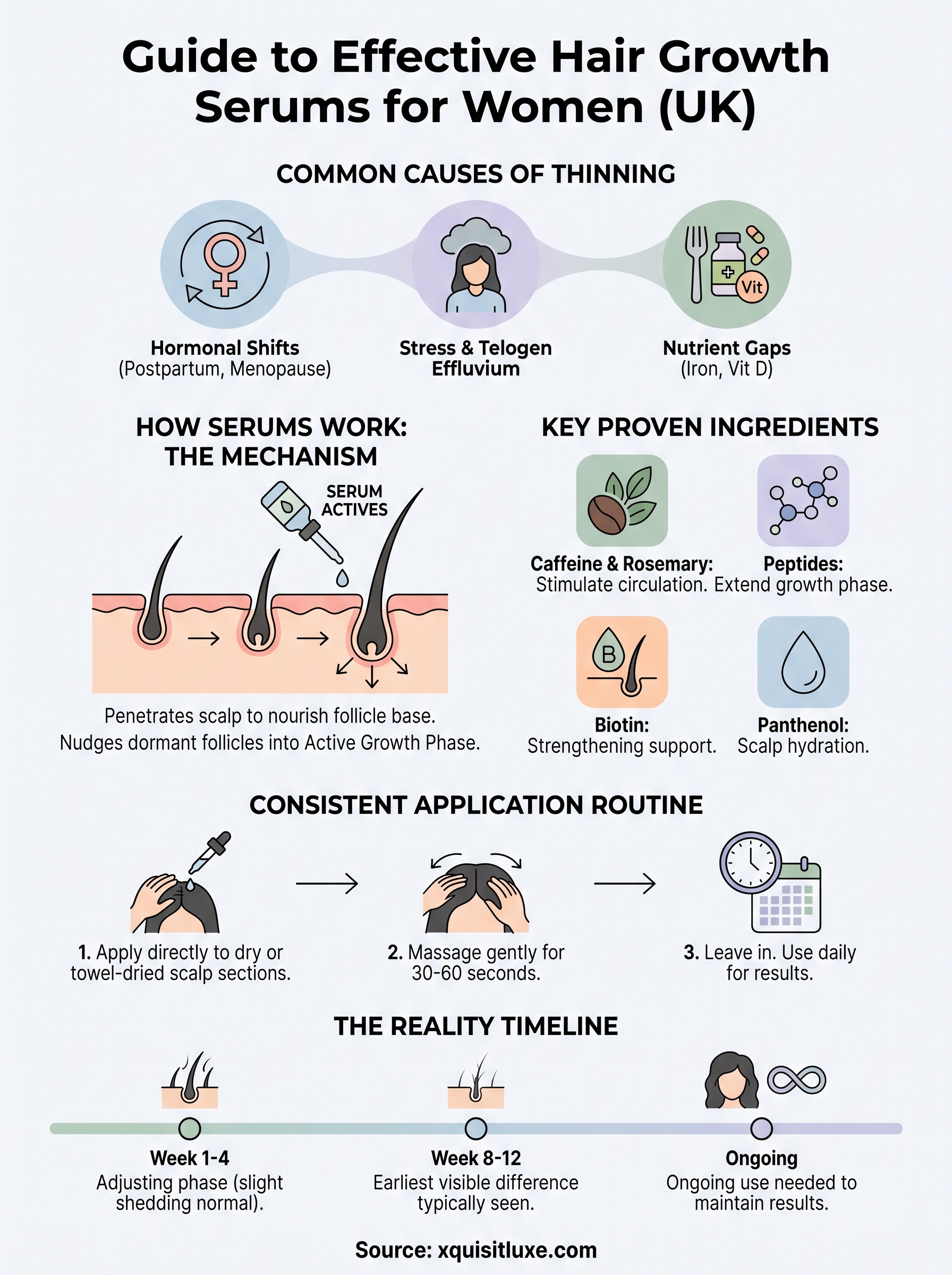
Hair thinning rarely has one single cause, which is why a serum that works for your friend might do nothing for you. Hormonal shifts are one of the biggest triggers, whether that's postpartum, perimenopause, or coming off hormonal contraception, all of which can push more follicles into the resting phase at once. Genetics also play a role, and female pattern hair loss tends to show up as diffuse thinning across the crown rather than a receding hairline like the male pattern.
Stress deserves its own mention because it's often overlooked until months after the trigger event. A period of intense physical or emotional stress can cause telogen effluvium, a temporary shedding phase that peaks around three months later, which catches a lot of women off guard. Nutrient deficiencies, particularly low iron, vitamin D, or zinc, show up on a blood test more often than people expect once they start investigating unexplained shedding.
Other common causes include:
- Thyroid conditions, both under and overactive
- Tight hairstyles causing traction alopecia at the temples
- Harsh chemical treatments or excessive heat styling
- Certain medications, including some blood pressure drugs
- Scalp conditions like psoriasis or seborrheic dermatitis
Treating thinning hair without knowing the cause is a bit like guessing the dose before you know the illness, so start with why before you buy.
Getting a clearer picture, ideally with a GP blood test if shedding feels sudden or severe, helps you choose a serum with the right actives rather than picking one at random off the shelf.
10. How do hair growth serums actually work
Most formulas work on the hair growth cycle, not on hair that's already gone. Every strand moves through anagen (active growth), catagen (transition), and telogen (resting and shedding), and a serum's job is to nudge more follicles into that active anagen phase and keep them there longer. That's why a hair growth serum for women rarely produces overnight results; you're working with a biological cycle that takes months to shift, not a switch you flip.
Delivery matters as much as the actives themselves. A serum sits directly on the scalp rather than coating the hair shaft, which means the formula needs to penetrate skin and reach the follicle base where growth actually starts. Ingredients like caffeine and peptides are chosen partly because they're small enough to absorb through the scalp barrier, unlike heavier oils that mostly sit on the surface.
If an ingredient can't reach the follicle, it can't influence the growth cycle, no matter how impressive it sounds on the label.
Circulation plays a supporting role too. Better blood flow to the scalp delivers oxygen and nutrients to follicles working overtime to produce new hair, which is why rosemary, peppermint, and caffeine appear across so many formulas on this list. According to the NHS, most hair loss in women is temporary and often improves once the underlying trigger, whether hormonal, nutritional, or stress-related, is addressed, which is worth keeping in mind: a serum supports the cycle, but it can't override a cause that hasn't been dealt with.
11. Key ingredients to look for in a hair growth serum
Reading a label properly saves you from buying the same serum twice under a different name. Look past the front-of-bottle claims and check the actual ingredient list, since that's where you'll spot whether a formula contains genuine actives or mostly water, fragrance, and filler oils dressed up with a growth claim.
Certain ingredients turn up again and again across the serums in this guide because the evidence behind them holds up. Here's a quick reference for what each one actually does once it's on your scalp:
| Ingredient | What it does |
|---|---|
| Caffeine | Stimulates circulation and follicle activity |
| Peptides (redensyl, procapil) | Signal follicles to extend the active growth phase |
| Biotin | Supports strand strength and reduces breakage |
| Rosemary/peppermint oil | Boosts scalp blood flow |
| Aminexil | Loosens collagen build-up restricting follicle growth |
| Panthenol | Hydrates scalp and conditions strands |
If you can't pronounce most of the ingredient list, that's usually a sign the formula is padded rather than purposeful.
Avoid bottles that list silicones or heavy fragrance near the top, since these coat the scalp rather than penetrate it, which defeats the point of a growth serum entirely. A short, recognisable ingredient list with two or three proven actives beats a long one stuffed with botanicals included purely for marketing appeal.
12. How to use a hair growth serum for the best results
Consistency beats concentration when it comes to any hair growth serum for women, and most disappointing results trace back to patchy application rather than a weak formula. Skipping a few days here and there resets the progress you were making, since follicles need sustained stimulation over weeks to shift into an active growth phase and stay there.
Application technique matters more than people assume. Dropper serums work best when applied to a dry or towel-dried scalp, parted in sections so the liquid reaches the skin rather than sitting on top of hair strands. Massage it in with fingertips for thirty seconds to a minute, focusing on areas where thinning is most visible, since gentle pressure also boosts local circulation.
A simple routine looks like this:
- Part hair into four to six sections for even coverage
- Apply the recommended drops directly to the scalp, not the lengths
- Massage for 30 to 60 seconds using fingertips, not nails
- Leave the product in rather than rinsing it out
- Apply once or twice daily, exactly as the label states
- Avoid washing hair for at least a few hours afterwards
Skipping application even a handful of times a month can undo weeks of consistent progress, so treat a hair serum like a daily habit, not an occasional treatment.
Timing also plays a part. Applying serum straight after washing, once hair is towel-dried rather than soaking wet, tends to improve absorption compared with slapping it onto damp lengths where water dilutes the actives before they reach the follicle.
13. Hair growth serum vs hair oil: what's the difference
Confusing these two products wastes money, since they're built to do different jobs even though they both end up on your scalp. A hair growth serum is formulated with concentrated actives like caffeine, peptides, or aminexil, designed to penetrate the scalp and influence the follicle directly. Hair oil, by contrast, mostly sits on the strand and scalp surface, offering shine, softness, and a barrier against moisture loss rather than any real influence on the growth cycle itself.
Texture gives away the difference immediately. Serums are usually water or gel-based, lightweight, and absorb quickly, while oils are thicker and designed to coat rather than sink in. That's not a flaw in oil, it's simply a different purpose: castor oil and coconut oil condition and protect existing hair, reducing breakage along the length, but they aren't formulated to reach the follicle base the way a serum's smaller molecules can.
Oil looks after the hair you already have, while a serum works on the hair you're trying to grow.
| Factor | Hair growth serum | Hair oil |
|---|---|---|
| Main goal | Stimulate follicle activity | Condition and protect strands |
| Texture | Lightweight, fast-absorbing | Thicker, sits on the surface |
| Key actives | Caffeine, peptides, aminexil | Castor, coconut, argan oils |
| Best used | Directly on scalp | On lengths and ends |
Many women use both together, applying serum to the scalp and oil to the ends, since neither one replaces what the other does properly.
14. How to choose the right serum for your hair concern
Matching a serum to your actual concern matters more than chasing whichever bottle has the best reviews. Postpartum shedding responds differently to a formula than diffuse thinning linked to menopause, and an oily, irritated scalp needs a calmer approach than one built purely for stimulation. Before buying, ask yourself what's driving the thinning: is it sudden and stress-related, gradual and hormonal, or tied to a scalp condition that flares up first?
Use your concern as the starting filter rather than price or packaging. Here's a quick way to narrow the field:
- Postpartum or stress-related shedding: look for gentle, natural formulas with biotin and rosemary, like the Xquisit Luxe serum
- Diffuse thinning across the whole scalp: peptide-led formulas such as Grow Gorgeous or The Ordinary
- Progressive thinning over months: clinically backed actives like aminexil in Vichy Dercos
- Oily or easily irritated scalp: Ayurvedic, cooling formulas like Chāmpo
- Weakened, breakage-prone hair: strengthening peptide serums like UKLASH
- Unclear or multiple triggers: a personalised service such as Hair + Me
The right hair growth serum for women is the one matched to your actual cause, not the one with the loudest marketing.
Budget and patience matter too. A cheaper bottle that suits your concern beats an expensive subscription that doesn't, and no serum on this list works faster than the hair growth cycle allows. Give any new formula eight to twelve weeks before judging results, and switch only if you've genuinely mismatched the actives to your concern rather than simply run out of patience.
15. Are hair growth serums safe? Possible side effects
Most hair growth serums are safe for the majority of women, but "safe" doesn't mean risk-free for everyone. Scalp irritation is the most common complaint, usually showing up as redness, tingling, or mild itching in the first week or two as your skin adjusts to a new active. Peppermint and rosemary oils cause this more often than synthetic actives, though it usually settles once your scalp gets used to the formula.
Certain ingredients carry specific warnings worth knowing before you buy. Aminexil, found in Vichy Dercos, isn't recommended during pregnancy or breastfeeding, and caffeine-heavy serums can occasionally cause a burning sensation on broken or sunburnt skin. Peptide formulas tend to be the gentlest option across this list, which is partly why brands like The Ordinary and UKLASH market them as suitable for sensitive scalps.
A patch test on the inside of your wrist, left for 24 hours, catches most reactions before they happen on your scalp.
Always patch test a new serum, and stop use immediately if you notice swelling, hives, or persistent burning rather than mild tingling. Pregnant or breastfeeding women should check ingredient lists carefully, since several actives common in this category lack safety data for that stage. If you're managing a diagnosed scalp condition like psoriasis, ask a pharmacist before adding a new serum, since some formulas can aggravate flare-ups rather than calm them. According to the NHS, persistent or worsening hair loss alongside other symptoms is worth raising with a GP rather than treating with over-the-counter products alone.
16. Your hair growth serum questions answered
Questions about hair growth serum for women tend to repeat across customer emails and reviews, so here are the ones worth clearing up before you buy.
How long before I see results?
Genuinely, most women need eight to twelve weeks before noticing a difference, since you're working with a growth cycle rather than an instant fix. Anyone promising visible regrowth within days is stretching the truth.
Can I use a serum alongside other hair loss treatments?
Usually yes. Layering a scalp serum with a strengthening shampoo or supplement rarely causes problems, though combining two active-heavy treatments, like aminexil and a strong peptide formula, is worth checking with a pharmacist first.
Do serums work on all types of hair loss?
Not always. Scarring alopecia and some autoimmune conditions like alopecia areata need medical treatment rather than an over-the-counter serum, so a GP referral matters more than another bottle in these cases.
Is it normal for shedding to increase at first?
Slightly, yes. Some women notice a short shedding phase in the first few weeks as weaker hairs make way for stronger regrowth, and this typically settles by week four.
If shedding increases sharply or doesn't settle within a month, stop and speak to a pharmacist rather than pushing through.
Do I need to keep using it forever?
Most formulas require ongoing use to maintain results, since stopping allows follicles to drift back into their previous resting pattern within a few months.
Choosing the serum that's right for your hair
Eight serums, one clear takeaway: the best hair growth serum for women is the one matched to your actual cause, not the one with the flashiest bottle. Postpartum shedding, hormonal thinning, and an irritated scalp all need different actives, so start there before you spend a penny. Give whichever formula you pick a proper eight to twelve week run, apply it daily, and resist swapping products every fortnight out of impatience.
Remember too that a serum works alongside your routine, not instead of one. Diet, stress levels, and how you treat your scalp day to day all shape whether those actives get a fair chance to work.
Our pick for most people: Biotin Hair Serum with Caffeine 10% — £16.99
A certified natural, lightweight scalp serum built around biotin with castor oil, rosemary extract and peppermint oil, designed for fine and thinning hair without silicones or synthetic fragrance. Made in the UK, dermatologist tested and cruelty-free.
Free UK delivery on orders over £25, and a 30-day money-back guarantee. New customers get 10% off a first order with the Xquisit Club newsletter.
