


Thinning hair, excess shedding, and sluggish growth affect millions of people across the UK, and the right hair oil can make a genuine difference. If you've been searching for the best hair oil for hair growth UK, you're not short of options, but not every oil lives up to its claims. Some are packed with silicones and fragrances that do little beyond making your hair smell nice for an hour. Others contain potent, naturally derived ingredients that actually nourish the scalp and support stronger, fuller strands over time.
If you want to see this in action, our Rosemary Oil for Hair Growth is formulated with these principles in mind.
At Xquisit Luxe Self Care, we formulate our hair care products right here in the UK using certified natural ingredients, no harsh chemicals, no animal testing. Our Hair Growth Oil and Hair Regrowth Bundle were developed specifically for people dealing with thinning and breakage, so we know what separates an effective oil from a marketing gimmick.
This guide breaks down nine hair oils worth your attention, including what makes each one effective, which hair types they suit best, and how to use them properly. Whether you're tackling postpartum shedding, stress-related thinning, or simply want thicker hair, you'll find a solid option below. We've also included key ingredients to look for, and a few to avoid, so you can shop with confidence.
1. Xquisit Luxe hair growth oil
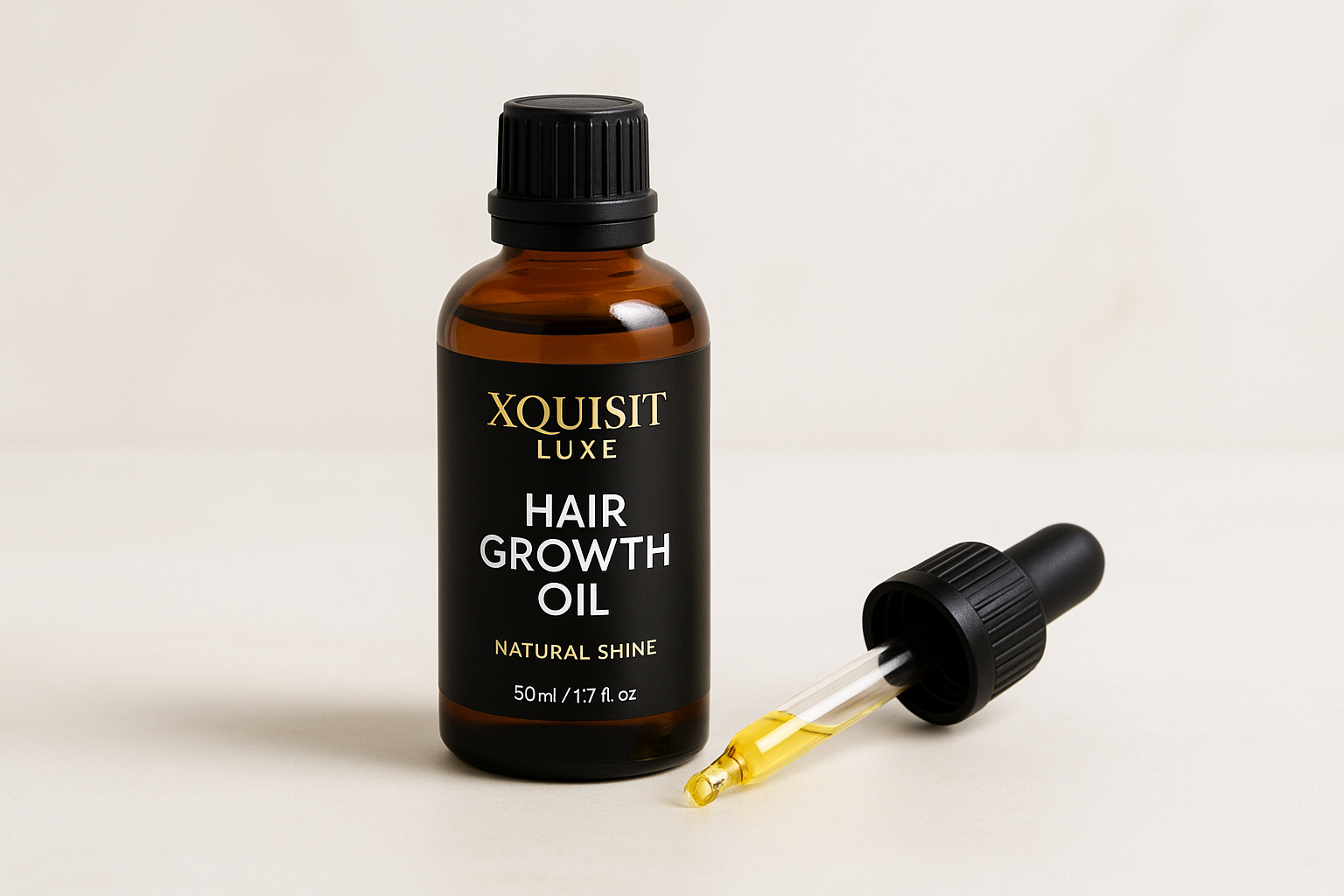
The Xquisit Luxe Hair Growth Oil sits at the top of this list for good reason. It combines a carefully selected blend of natural oils and plant extracts, all formulated and produced in the UK, to target thinning hair at the root cause rather than simply coating the surface.
What it is and what to expect
The Xquisit Luxe Hair Growth Oil is a lightweight, fast-absorbing scalp treatment built around a blend of natural carrier oils and active botanical ingredients. You can expect less shedding within the first few weeks of consistent use, with visible improvements in density and length typically appearing after six to eight weeks. It works by addressing scalp health and hair follicle function directly rather than just adding shine or slip to your hair.
Why it can support growth and reduce breakage
Its formula includes ingredients that improve blood circulation to the scalp, which feeds the follicles the oxygen and nutrients they need to enter and sustain the growth phase. It also contains nourishing oils that seal moisture into the hair shaft, reducing the brittleness that leads to breakage. Fewer breakages mean you retain more length over time, which is often the missing piece for people who feel their hair never seems to grow.
Scalp health is the foundation of hair growth. If your scalp is dry, inflamed, or clogged with product build-up, even the best hair oil for hair growth UK cannot deliver results.
How to use it in a weekly routine
Apply three to five drops directly to your scalp using the applicator tip, then massage for two to three minutes to stimulate circulation. Use it two to three times per week, either as an overnight treatment or 30 minutes before washing. Consistent application matters more than heavy use, so lighter and more frequent beats drenching your scalp once a week.
Who it suits best
This oil works particularly well for people dealing with stress-related or postpartum hair thinning, as well as those with a dry or sensitive scalp. Because the formula is dermatologist tested and free from synthetic fragrances, it suits people with reactive skin who have struggled to tolerate other hair oils in the past.
Rosemary Oil for Hair Growth — £14.99
A lightweight, fast-absorbing scalp treatment built around natural carrier oils and active botanicals, formulated to support follicle health and reduce breakage rather than simply coat the hair. Made in the UK, dermatologist tested and cruelty-free.
Free UK delivery on orders over £25, and a 30-day money-back guarantee. New customers get 10% off a first order with the Xquisit Club newsletter.
2. Rosemary oil
Rosemary oil has earned a strong reputation as one of the best hair oils for hair growth UK buyers keep returning to, and the science backs that up. A 2015 study published in SKINmed Journal found rosemary oil performed comparably to minoxidil after six months of use, with fewer side effects reported by participants.
What it is and what to expect
Extracted from the Rosmarinus officinalis plant, rosemary is an essential oil that needs diluting in a carrier oil before you apply it to your scalp. You can expect reduced shedding within four to six weeks of consistent use, with noticeable improvements in thickness typically appearing closer to three months in.
Why it can support growth and reduce breakage
The active compound carnosic acid in rosemary oil helps heal nerve and tissue damage, which rejuvenates scalp circulation and allows follicles to receive more nutrients. It also carries anti-inflammatory properties that calm an irritated or flaky scalp, creating a better environment for sustained growth.
Consistent, diluted application matters far more than concentration. Applying undiluted essential oils directly to your scalp can cause irritation and worsen shedding.
How to use it in a weekly routine
Mix four to six drops of rosemary essential oil with a tablespoon of a carrier oil like jojoba or almond oil. Massage the blend into your scalp two to three times per week and leave it on for at least 30 minutes before shampooing.
Who it suits best
Rosemary oil works well for people experiencing androgenic alopecia or general thinning, and it suits most hair types. Those with oily scalps should choose a lighter carrier oil, such as jojoba, to avoid weighing the hair down.
How it compares
Neat rosemary oil has the strongest single-ingredient evidence base on this list — the 2015 SKINmed study put it alongside minoxidil over six months with fewer side effects reported, and carnosic acid brings a genuine anti-inflammatory benefit for a flaky or irritated scalp. The catch is that it's a raw essential oil, not a finished product: you have to dilute it correctly in a carrier every single time, and applying it undiluted can irritate the scalp and make shedding worse. A ready-to-use UK-made formula does that blending for you at a level that has already been dermatologist tested.
3. Castor oil
Castor oil is one of the most widely used oils for hair growth in the UK, and its thick, sticky consistency is part of what makes it so effective. It has been used in hair and scalp care for generations, and it remains a go-to option for people looking for dense nourishment and a natural way to combat thinning.
What it is and what to expect
Derived from the seeds of the Ricinus communis plant, castor oil is a thick, pale yellow oil with a high viscosity. Expect your hair to feel noticeably stronger and more moisturised after four to six weeks of regular use, though growth improvements typically take a full three months to become visible.
Why it can support growth and reduce breakage
Castor oil is rich in ricinoleic acid, a unique fatty acid that makes up around 90% of its composition. This compound improves scalp circulation and carries anti-fungal and anti-inflammatory properties that help address dandruff and scalp irritation, both of which can slow the hair growth cycle down.
A healthy, clean scalp is essential if you want any of the best hair oil for hair growth UK options to work effectively.
How to use it in a weekly routine
Because castor oil is thick, blend it with a lighter carrier oil such as almond or jojoba in a 1:2 ratio before applying. Massage into your scalp once or twice a week and leave it for at least an hour before washing out thoroughly.
Who it suits best
Castor oil suits people with dry scalps, brittle hair, or slow-growing hair. Those with fine or oily hair should use it sparingly, as over-application can weigh strands down.
How it compares
Castor oil earns its long-standing reputation on ricinoleic acid, which makes up around 90% of the oil and brings anti-fungal and anti-inflammatory properties alongside better scalp circulation — genuinely useful if dandruff or irritation is slowing your growth cycle. The drawbacks are practical rather than scientific: it's thick and sticky, it needs blending with a lighter carrier at roughly one to two before it's usable, it wants an hour on the scalp and a thorough wash out afterwards, and fine or oily hair is easily weighed down by it. A ready-to-use UK-made formula is lighter and faster-absorbing, with the blending already done for you.
4. Coconut oil
Coconut oil is one of the most recognisable names in natural hair care, and it consistently appears in conversations about the best hair oil for hair growth UK shoppers can actually find on a budget. Its wide availability and versatile application make it a practical starting point for anyone building a scalp care routine.
What it is and what to expect
Extracted from mature coconut kernels, coconut oil is a solid at room temperature and melts quickly between your palms before application. Most people notice softer, more manageable hair within the first two to three weeks, while meaningful improvements to breakage and overall density tend to appear closer to six to eight weeks of consistent use.
Why it can support growth and reduce breakage
Coconut oil is uniquely high in lauric acid, a medium-chain fatty acid with a small molecular structure that can penetrate the hair shaft rather than just sitting on top of it. This penetration reduces protein loss during washing, which is a key driver of breakage in people with fine or chemically treated hair.
Protein loss is a leading cause of hair breakage, and reducing it through regular oil application helps you retain significantly more length over time.
How to use it in a weekly routine
Warm one to two teaspoons between your palms and apply it directly to your scalp and mid-lengths. Leave it on for 30 minutes to overnight before shampooing, and use it once or twice a week.
Who it suits best
Coconut oil works best for people with dry, coarse, or colour-treated hair. Those with fine or low-porosity hair should use it sparingly, as it can cause build-up.
How it compares
Coconut oil's real edge is lauric acid, whose small molecular structure lets it penetrate the hair shaft rather than sit on top of it, cutting the protein loss during washing that drives breakage in fine and chemically treated hair. It's also one of the easiest oils on this list to get hold of. Where it falls short is scalp work: it's solid at room temperature so it needs melting first, it wants anything from 30 minutes to a full night to do its job, and it causes build-up on fine or low-porosity hair. A ready-to-use UK-made scalp formula absorbs quickly and is aimed at the follicle rather than the strand.
5. Jojoba oil
Jojoba oil stands out from most other hair oils because it is technically a liquid wax, not an oil. This distinction matters because jojoba closely mimics the sebum your scalp produces naturally, making it exceptionally well-tolerated and easy to absorb without leaving heavy residue behind.
What it is and what to expect
Extracted from the seeds of the Simmondsia chinensis shrub, jojoba oil has a golden colour and a light, silky texture. Most people notice a more balanced scalp and less greasiness within two to three weeks of regular use, with improved hair strength and reduced breakage typically appearing after four to six weeks of consistent application.
Why it can support growth and reduce breakage
Jojoba helps unclog hair follicles by dissolving excess sebum and product build-up that can block growth over time. It also delivers vitamins B and E alongside zinc directly to the scalp, all of which support follicle health and the hair growth cycle.
A clogged follicle cannot produce hair effectively, so keeping your scalp clear is one of the most direct steps you can take for sustained growth.
How to use it in a weekly routine
Apply four to six drops directly to your scalp two to three times per week and massage for two minutes. You can also use jojoba as a carrier oil to dilute essential oils like rosemary or peppermint before scalp application.
Who it suits best
Jojoba suits all hair types, but works particularly well for oily scalps and anyone dealing with product build-up. Its lightweight texture makes it one of the best hair oil for hair growth UK options available for people with fine hair who worry about weighing strands down.
How it compares
Jojoba is technically a liquid wax rather than an oil, and that's precisely the point: it closely mimics your scalp's own sebum, so it's exceptionally well tolerated, absorbs without residue, and helps unclog follicles by dissolving excess sebum and build-up, while delivering vitamins B and E plus zinc. What it doesn't do is act as a growth stimulant in its own right — its usual job is as the base you dilute actives like rosemary or peppermint into, rather than the active itself. A ready-to-use UK-made formula pairs that kind of light, well-tolerated base with the actives already blended in.
6. Argan oil
Argan oil comes from the kernels of the Argania spinosa tree, native to Morocco, and has built a solid reputation in hair care for its ability to smooth, strengthen, and protect without feeling heavy. It is one of the more refined options on this list, sitting comfortably between a treatment oil and a finishing oil.
What it is and what to expect
Argan oil has a light, golden texture that absorbs quickly into both the scalp and hair shaft. Most people notice reduced frizz and improved shine within the first week of use, with stronger, less breakage-prone strands typically becoming apparent after four to six weeks of consistent application.
Why it can support growth and reduce breakage
Argan oil is rich in oleic and linoleic acids, both of which nourish hair follicles and help the scalp maintain a healthy moisture balance. It also delivers a high concentration of vitamin E and antioxidants that protect the scalp from oxidative stress, a factor that can disrupt the natural hair growth cycle over time.
Oxidative stress at the scalp level can shorten the active growth phase of your hair follicles, so using an antioxidant-rich oil consistently helps protect the cycle.
How to use it in a weekly routine
Warm three to four drops between your palms and massage into your scalp two to three times a week. You can also apply a small amount to your mid-lengths and ends after washing to reduce breakage between treatments.
Who it suits best
Argan oil is one of the most versatile of the best hair oil for hair growth UK options available, suiting all hair types including fine, colour-treated, and heat-damaged hair.
How it compares
Argan sits between a treatment oil and a finishing oil, and it's probably the most versatile thing on this list: light, fast-absorbing, and suitable for fine, colour-treated and heat-damaged hair, with oleic and linoleic acids nourishing the follicle and vitamin E and antioxidants protecting the scalp from oxidative stress. The honest limitation is emphasis — most of what you'll see in the first week is less frizz and more shine, with strength gains taking four to six weeks, so it protects hair at least as much as it grows it. A ready-to-use UK-made scalp formula is aimed squarely at density and shedding rather than finish.
7. Almond oil
Almond oil is an underrated but effective option among the best hair oil for hair growth UK choices available today. It offers a gentle yet nourishing approach to scalp care, making it accessible even for those with sensitive skin or a reactive scalp.
What it is and what to expect
Pressed from the kernels of sweet almonds (Prunus dulcis), almond oil has a light, pale golden colour and a smooth, non-greasy texture that makes it easy to work into both scalp and hair. Expect reduced dryness and improved softness within two to three weeks of regular use, with noticeable reductions in breakage appearing after four to six weeks of consistent application.
Why it can support growth and reduce breakage
Almond oil is rich in magnesium, a mineral directly linked to reducing hair loss by strengthening the hair shaft. It also delivers a high vitamin E content alongside oleic and linoleic acids that nourish follicles and help maintain scalp moisture balance without clogging pores.
Magnesium deficiency has been associated with increased hair shedding, so using a magnesium-rich oil consistently helps address one of the less obvious contributors to thinning.
How to use it in a weekly routine
Warm three to four drops between your palms and massage directly into your scalp two to three times per week. You can also apply a small amount to your ends as a leave-in treatment to reduce split ends and breakage between washes.
Who it suits best
Almond oil works particularly well for people with dry, brittle, or fine hair, and suits sensitive scalps due to its mild, low-irritation profile.
How it compares
Almond oil is the gentlest option here and the easiest to tolerate — a smooth, non-greasy texture, a low-irritation profile that suits reactive scalps, and magnesium alongside vitamin E and oleic and linoleic acids to strengthen the shaft without clogging pores. For dry, brittle or fine hair it's a sensible pick. What it isn't is a stimulant: it works on moisture and breakage rather than on follicle activity, which is why it usually appears as the carrier in a blend rather than the star of one. A ready-to-use UK-made formula combines that same nourishment with actives aimed directly at the follicle.
8. Peppermint oil
Peppermint oil is one of the most research-backed essential oils for scalp stimulation, and it earns its place among the best hair oil for hair growth UK options due to its direct, measurable effect on follicle activity.
What it is and what to expect
Derived from the Mentha piperita plant, peppermint oil is a potent essential oil that must always be diluted before applying to your scalp. Most people notice a cooling, tingling sensation immediately after application, which signals increased blood flow to the area. Visible reductions in shedding typically appear after six to eight weeks of consistent use.
Why it can support growth and reduce breakage
The primary active compound in peppermint oil is menthol, which works as a vasodilator, widening blood vessels at the scalp and increasing circulation to your hair follicles. A 2014 study published in Toxicological Research found that peppermint oil increased follicle depth and number within four weeks of topical application.
Vasodilation at the scalp level directly increases the delivery of oxygen and nutrients to follicles, supporting a longer and more productive growth phase.
How to use it in a weekly routine
Mix three to five drops of peppermint essential oil with a tablespoon of carrier oil such as jojoba or almond oil. Massage the blend into your scalp two to three times per week and leave it on for at least 20 minutes before washing out.
Who it suits best
Peppermint oil works well for people with oily or congested scalps, as it helps regulate sebum production alongside stimulating growth. Those with sensitive or broken skin on the scalp should avoid it until the skin has fully healed.
How it compares
Peppermint has some of the clearest research behind it: the 2014 Toxicological Research study found increased follicle depth and number within four weeks, and menthol acts as a genuine vasodilator, which is why the tingle is immediate. The limits are handling and tolerance — it's a potent essential oil that must always be diluted before it touches your scalp, and it should be avoided entirely on sensitive or broken skin until that has healed. A ready-to-use UK-made formula delivers that kind of stimulation pre-blended at a dermatologist-tested level, rather than one you have to mix correctly yourself each time.
9. Black seed oil
Black seed oil is one of the most potent options among the best hair oil for hair growth UK users seek for thinning or shedding-prone hair. Its long history in traditional medicine, combined with a growing body of modern research, makes it a compelling choice.
What it is and what to expect
Pressed from the seeds of Nigella sativa, black seed oil has a dark amber colour and a distinctive, slightly bitter aroma. You can expect reduced shedding and a less irritated scalp within four to six weeks, with visible improvements in density typically appearing after eight to ten weeks of consistent use.
Why it can support growth and reduce breakage
Black seed oil contains thymoquinone, a compound with well-documented anti-inflammatory and antioxidant properties that help protect follicles from damage and support a healthy growth cycle. It also delivers essential fatty acids and amino acids that strengthen the hair shaft and reduce the brittleness that leads to breakage.
Thymoquinone directly reduces scalp inflammation, which is one of the most common but overlooked drivers of chronic hair shedding.
How to use it in a weekly routine
Massage three to five drops into your scalp two to three times per week, either alone or blended with a lighter carrier oil such as jojoba. Leave it on for at least 30 minutes before washing out thoroughly.
Who it suits best
Black seed oil works particularly well for people experiencing inflammation-related shedding or alopecia areata, and it suits most hair types including natural and chemically treated hair.
How it compares
Black seed oil is the one to look at if inflammation is what's driving your shedding: thymoquinone has well-documented anti-inflammatory and antioxidant properties, and the essential fatty acids and amino acids alongside it strengthen the shaft and reduce brittleness. It suits most hair types, including natural and chemically treated hair. Two things to expect — a distinctive, slightly bitter aroma, and a slower timeline than most, with density changes typically taking eight to ten weeks. A ready-to-use UK-made formula works on the same scalp-health foundation in a lighter, faster-absorbing, fragrance-free base.
How to choose the right hair oil for your hair and scalp
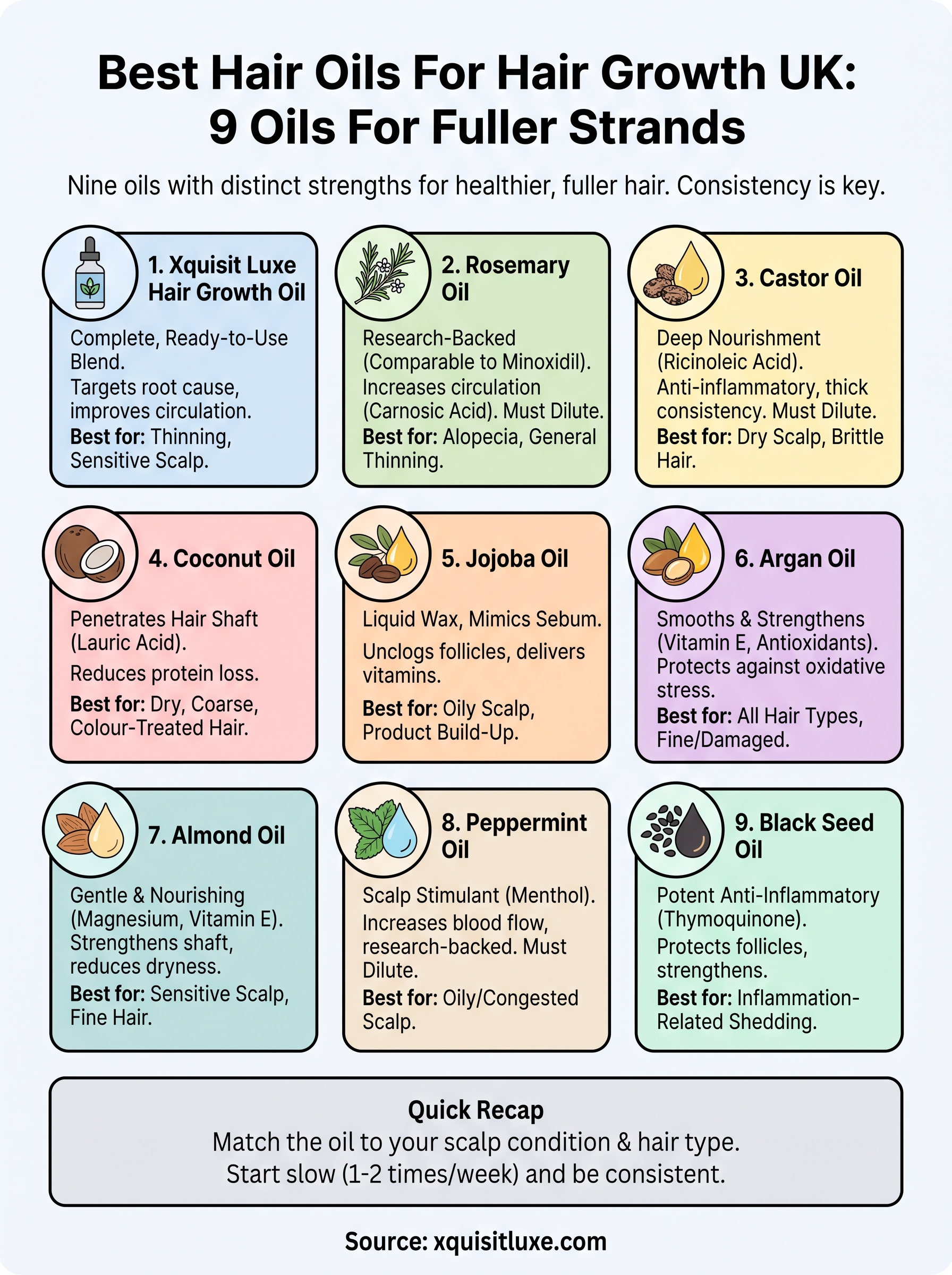
With nine strong options, the honest answer is that the best hair oil for hair growth UK shoppers can buy is the one that matches your actual scalp condition — not the one with the loudest reputation. Use this as a quick shortcut before you buy.
- ✓ Thinning or shedding at the root — reach for a stimulant like rosemary or peppermint, or a ready-blended scalp formula that already contains them at a safe, tested strength.
- ✓ Dry, brittle lengths that snap — coconut, castor or almond oil seal moisture into the shaft and cut the breakage that quietly costs you length.
- ✓ Oily or congested scalp — jojoba and peppermint help rebalance sebum and clear follicles without weighing hair down.
- ✓ Sensitive or reactive scalp — almond and jojoba are the gentlest, and a fragrance-free, dermatologist-tested formula removes most of the guesswork.
- ✓ Inflammation-driven shedding — black seed oil's thymoquinone targets the irritation that keeps hair in the resting phase.
If you would rather not diagnose your own scalp or mix carrier oils by hand, a finished UK-made blend does that work for you — which is why our own Rosemary Oil for Hair Growth sits at the top of this guide.
How to apply hair oil so it actually works
Most people who feel a hair oil "did nothing" were using it the wrong way, not using the wrong oil. Get the method right and almost any oil on this list performs better.
- ✓ Patch test first — dab a little behind your ear and wait 24 hours, especially with potent essential oils like rosemary and peppermint.
- ✓ Warm it slightly — a few seconds between your palms helps the oil spread and absorb instead of pooling on the surface.
- ✓ Work the scalp, not just the lengths — growth happens at the follicle, so massage into the scalp for two to three minutes to boost circulation.
- ✓ Little and often — two to three light applications a week beats drowning your scalp once; consistency is what moves the needle.
- ✓ Dilute essential oils every time — four to six drops of rosemary or peppermint per tablespoon of a carrier such as jojoba, never neat on skin.
Mistakes that stop hair oils working
If you have tried oils before and given up, one of these is usually the reason.
- ✓ Expecting overnight results — the hair growth cycle is slow. Give any oil at least six to eight weeks of steady use before you judge it.
- ✓ Using undiluted essential oils — neat rosemary or peppermint can irritate the scalp and make shedding worse, the opposite of what you want.
- ✓ Applying too much — heavy oil clogs follicles and is a nightmare to wash out; a few drops is plenty.
- ✓ Ignoring the basics — no oil can outwork poor sleep, crash dieting, iron or vitamin D deficiency, or constant heat and tight styling.
- ✓ Stopping too early — the moment you see progress is the moment to keep going, not to quit.
Frequently asked questions
How long does it take to see results from hair oil?
Most people notice less shedding within four to six weeks and visible improvements in thickness or density closer to eight to twelve weeks of consistent use. Hair grows roughly a centimetre a month, so patience and routine matter more than any single product.
Can I leave hair oil in overnight?
Yes, for most carrier oils like coconut, castor, argan and almond, an overnight treatment on a towel-covered pillow gives the oil time to absorb. Essential oils such as rosemary and peppermint are better left on for 20 to 60 minutes and then washed out, as they are more likely to irritate if left on skin for hours.
Do hair oils really regrow hair, or just reduce breakage?
Both, depending on the oil. Stimulants like rosemary and peppermint have research suggesting a genuine effect on follicle activity, while nourishing oils like coconut and almond mainly help you retain length by reducing breakage. For many people, keeping the hair they already have is the fastest visible "growth" they will see.
How often should I oil my hair for growth?
Two to three times a week is the sweet spot for most scalps. More than that risks build-up and clogged follicles; less than that rarely gives the scalp enough consistent support to change the growth cycle.
When should I see a doctor instead?
If you are losing hair in patches, shedding suddenly and heavily, or seeing a receding hairline or crown thinning that keeps progressing, speak to your GP or a trichologist. Oils support scalp health, but conditions like alopecia areata and pattern hair loss may need medical treatment alongside them.
Quick recap
Nine oils, each with a distinct strength. If you want a complete, ready-to-use formula built specifically for thinning hair, the Xquisit Luxe Hair Growth Oil gives you a dermatologist-tested blend without the guesswork. Rosemary and peppermint oil suit those who want research-backed scalp stimulation on a budget, provided you dilute them properly. Castor and coconut oil deliver deep nourishment for dry, brittle strands, while jojoba works best when your scalp needs rebalancing. Argan and almond oil offer lighter, everyday options that protect as much as they treat. Black seed oil rounds out the list for anyone dealing with inflammation-driven shedding.
Finding the best hair oil for hair growth UK comes down to matching the right oil to your specific scalp condition and hair type. Consistency always matters more than quantity. Start with one or two applications per week, give it at least six weeks, and track your results.
Our pick for most people: Rosemary Oil for Hair Growth — £14.99
A lightweight, fast-absorbing scalp treatment that blends natural carrier oils with active botanicals, so there's no diluting or mixing to get right before you use it. Made in the UK, dermatologist tested and cruelty-free.
Free UK delivery on orders over £25, and a 30-day money-back guarantee. New customers get 10% off a first order with the Xquisit Club newsletter.
