


You've probably seen dozens of hair growth oils promising thicker, fuller hair in just weeks. But does hair growth oil really work, or is it mostly clever marketing? It's a fair question, and one worth answering properly before you spend money on products that may not deliver what they claim. The truth, as with most things in skincare and haircare, sits somewhere between the hype and the scepticism.
At Xquisit Luxe Self Care, we formulate certified natural hair care products in the UK, including our own hair growth oils. So we have a vested interest in being honest here. If these oils didn't produce real results, our customers wouldn't come back, and they do, consistently. But we also believe you deserve to understand exactly what hair oils can and can't do before you commit to any product or routine.
This article breaks down the actual evidence behind hair growth oils, what the research says, which ingredients have clinical backing, and what kind of results you can realistically expect. We'll also cover why some oils outperform others and how to tell the difference between a genuinely effective formula and one that's all packaging. By the end, you'll have the clarity to make a confident, informed decision about whether a hair growth oil belongs in your routine.
Why hair growth oils rarely equal new growth
When people ask does hair growth oil really work, the most important thing to understand is what "hair growth" actually means at a biological level. Hair grows from follicles, which are small organs sitting beneath your scalp's surface. Whether those follicles are active, dormant, or miniaturised determines your overall hair density far more than anything you apply topically. This is the root of the confusion. Most people assume an oil that says "growth" on the label will stimulate new follicles into action. In reality, what most oils do is quite different, and understanding that difference will help you set realistic expectations before spending any money.
The follicle factor: what oils can't reach
Your hair follicles sit several millimetres below the scalp's surface, deep within the dermis layer of skin. Most topically applied products, including oils, do not penetrate to that depth. This is not a flaw unique to any particular oil; it is basic skin biology. Even highly bioactive botanical oils have molecular structures too large to travel through the epidermis and into the follicle itself. So if your hair loss stems from follicle miniaturisation, hormonal shifts, or genetic androgenic alopecia, applying oil to your scalp is unlikely to reverse that process in any direct way.
Most topical treatments cannot reach the follicle depth needed to stimulate genuinely new growth without clinical-level intervention.
For a dormant follicle to re-enter its active growing phase (anagen), it needs a specific biological signal. That signal, in cases of meaningful hair loss, typically comes from systemic factors: hormones, nutritional status, stress levels, or prescription treatments such as minoxidil. Topical oil application alone does not reliably trigger that signal for most people experiencing visible thinning, and any brand suggesting otherwise is overstating what the science currently supports.
Where breakage gets mistaken for hair loss
Here is where things get genuinely useful. A significant proportion of people who believe they have poor or stalled hair growth are actually dealing with excessive breakage. When hair snaps repeatedly mid-shaft, the visible result looks almost identical to slow or absent growth, because length never accumulates at a noticeable rate. Your follicles are producing hair at a normal pace; it simply breaks off before you can see the difference.
By coating the hair shaft and reducing friction, quality oils lower the rate of mechanical breakage caused by brushing, heat styling, and everyday environmental stress. Over weeks of consistent use, this means retained length and visibly improved density, which is a real, measurable outcome. It just is not the same as creating new follicular activity.
Recognising this distinction shifts your expectations in a practical direction. You stop waiting for an oil to perform a biological function it was never designed to perform, and you start evaluating it on what it can genuinely deliver: stronger individual strands, less shedding from breakage, and a healthier scalp environment that removes barriers to your hair reaching its natural potential.
How to use hair oil for real-world benefits
Understanding how to apply hair oil correctly matters more than most people realise. The method and consistency of your application determines whether you get the scalp-stimulating and strand-protecting benefits the oil is actually capable of delivering. If you are still asking does hair growth oil really work, the honest answer often comes down to whether you are using it in a way that lets it do its job properly.
Scalp massage: the technique that actually matters
Applying oil is not the only variable; how you work it into the scalp directly affects its impact. Use your fingertips, not your nails, and massage in small circular motions for at least three to five minutes. This technique increases local blood circulation, bringing oxygen and nutrients closer to your follicles, which creates a more receptive environment for healthy hair production. The oil itself is the vehicle, but the massage is what drives real scalp-level results.
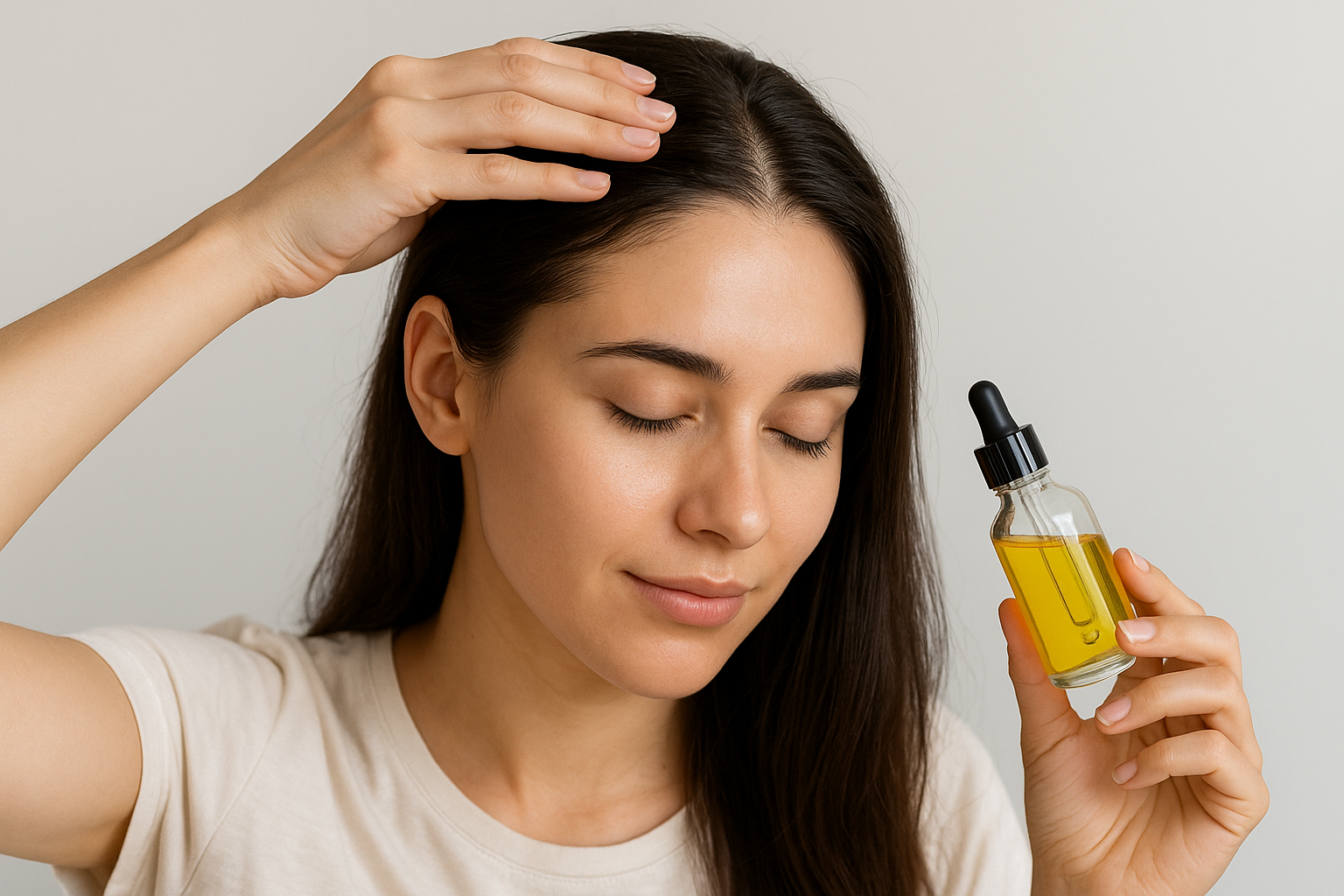
Scalp massage combined with oil application has shown more consistent benefits in studies than oil application alone, largely due to improved circulation.
Aim to apply your oil two to three times per week rather than every day. Daily use can build up on the scalp and block follicles, which works against everything you are trying to achieve. A small amount, roughly the size of a five pence coin, is enough for most people with short to medium-length hair.
Protecting the strand from root to tip
Your mid-lengths and ends need consistent moisture and barrier support to retain the length your follicles are already producing. Apply a small amount of oil to damp hair after washing, focusing on the lengths rather than the roots. This seals the cuticle and reduces the friction from styling, brushing, and environmental exposure that causes the kind of breakage most people misread as poor growth.
Pairing scalp application with strand care gives you a complete routine that addresses both the environment your hair grows in and the strength of each individual strand once it emerges. Both steps work together, and skipping one limits what the other can achieve.
What the evidence says about popular oils
When people ask does hair growth oil really work, the most credible way to answer is by looking at what the research actually shows for specific ingredients. The evidence is uneven across different oils. Some have genuine clinical data behind them, others are supported mainly by tradition and anecdote. Knowing which is which helps you spend money on something with a real mechanism rather than a compelling label.
Rosemary oil: the strongest evidence
Rosemary oil is the ingredient with the most convincing research behind it. A 2015 randomised controlled trial published in a peer-reviewed dermatology journal compared rosemary oil directly with 2% minoxidil, a clinically approved hair loss treatment, over six months. Both groups showed similar increases in hair count by the end of the trial, with rosemary producing fewer scalp-related side effects. That is a meaningful result, and it gives rosemary a degree of scientific credibility that most botanical oils simply do not have. The proposed mechanism involves improved circulation and inhibition of a hormonal pathway linked to androgenic hair thinning.
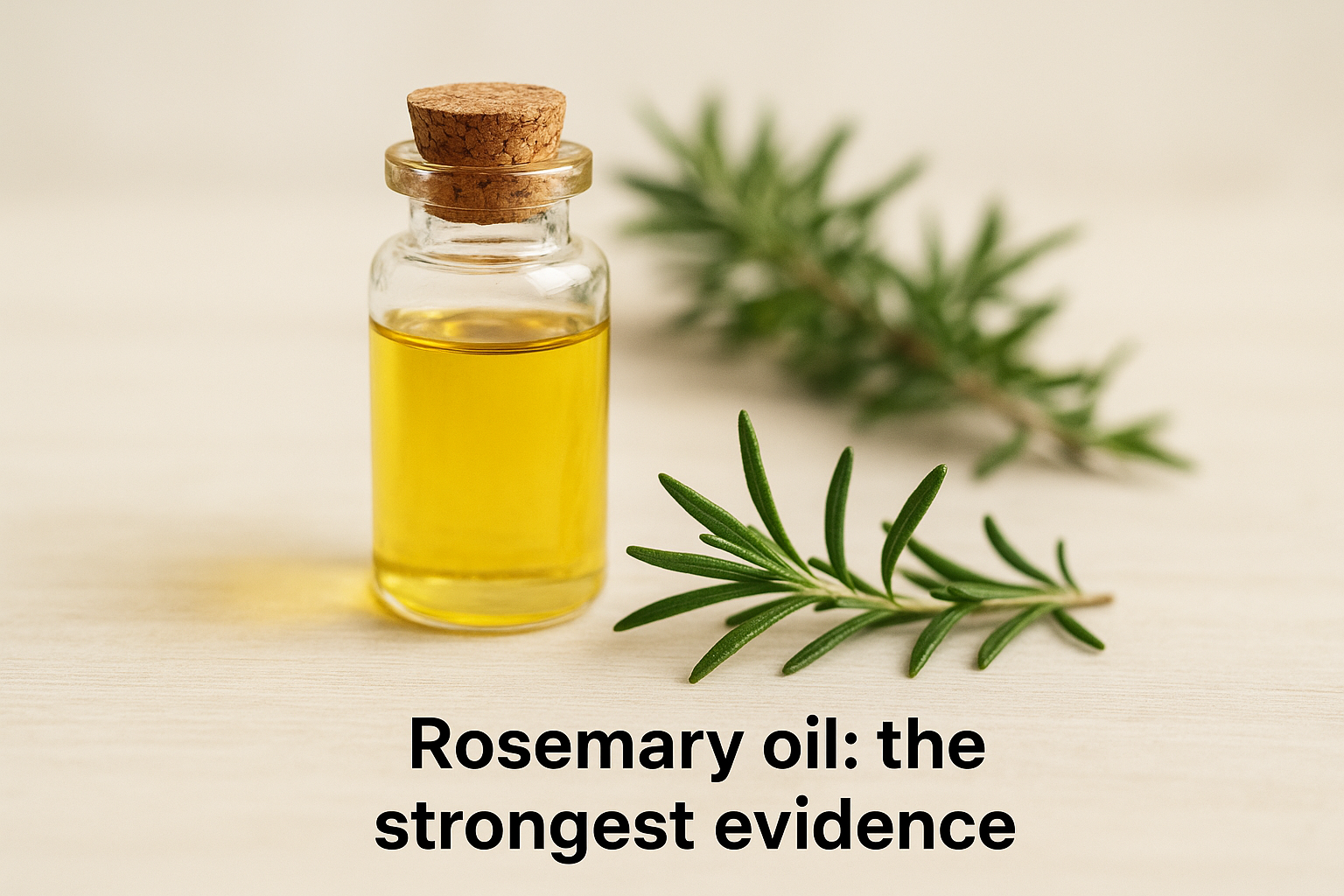
Rosemary oil is one of the few topical botanicals to show results comparable to a regulated pharmaceutical treatment in a controlled study.
Castor, coconut, and peppermint
Castor oil is widely used for hair, but the evidence behind it as a growth stimulant is largely anecdotal. Its main benefit appears to come from its thick consistency, which coats and seals the hair shaft effectively, reducing breakage and increasing the appearance of thickness. That is genuinely useful, but it is a conditioning effect rather than a follicle-level one. Coconut oil has better research behind its protective properties, particularly its ability to reduce protein loss from the hair shaft when applied before washing. Peppermint oil has shown some promise in early animal studies due to its circulation-boosting properties, though human clinical trials remain limited. For any of these oils to deliver their full benefit, the formula they sit in matters as much as the ingredient itself, including concentration, carrier oils, and how the product is designed to absorb.
When to skip oils and treat the cause
Answering does hair growth oil really work honestly means acknowledging that oils are not the right tool for every situation. If your hair loss stems from a deeper underlying cause, applying oil to your scalp will not address what is actually happening, and delaying proper treatment can make recovery slower and harder. Knowing when to step back from topical products and seek real intervention is one of the most useful pieces of information this article can give you.
Signs your hair loss needs medical attention
Sudden or rapid shedding that begins within a short timeframe is rarely something a topical oil can fix. This pattern is often linked to telogen effluvium, where a physical or emotional stressor, such as illness, surgery, rapid weight loss, or significant hormonal change, pushes a large number of follicles into the resting phase simultaneously. The trigger happened weeks before the shedding became visible, and the route to recovery runs through identifying and resolving that underlying stressor, not through what you apply to your scalp.
If you notice patchy hair loss, a receding hairline, or shedding that worsens consistently over months, speaking to a GP or dermatologist is the most effective next step.
Visible scalp changes such as redness, scaling, tenderness, or inflammation are also warning signs that the scalp environment itself needs treatment. Conditions like seborrheic dermatitis, psoriasis, or fungal infections require targeted medical or dermatological treatment first. Adding oil to an already inflamed or infected scalp can sometimes trap bacteria or irritants against the skin, which worsens the situation rather than improving it.
What actually treats the root cause
Clinically recognised treatments such as minoxidil, prescribed finasteride for men, or hormone therapy for women experiencing androgenic thinning operate at a systemic or follicular level that topical oils cannot reach. For nutritional deficiencies, particularly low ferritin, vitamin D, or zinc, addressing the gap through diet or supplementation will produce far more meaningful results than any external product. Oils work best as a complement to a healthy scalp foundation, not as a substitute for addressing the cause directly.
How long it takes and what to expect
One of the most common reasons people conclude that does hair growth oil really work is unanswerable is that they quit too early. Hair grows roughly one centimetre per month on average, and visible changes to length, density, or strength take time to register in a way you can see and measure. Setting a realistic timeline before you start is what separates a productive haircare routine from a frustrated one.
The first four to eight weeks
During the first month or two, do not expect dramatic visible change. What you are building in this period is a more consistent scalp environment and stronger, better-conditioned strands. Your hair will feel different before it looks different. You might notice reduced shedding in your brush or shower drain, which is an early and meaningful signal that the breakage cycle is slowing down. Some people also notice that existing strands feel smoother and less prone to tangling. These are real outcomes worth tracking, even if they do not photograph well.
Most people see their clearest results between weeks eight and twelve, not in the first few weeks, which is why premature judgements are common.
What consistent use looks like at three months
By the three-month mark, the gap between what your follicles are producing and what you are actually retaining starts to show. Length accumulates more noticeably when breakage has been reduced consistently over that period. If you combined oil application with regular scalp massage two to three times a week, improved circulation to the follicle area will have had enough time to make a measurable difference in strand health and density. Take photographs at the start, at four weeks, and at twelve weeks under the same lighting. Progress in haircare is gradual enough that without a reference point, you will likely underestimate what has changed.
Consistent application, correct technique, and realistic expectations are the three factors that determine whether your results match the potential of the product you are using. Missing any one of them makes results harder to assess and easier to dismiss unfairly.
Final takeaway
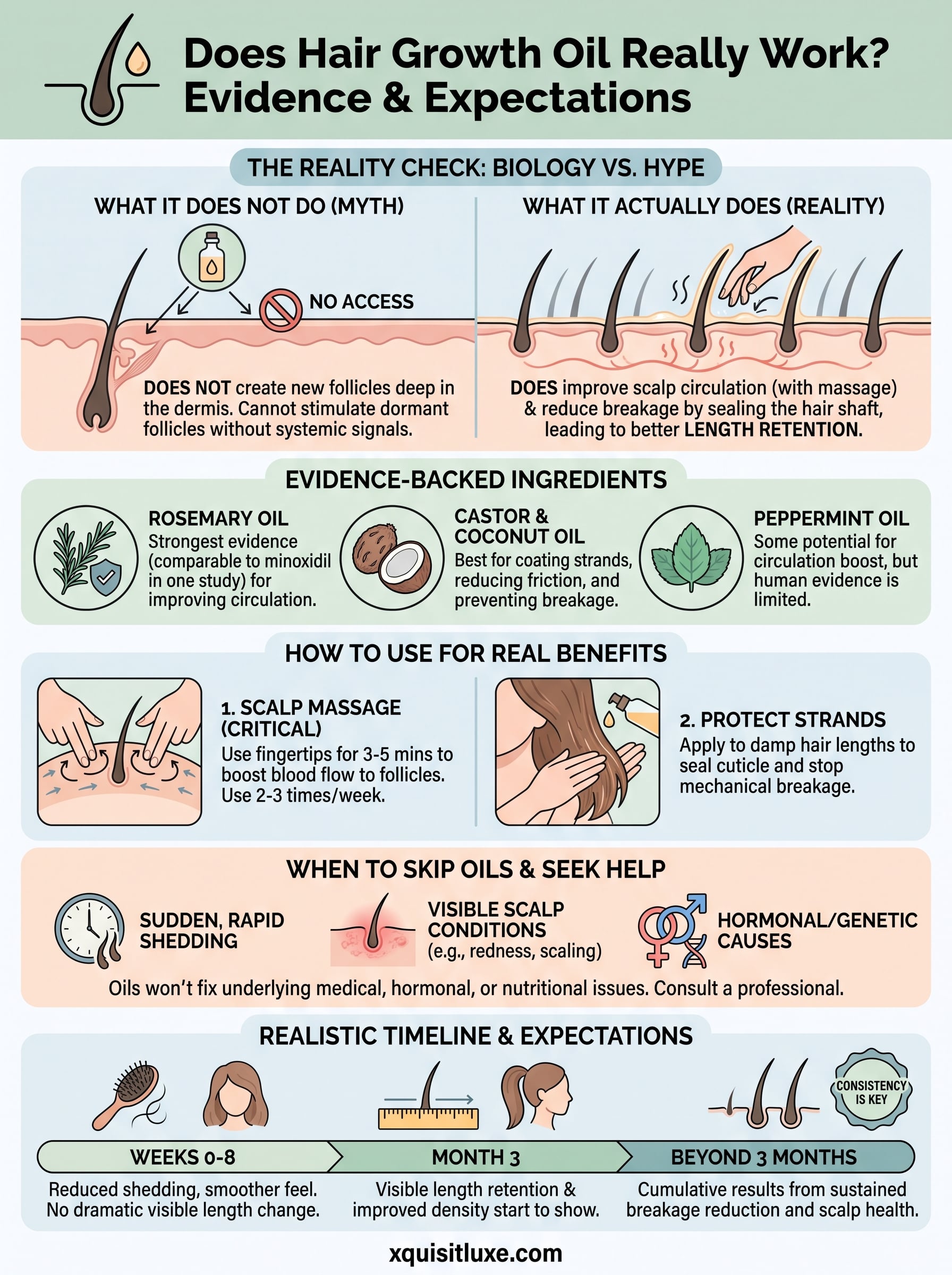
So, does hair growth oil really work? Yes, but within specific limits. Quality oils with evidence-backed ingredients like rosemary genuinely improve scalp circulation, reduce breakage, and help your hair retain the length your follicles are already producing. What they do not reliably do is create new follicular activity from scratch, particularly if your hair loss has a medical or hormonal root cause. Understanding that distinction is what makes the difference between disappointment and measurable results.
Your best approach is to use oil consistently, apply it with proper scalp massage technique, and give it a minimum of eight to twelve weeks before drawing conclusions. Pair that with honest attention to whether something deeper might need addressing. If you want a formula built around natural, dermatologist-tested ingredients designed for real results, explore the full Xquisit Luxe hair care range and find the right fit for your hair type and goals.

