


Trouver une crème visage au collagène pour peaux sensibles ne devrait pas être un pari. Mais si votre peau réagit à la moitié des produits que vous essayez, chaque nouvel achat comporte un certain degré de risque, de rougeur, d'irritation ou d'éruption qui vous fait reculer de plusieurs semaines. Les crèmes stimulant le collagène peuvent faire des merveilles pour les ridules, la fermeté et la texture globale de la peau. Le problème est que de nombreuses formules sont chargées de parfums, d'actifs agressifs ou de charges synthétiques que les peaux sensibles ne toléreront tout simplement pas.
Alors, comment obtenir les bienfaits anti-âge du collagène sans déclencher de réaction ? Tout dépend de la capacité à savoir exactement ce qu'il faut rechercher sur l'étiquette et, tout aussi important, ce qu'il faut éviter. Les bons ingrédients, les bonnes concentrations et les bonnes certifications font toute la différence entre une crème qui agit pour votre peau et une autre qui agit contre elle.
Chez Xquisit Luxe, nous formulons des soins certifiés naturels et testés dermatologiquement, conçus pour les peaux sensibles. Ce guide vous expliquera tout ce que vous devez savoir, des ingrédients clés aux signaux d'alerte, en passant par des conseils pratiques, afin que vous puissiez choisir une crème visage au collagène en toute confiance, sans croiser les doigts.
Ce que signifie une crème visage au collagène pour les peaux sensibles
Une crème visage au collagène est un hydratant formulé pour soutenir les niveaux de collagène de votre peau ou reproduire les effets du collagène en surface. Le collagène est une protéine structurelle qui donne à la peau sa fermeté, son élasticité et cet aspect repulpé et lisse associé à une peau d'apparence plus jeune. Votre corps en produit moins à partir de la mi-vingtaine, c'est pourquoi les crèmes ciblant le collagène sont devenues un incontournable des routines de soins anti-âge. Cependant, lorsque votre peau est sensible, la formulation est bien plus importante que l'ingrédient principal figurant sur l'emballage.
Comment le collagène agit dans une crème
Les molécules entières de collagène sont trop grosses pour pénétrer la couche externe de la peau, de sorte que les crèmes au collagène les plus efficaces ne délivrent pas directement le collagène dans le derme. Au lieu de cela, elles reposent sur du collagène hydrolysé ou des peptides de collagène, qui sont des fragments plus petits et dégradés qui interagissent avec la surface de la peau et signalent à votre corps d'en produire davantage. Certaines formules incluent également des ingrédients de soutien comme la vitamine C ou la niacinamide qui favorisent la synthèse du collagène de l'intérieur de la peau, plutôt que de l'apporter de l'extérieur.
La distinction entre le collagène en tant qu'hydratant de surface et le collagène en tant que stimulateur de synthèse est importante, car les deux approches utilisent des ingrédients très différents, et tous ne conviennent pas aux peaux sensibles.
Lire attentivement une étiquette en dit bien plus que le nom d'un produit. Une crème peut indiquer "collagène" sur le devant, mais ce qui détermine réellement les résultats est la liste complète des ingrédients, y compris les actifs, les excipients et les conservateurs qui pourraient silencieusement déclencher une réaction.
Ce que signifie "peau sensible" dans ce contexte
La peau sensible n'est pas une condition unique. C'est un terme général couvrant une peau qui réagit plus facilement que la moyenne aux produits, aux changements environnementaux ou aux déclencheurs physiques. Cela inclut les peaux sujettes à la rosacée, les peaux avec une barrière cutanée compromise, les peaux sujettes aux allergies, et les peaux qui rougissent, démangent ou présentent des éruptions cutanées lorsqu'elles rencontrent certains produits chimiques. Ce que tous ces types ont en commun est un seuil de tolérance plus bas, ce qui signifie que des ingrédients parfaitement acceptables pour la plupart des gens peuvent provoquer une irritation visible pour vous.
Lorsque vous achetez une crème visage au collagène pour peaux sensibles, ce seuil abaissé est important car les formules standard de collagène contiennent souvent de l'alcool, des parfums synthétiques ou des concentrations élevées d'actifs comme le rétinol qui décapent ou irritent les peaux réactives. Votre barrière cutanée est plus perméable et moins capable de se défendre contre les irritants, de sorte que même des ingrédients utilisés à des concentrations relativement faibles peuvent toujours provoquer une réaction si votre barrière est déjà affaiblie ou enflammée. Comprendre cette distinction vous permet de filtrer les formules qui semblent bonnes sur le papier mais ne fonctionneront pas réellement pour votre peau.
Pourquoi les peaux sensibles nécessitent une formule différente
Les formules de soins standard sont conçues pour le type de peau moyen, ce qui signifie qu'elles sont optimisées pour une peau capable de supporter un niveau raisonnable d'exposition chimique sans réagir. Les peaux sensibles ne suivent pas ces mêmes règles. Votre barrière cutanée, la couche la plus externe responsable du maintien de l'humidité et de l'exclusion des irritants, est plus fine ou plus facilement perturbée, ce qui signifie qu'elle absorbe davantage ce que vous y mettez et a beaucoup moins de capacité à récupérer lorsque quelque chose l'aggrave.
Le problème de la barrière cutanée
Votre barrière cutanée fonctionne comme un mur protecteur composé de cellules cutanées et de lipides. Lorsqu'elle est saine, elle bloque la plupart des irritants et les empêche de pénétrer profondément. Lorsqu'elle est compromise, des lacunes apparaissent entre ces cellules, et des ingrédients qui, autrement, resteraient inoffensifs à la surface commencent à voyager plus profondément dans la peau. Pour les peaux sensibles, cela se produit plus facilement et plus souvent, que ce soit à cause d'un lavage excessif, du froid, du stress ou simplement de l'utilisation de produits trop agressifs. Une barrière affaiblie réagit à des choses que la peau saine remarque à peine, y compris les conservateurs, les émulsifiants et même les formulations à base d'eau avec un pH déséquilibré.
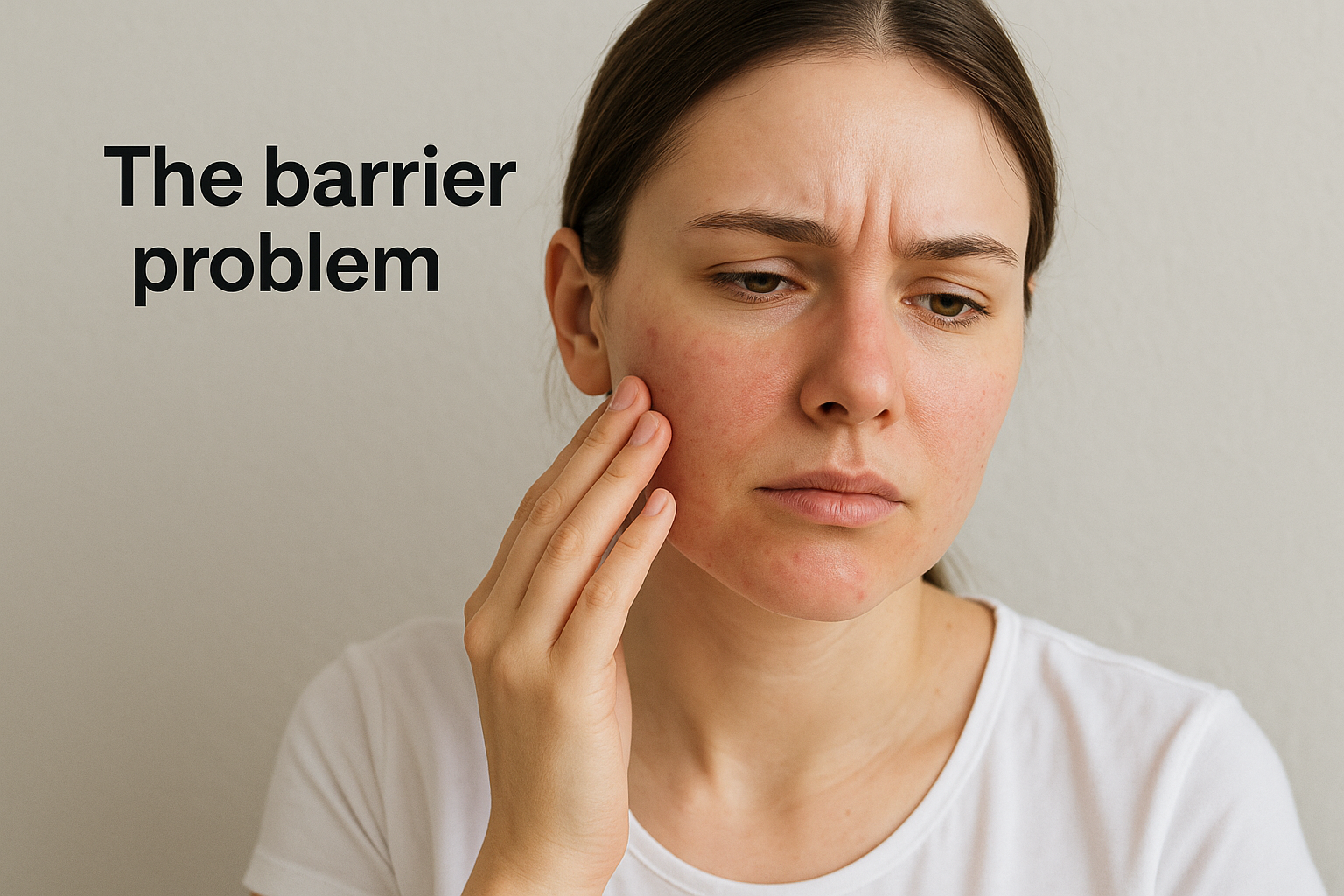
Réparer votre barrière cutanée avant d'introduire de nouveaux ingrédients actifs, y compris les peptides de collagène, donne à n'importe quelle crème une bien meilleure chance de fonctionner sans provoquer de poussée.
Comment les formules standard ne sont pas à la hauteur
La plupart des crèmes au collagène disponibles dans le commerce sont conçues pour l'efficacité pour la majorité, et non pour la tolérance des peaux réactives. Cela signifie souvent des concentrations plus élevées d'ingrédients actifs pour des résultats plus rapides, des parfums synthétiques pour attirer sur les étagères, et des systèmes de conservation qui prolongent la durée de conservation mais irritent les peaux sensibilisées. Lorsque vous appliquez une crème visage au collagène pour peaux sensibles qui n'est pas réellement formulée en tenant compte de votre type de peau, vous demandez essentiellement à un produit à haute tolérance de se comporter en douceur sur une peau à faible tolérance.
Le résultat est prévisible : rougeurs, tiraillements ou petites éruptions cutanées qui sont mal interprétées comme une "purification" alors qu'il s'agit en fait d'un signe d'irritation, et non d'amélioration. Choisir une formule spécifiquement conçue autour d'ingrédients doux et compatibles avec la peau élimine entièrement ce risque. Il ne s'agit pas de se contenter de moins ; il s'agit de sélectionner un produit conçu autour de ce que votre peau peut réellement tolérer sans compromettre les résultats.
Ce qu'il faut rechercher sur la liste des ingrédients
La liste des ingrédients est l'endroit où réside la véritable histoire de tout produit de soin de la peau. Les allégations marketing figurant sur le devant d'une bouteille ne sont pas réglementées, mais la liste INCI (International Nomenclature of Cosmetic Ingredients) au dos vous indique précisément ce que vous appliquez sur votre peau. Lorsque vous choisissez une crème visage au collagène pour peaux sensibles, savoir quels ingrédients rechercher activement vous aide à filtrer les produits avant même qu'ils ne touchent votre visage.
Ingrédients qui favorisent la production de collagène
Les peptides de collagène et le collagène hydrolysé sont les premières choses à rechercher. Ces fragments de protéines plus petits se situent à la surface de la peau ou juste en dessous, signalant à votre peau de produire plus de son propre collagène au fil du temps. Recherchez des termes tels que palmitoyl tripeptide-1, palmitoyl tetrapeptide-7 ou collagène hydrolysé dans la première moitié de la liste des ingrédients, car l'emplacement indique la concentration.
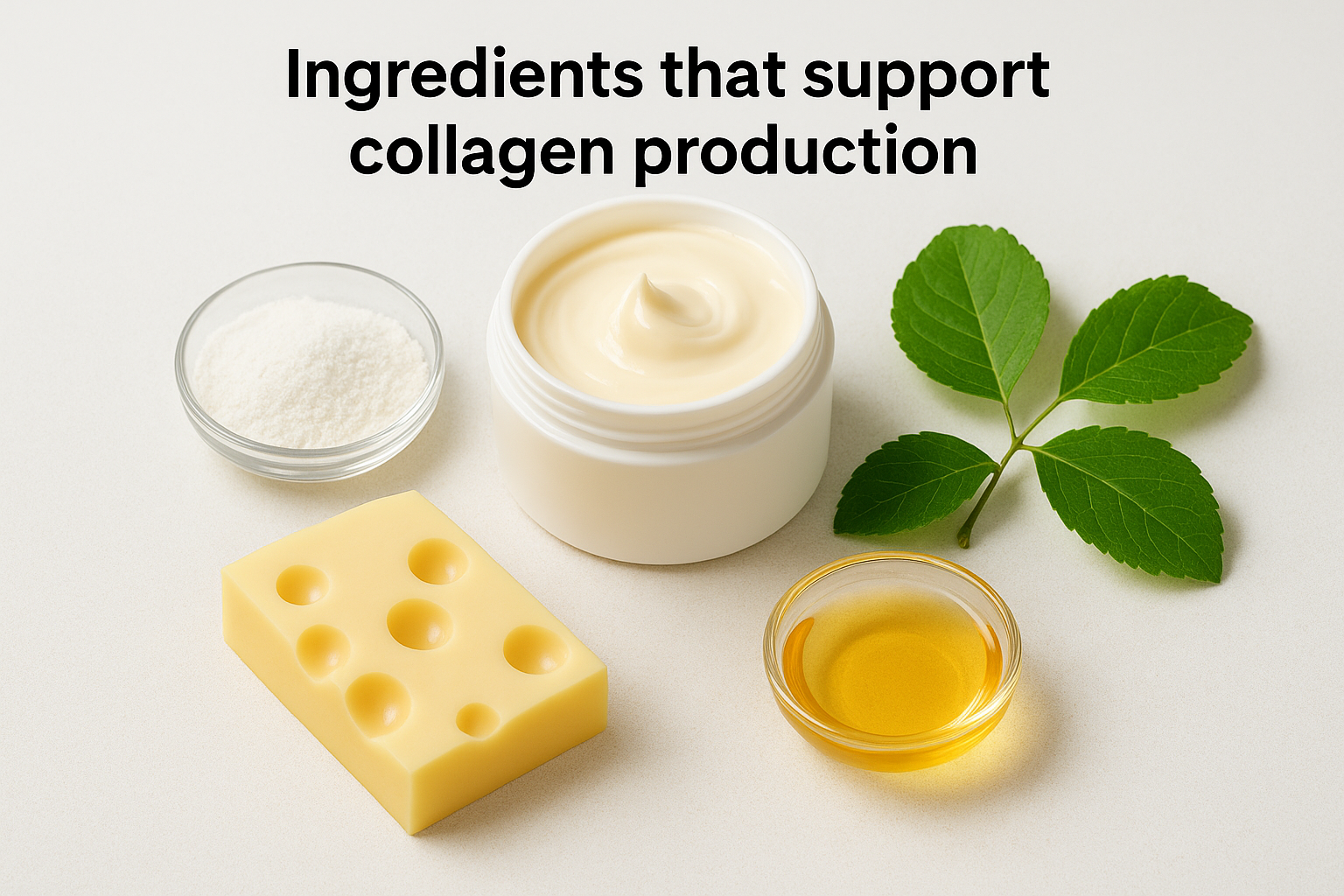
Plus un ingrédient apparaît haut dans la liste INCI, plus sa concentration est élevée dans la formule.
La vitamine C sous une forme stable et douce, telle que l'ascorbyl glucoside ou le phosphate d'ascorbyle de sodium, favorise également la synthèse du collagène sans le risque d'irritation qui accompagne l'acide L-ascorbique pur. Ces dérivés agissent à un rythme plus lent mais sont bien mieux adaptés aux peaux réactives car ils ne perturbent pas l'équilibre du pH de votre peau comme peuvent le faire les sérums à haute concentration de vitamine C.
Ingrédients qui protègent et apaisent la barrière cutanée
Les céramides, la niacinamide et l'acide hyaluronique sont trois des ingrédients de soutien les plus précieux dans toute crème conçue pour les peaux sensibles. Les céramides reconstituent directement les lipides dont votre barrière a besoin pour fonctionner correctement. La niacinamide réduit les rougeurs, renforce la barrière et agit bien avec les peptides de collagène sans provoquer de problèmes d'interaction. L'acide hyaluronique attire l'humidité dans la peau, ce qui aide à maintenir l'aspect repulpé et sain que le collagène cible.
Les plantes apaisantes telles que la centella asiatica (mentionnée sur les étiquettes comme extrait de Centella Asiatica) et l'allantoïne valent également la peine d'être recherchées. Toutes deux ont fait leurs preuves pour calmer l'inflammation, réduire les réactions de sensibilité et soutenir la récupération d'une barrière compromise, ce qui en fait des compagnons idéaux des ingrédients axés sur le collagène dans une formule conçue pour les peaux réactives.
Ce qu'il faut éviter si vous réagissez facilement
Savoir ce qu'il faut exclure de vos soins de la peau est tout aussi important que de savoir ce qu'il faut inclure. La liste des ingrédients d'une crème au collagène standard contient souvent plusieurs irritants courants que les peaux réactives ont du mal à tolérer, et les pires coupables ont tendance à apparaître dans des produits par ailleurs bien évalués simplement parce qu'ils ne posent aucun problème à la plupart des types de peau. Si votre peau réagit facilement, ce sont les catégories que vous devez d'abord exclure.
Parfums et ingrédients masquant les parfums
Le parfum est la cause la plus fréquente de réactions cutanées cosmétiques, et c'est la catégorie d'ingrédients la plus importante à éliminer lors du choix d'une crème visage au collagène pour peaux sensibles. Il apparaît sous une large gamme de noms sur les listes d'ingrédients, ce qui le rend facile à manquer si vous ne cherchez que le mot "parfum". Parfum, linalol, limonène, citronellol et eugénol sont tous des éléments liés au parfum qui peuvent déclencher une dermatite de contact, des rougeurs et des démangeaisons persistantes sur les peaux réactives.
Si un produit prétend être "non parfumé", vérifiez quand même la liste des ingrédients, car les formules non parfumées contiennent parfois des parfums masquants qui neutralisent l'odeur sans éliminer les produits chimiques irritants qui la sous-tendent.
Certaines marques utilisent également des huiles essentielles comme alternatives naturelles aux parfums, notamment la lavande, la rose et les huiles d'agrumes. Ce sont toujours des composés parfumés et elles présentent le même risque d'irritation pour les peaux sensibles. Naturel ne signifie pas automatiquement doux, et les huiles essentielles font partie des irritants botaniques les plus courants trouvés dans les produits de soin de la peau.
Actifs agressifs et alcool
Le rétinol à haute concentration, les AHA et les BHA peuvent être trop agressifs pour les peaux sensibles, surtout lorsqu'ils apparaissent dans la même formule que les peptides de collagène. Ces actifs accélèrent le renouvellement cellulaire de la peau, ce qui semble bénéfique mais décape souvent la barrière plus rapidement qu'elle ne peut se régénérer, entraînant des rougeurs, des desquamations et une réactivité accrue au fil du temps. Si vous souhaitez des bienfaits de la vitamine A ou des exfoliants en plus du collagène, recherchez-les dans des produits séparés à plus faible concentration plutôt que combinés dans une seule crème.
L'alcool, en particulier l'alcool dénaturé (indiqué comme alcohol denat.) et l'alcool isopropylique, est un autre ingrédient à éviter complètement. Les deux s'évaporent rapidement sur la peau, ce qui crée un effet matifiant que les marques utilisent pour améliorer la texture, mais ils perturbent la couche lipidique de votre barrière et laissent la peau sensible plus sèche et plus vulnérable après chaque application.
Comment utiliser une crème au collagène sans irritation
Même la meilleure crème visage au collagène pour peaux sensibles peut provoquer une réaction si vous l'introduisez de manière incorrecte. La méthode et le moment de l'application sont aussi importants que la formule elle-même, et prendre quelques mesures délibérées avant et après avoir commencé à utiliser un nouveau produit réduit considérablement le risque d'irritation.
Faites un test de patch avant de vous engager
Avant d'appliquer une nouvelle crème sur votre visage, testez-la d'abord sur une petite zone discrète de votre peau, comme l'intérieur de votre poignet ou derrière votre oreille. Appliquez une petite quantité une fois par jour pendant deux à trois jours consécutifs et observez attentivement l'apparition de rougeurs, de démangeaisons ou de gonflements. Si rien ne se produit, votre peau est susceptible de tolérer le produit lorsqu'il est appliqué sur votre visage. Sauter cette étape est la raison la plus courante pour laquelle les gens subissent des réactions évitables, en particulier avec des produits contenant des ingrédients actifs comme les peptides de collagène ou la niacinamide.
Un test de patch ne vous coûte rien, si ce n'est quelques jours, et pourrait vous épargner des semaines de temps de récupération inutile pour votre peau.
Introduisez-la lentement
Appliquer une nouvelle crème au collagène deux fois par jour dès le premier jour exerce une pression inutile sur les peaux sensibles, même si la formule est bien adaptée à votre type de peau. Commencez par une application tous les deux soirs, laissant à votre peau le temps de s'adapter pendant la nuit, lorsque son mode de réparation est naturel. Après une à deux semaines sans aucun signe d'irritation, passez à une utilisation quotidienne. Cette approche progressive permet à votre barrière de s'adapter au lieu de la submerger d'ingrédients inconnus d'un coup, ce qui est souvent le point de départ de nombreuses réactions.
Appliquer sur une peau propre et légèrement humide
L'état de votre peau au moment de l'application affecte directement la façon dont la crème est absorbée et agit. L'application de votre crème au collagène sur une peau propre et légèrement humide aide les ingrédients actifs comme les peptides et l'acide hyaluronique à se lier à l'humidité disponible en surface plutôt que de puiser l'hydratation de votre peau. Utilisez un nettoyant doux et sans parfum au préalable, tapotez votre visage pour le sécher sans frotter, et appliquez la crème tant qu'une petite quantité d'humidité reste à la surface. Cette habitude simple fait une différence mesurable pour le confort et les résultats globaux que vous observez au fil du temps.
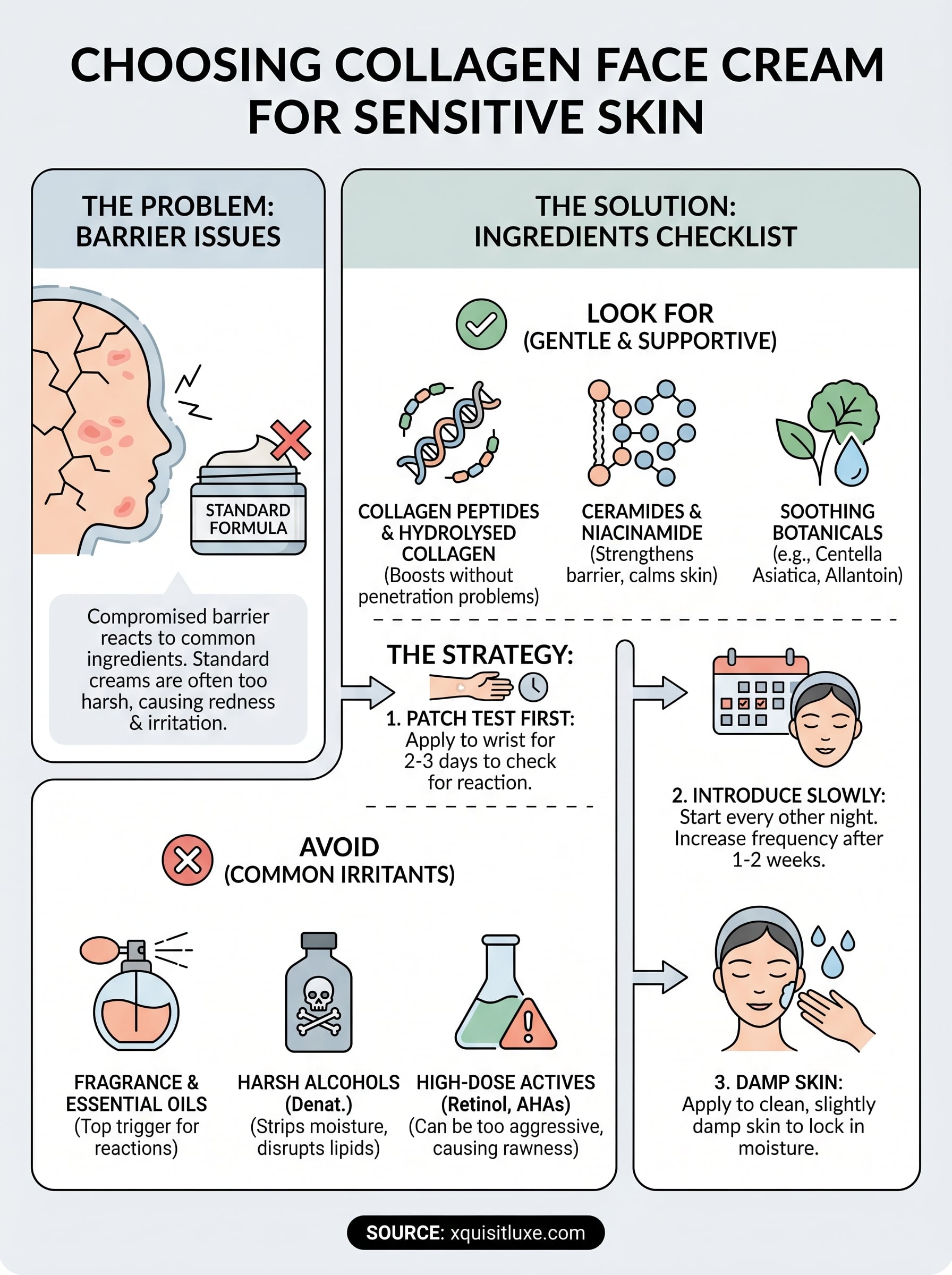
Récapitulatif rapide
Choisir une crème visage au collagène pour peaux sensibles se résume à deux choses : comprendre ce dont votre peau a réellement besoin et lire attentivement la liste des ingrédients. Les peptides de collagène, les céramides, la niacinamide et les actifs botaniques doux vous procurent de véritables résultats anti-âge sans dépasser le seuil de tolérance des peaux réactives. Les parfums, les alcools agressifs et les actifs à forte concentration sont les principaux responsables des réactions inutiles, et les éviter est simple une fois que vous savez quoi rechercher.
Votre routine est tout aussi importante que votre produit. Les tests de patch, l'introduction progressive et l'application sur une peau propre et légèrement humide sont des habitudes simples qui protègent votre barrière tout en donnant à la formule la meilleure chance d'agir. Une peau sensible ne signifie pas devoir se contenter de moins. Cela signifie être sélectif, et cette sélectivité porte ses fruits. Si vous souhaitez des soins de la peau élaborés à partir d'ingrédients certifiés naturels et testés dermatologiquement, explorez la gamme complète de Xquisit Luxe et trouvez une formule dont votre peau vous remerciera.

